








 The North News
By Saurabh Duggal
Conceived during one of the darkest chapters in India’s democratic history and shaped through the turbulent years of Punjab’s insurgency, the Chandigarh Press Club has, over the past 46 years, evolved into much more than a professional association. It has become a symbol of press freedom, journalistic solidarity and democratic values.
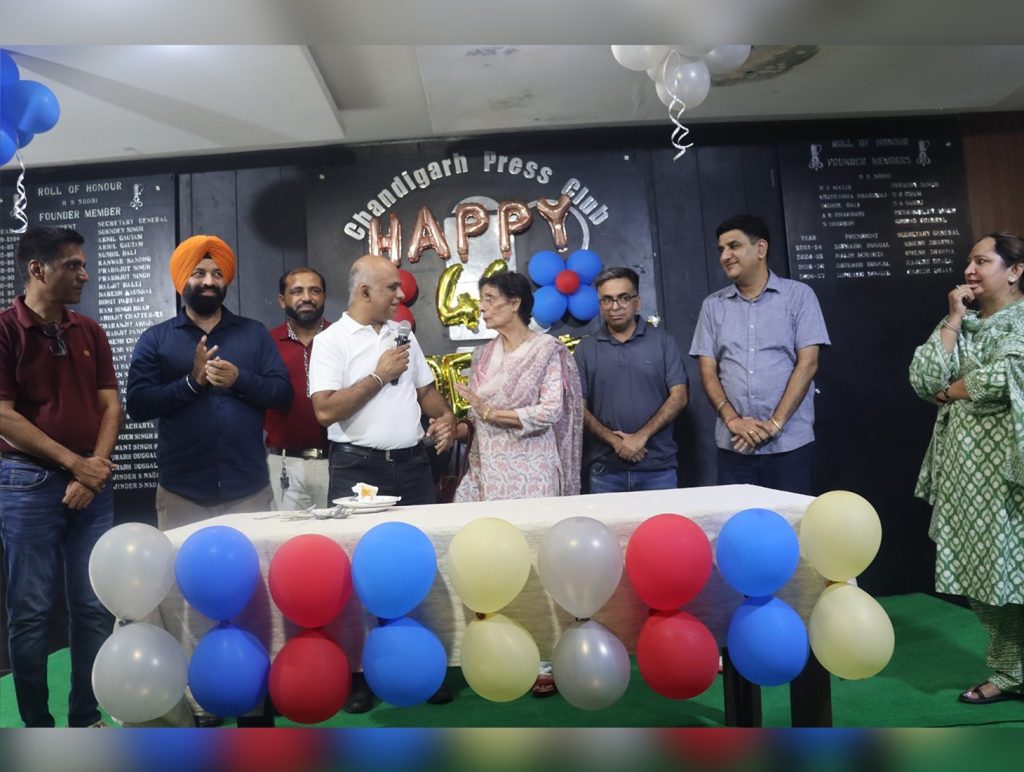
As the Chandigarh Press Club celebrated its 46th Foundation Day on July 15, 2026, the occasion was not merely an anniversary but a tribute to an institution that has consistently stood with journalists in difficult times—during the Emergency, throughout the years of militancy in Punjab, during the COVID-19 pandemic, and in the continuing defence of freedom of expression.
Founder members N.S. Malik and Harkanwal Singh, along with former presidents, former secretary-generals and members of the present Governing Council, cut a ceremonial cake to commemorate the occasion.
In a reflection of the changing face of Indian journalism, pioneering women journalists and members of the younger generation also participated in a special cake-cutting ceremony celebrating the growing presence and leadership of women in the profession.
An Idea Conceived During the Emergency
The origins of the Chandigarh Press Club lie in the Emergency (1975–77), when censorship and restrictions on the media prompted journalists in Chandigarh to think about establishing a common platform similar to the Press Club of India in New Delhi and press clubs in Kolkata and Mumbai.
The vision was to create a place where journalists could freely exchange ideas, discuss professional concerns, support colleagues and collectively uphold the values of an independent press.
After nearly two years of discussions, eleven journalists transformed that idea into reality. They were N.S. Malik (UNI), Sukhdev Singh (The Tribune), Gyaninder Bhardwaj (Hindustan Samachar), B.K. Chum (Indian Express), S. Bali (PTI), S.S. Saroj (Punjab Mail), H.S. Sodhi, A.K. Bhandari (UNI), Harkanwal Singh (Ajit), S. Shaukin (Patriot) and Gobind Thukral (Indian Express).
Their efforts culminated on October 11, 1979, when the Chandigarh Press Club was formally registered under the Societies Registration Act.
Founder member Harkanwal Singh had recalled:
“The restrictions imposed on the media during the Emergency forced us to think that there should be a common place or club for journalists in Chandigarh where the media could freely discuss its issues. The place would also serve as a platform to support journalists. After nearly two years of effort, we were able to register the Chandigarh Press Club on October 11, 1979.”
Building an Institution
Without premises of its own, the club held its first meeting at the Sector 22 residence of founder member Sukhdev Singh.
B.K. Chum became the founding president, while Sukhdev Singh became the founding Secretary-General.
Remembering that day, Sukhdev Singh had said:
“After completing the registration process, we all gathered at my residence the same day. It was our first official meeting as members of the Chandigarh Press Club and also a celebration of achieving our long-cherished dream.”
The next challenge was to secure a permanent home.
Sukhdev Singh later recalled that journalists approached the then Union Home Minister Giani Zail Singh, who eventually facilitated allotment of the present site, originally earmarked for a community centre.
The first elections of the club were held in 1984, with Najm Ul Hassan unanimously elected President and Akhil Gautam elected Secretary-General unopposed.
Sukhdev Singh also drafted the club’s constitution after obtaining the constitution of the Press Club of India for reference.
Through the Years of Insurgency
The Punjab insurgency of the 1980s and early 1990s became another defining chapter in the club’s history.
As journalists reported on one of the most challenging periods in North India’s contemporary history, the Chandigarh Press Club emerged as a place of professional solidarity, discussion and mutual support. It provided journalists with a common platform at a time when reporting carried extraordinary risks and reaffirmed the profession’s commitment to truth and public interest.
Growing into a National Institution
Over the decades, the Chandigarh Press Club evolved into one of India’s most respected media institutions.
Besides serving as a professional forum, it developed facilities including a swimming pool, tennis and badminton courts and family dining spaces.
Former Prime Minister Dr. Manmohan Singh attended its Silver Jubilee celebrations. The club has hosted distinguished political leaders, eminent journalists, writers and personalities from different walks of life.
Among its honorary members were legendary sprinter Milkha Singh and three-time Olympic gold medallist Balbir Singh Sr., both of whom shared a close association with the institution.
Former President late Gobind Thukral often described the club as “a second home” for journalists.
A Personal reflection
For me, the Chandigarh Press Club is not merely an institution I have had the privilege to lead—it is also deeply personal.
I was inspired to join journalism by my family friend, senior journalist Gobind Thukral, one of the founder members and a former president of the Chandigarh Press Club. His commitment to fearless journalism, intellectual integrity and public service left a lasting impression on me.
His book, Troubled Reflections: Reporting Violence, written after a fellowship at the Indian Institute of Advanced Study, remains an important work documenting the challenges of reporting conflict and violence.
Serving as president of this prestigious institution is both an honour and a responsibility. It has provided me with an opportunity to contribute meaningfully to the journalistic fraternity while carrying forward the values nurtured by the club’s founders.
Working collectively with my colleagues in the Governing Council, our endeavour has been to strengthen the institution by championing journalists’ rights, promoting press freedom and investing in professional capacity building.
We have also focused on making the club more inclusive and sustainable. During this period, the club constructed a gender-neutral, wheelchair-accessible washroom, promoted inclusion through public art supporting gender equality, LGBTQ+ rights and disability awareness, commissioned artwork by economically disadvantaged young artists, and embraced renewable energy, with nearly 90 per cent of the club’s electricity requirements now being met through solar power.
These initiatives reflect our belief that a modern press club must not only defend free speech but also embody the values of equality, accessibility, sustainability and social responsibility.
Carrying the Legacy Forward
From an idea conceived during the Emergency to an institution strengthened during the years of insurgency and dedicated to defending democratic values today, the Chandigarh Press Club’s journey mirrors the resilience of Indian journalism itself.
Forty-six years after its registration, the Chandigarh Press Club continues to remind us that institutions built in defence of free speech remain indispensable to democracy. Its legacy belongs not merely to its founders or office-bearers, but to generations of journalists who have sustained it with integrity, courage and an unwavering commitment to the public interest.

Imagine this: It’s 12:01 am, you open Instagram and instead of reels, you get…
Punjab has heard promises to end its drug menace for years. The governments have announced…
The Congress has turned to Sachin Pilot in the hope of bringing its deeply divided…
“Aanewala Pal Jaane Wala Hai, Ho Sake To Iss Mein Zindagi Bita Do…” These…