








 The North News
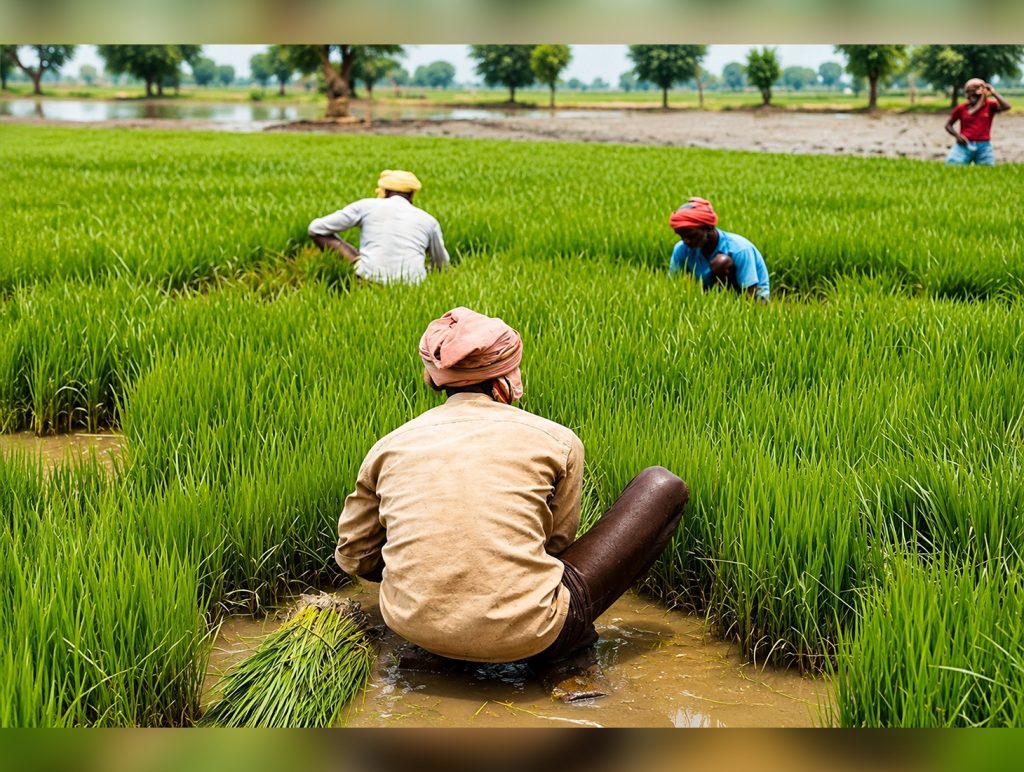
The state’s record yields hide the real crisis — warmer nights, hotter grain-filling weeks, a new generation of pests, a rising bill and a falling water table.
By Dhananjay Kumar & Siddhima Sirohi
Read only the yield figures, and Punjab’s fields look like a success story that refuses to end. Rice has climbed from about six quintals an acre in 1970 to a record near eighteen; wheat sits close to its all-time high. By the one number policy obsesses over — production — the granary of India is still delivering. That number is hiding the truth about cost, water and risk. The climate is not coming for Punjab’s harvest in a single dramatic blow; it is doing something quieter, and in the long run more dangerous — steadily raising the price of keeping that harvest steady.
Start with the weather, because it has changed in a way few notice, and it strikes Punjab’s two main crops through different doors. The nights have warmed by almost half a degree Celsius since the 1950s — and warm nights are bad news for paddy, speeding the plant’s night-time respiration and breeding the warm, humid conditions in which planthoppers and disease thrive. The wheat-critical weeks of February and March have warmed by more than a degree, nudging the crop ever closer to terminal-heat damage just as it fills its grain. Strikingly, the afternoons have, if anything, cooled — the unmistakable fingerprint of millions of tube-wells flooding the fields and chilling the daytime air. Part of the night-time warming, especially around expanding cities such as Ludhiana, Amritsar and Jalandhar, is amplified by urbanisation — concrete and built-up land holding the day’s heat well into the night — layered on top of the broader regional trend.
But the gradual trend is not where the damage lives. Compare each district’s yield against its own long-run path and the warming barely registers. The harm is concentrated in bad years — and it hits the two crops in two different ways. For wheat, the bad years are weather shocks: untimely March rain in 2015 and a freak heatwave in 2022 each knocked roughly two quintals an acre off the crop, single seasons that did more damage than decades of slow change.
For paddy, the bad years increasingly mean biology. A dwarf virus unknown in Punjab before 2022 struck about 34,000 hectares that year and resurged across eight districts in 2025, in seasons whose warm, humid, overcast weather looked almost identical. It is part of a wider squeeze of new and resurgent pests, disease and weeds.
And here is what makes that squeeze so expensive: the old remedies are failing. When a pest or weed evolves resistance, the same spray stops working, so farmers spray more often, mix products and reach for newer, costlier molecules. Wheat’s Phalaris minor — gulli danda, the grassy weed that mimics wheat — handed India its very first case of herbicide resistance back in 1992-93 and now shrugs off three separate chemical groups; paddy’s whitebacked planthopper is travelling the same road. Alongside the resistance treadmill come genuinely new arrivals with no cheap, proven cure — the dwarf virus, and weedy rice, a rice look-alike that cannot be selectively sprayed and is spreading just as farmers shift to direct seeding. Warm, humid seasons load the dice for all of them, favouring planthoppers, false smut and stem borers and letting pests survive milder winters. The one upside: yellow rust, which prefers the cold, is suppressed by the warming.
All of this shows up in the one figure the production number hides — cost. To hold those yields steady, farmers now spend far more every year. On the official record, the cost of cultivating paddy has roughly quintupled since the late 1990s, and doubled in just the last decade; wheat has followed the same curve. Some of that is ordinary inflation. But the fastest-climbing line is plant protection: across paddy states the insecticide bill has risen many times faster than the total, and insecticide alone is now about twelve paise of every rupee a Punjab paddy farmer pays out. For wheat, the herbicide-resistance treadmill is reckoned to have lifted cost of cultivation by around a tenth.
The squeeze is no abstraction, and the last four seasons show how quickly a bad year now turns into a financial blow — and how the shocks are clustering. In 2022, the March heatwave cut wheat yields while the dwarf virus made its first appearance in paddy. In 2023, July floods along the Ravi, Beas and Sutlej destroyed standing crops in the riverine belts, with some farmers reporting as little as ₹1,500 in compensation. Even 2024, a year without a single state-wide shock, offered little relief, as high plant-protection and diesel costs and ever-deeper pumping kept margins thin.
Then came 2025 — Punjab’s worst floods since 1988, striking 18 of its 23 districts, with false smut and the dwarf virus piling on. Around two lakh hectares of paddy were destroyed and preliminary losses reached some ₹7,500 crore. The arithmetic was brutal: a farmer who had spent ₹22,000 to ₹30,000 to grow an acre of paddy, only to watch it drown, stood to receive at most ₹20,000 in compensation — and Punjab has no crop-insurance scheme of its own to fall back on.
So the real crisis is not a collapse in what Punjab grows; it is the rising, often invisible, cost of continuing to grow it the same way — paid in deeper borewells, costlier sprays, bad-year losses and a public subsidy bill that swells as the aquifer shrinks. We have been watching the wrong number. Production and the minimum support price tell us the granary is full; they say nothing about how much harder, and more expensive, each full granary has become to fill.
None of this is a counsel of despair. The levers that matter now are the ones that lower cost, water and risk rather than chase the next quintal. Direct seeding of rice and alternate wetting and drying cut water use — and the pumping bill — without cutting the harvest. No-burn residue management lets wheat be sown earlier, widening its escape from the March heat that has twice wrecked the crop. Integrated pest management and faster early warning blunt the resistance treadmill before it forces yet another costly spray, and diversification eases the pressure on the water table.
Give the state’s farmers — among the most skilled and responsive anywhere — a cheaper, lower-risk way to farm, and they take it. The first step is simply to stop being reassured by a yield line that keeps ticking up, and to start reading the numbers underneath it: the cost, the water, and the spreading pests. Those are the numbers that will decide whether Punjab’s fields are still feeding India a generation from now
Dhananjay and Siddhima work with Manav Vikas Sansthan, which runs Project PRANA on regenerative, no-burn agriculture across 6,000+ villages & 18 districts of Punjab. The project is funded by The Nature Conservancy. The analysis draws on ERA5-Land and IMD climate records, Punjab government yield data, the official Cost of Cultivation series, and reports from Punjab Agricultural University.
Industrial feeders to face power cuts from 8 pm to 6 am, PSPCL says Patiala,…

Chandigarh, September 12 The Punjab Police have secured the extradition of an alleged key operative…

Police recover two .30 bore pistols and 10 live cartridges from suspects Chandigarh/Pathankot, September 11…

Camps to be held in 2,008 villages and wards, while door-to-door delivery continues for remaining…