




 Dr Kiran Deep
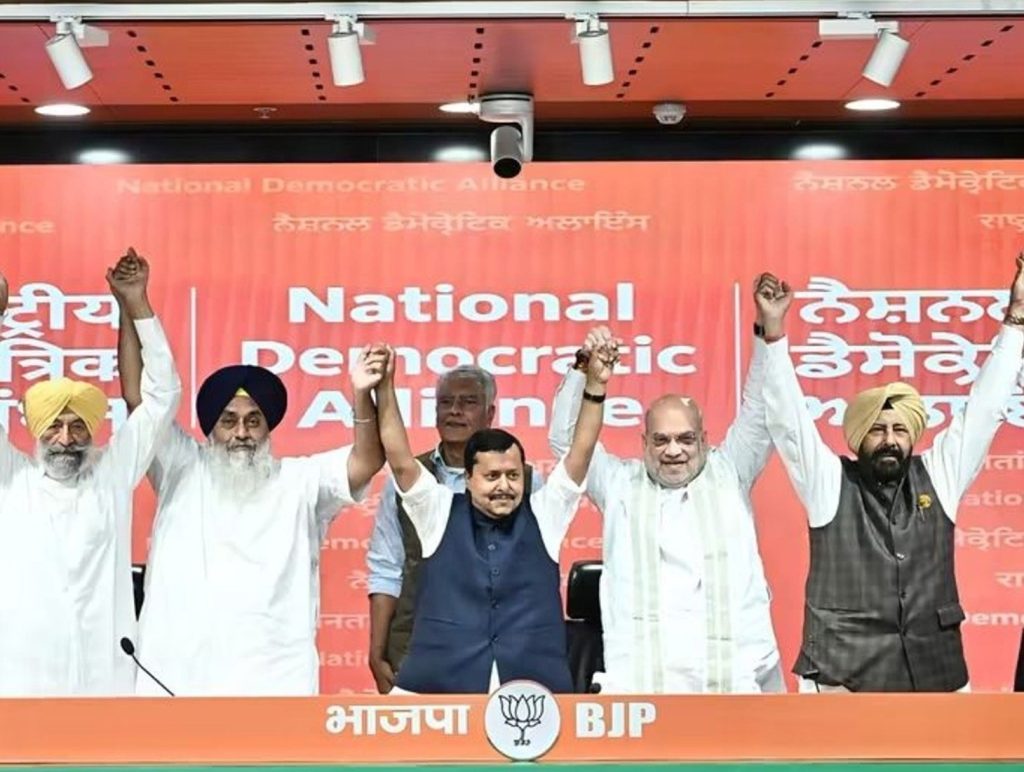

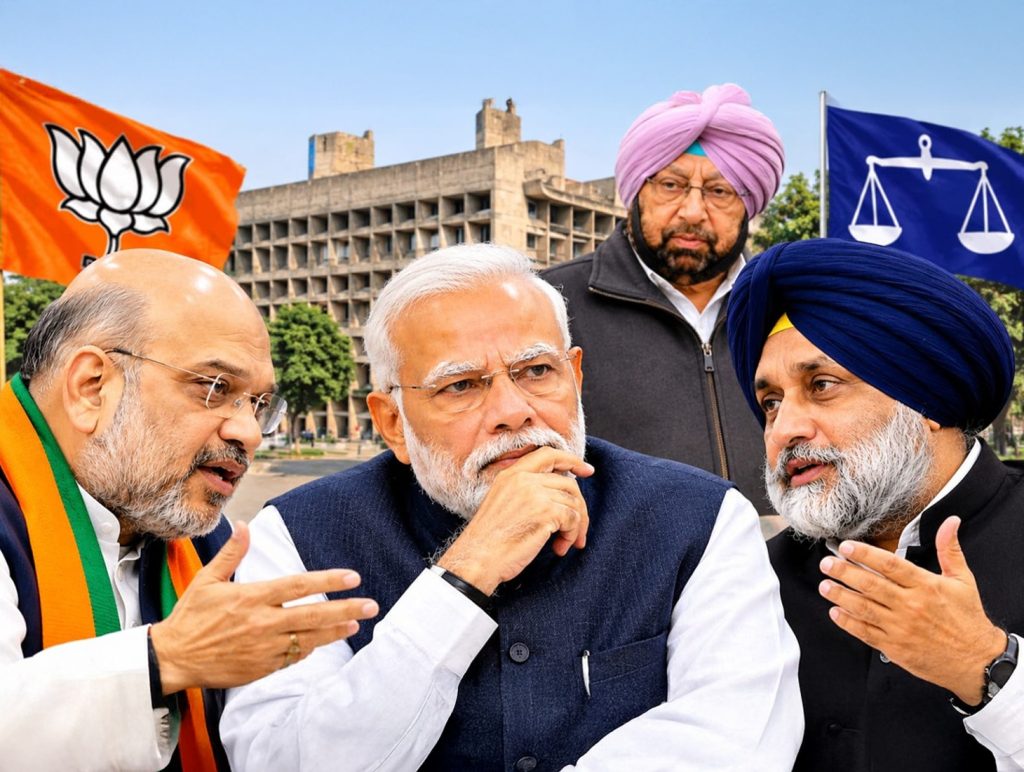
After six years of political separation, the BJP and Shiromani Akali Dal have found their way back to each other, hoping to revive an alliance that once dominated Punjab’s politics.
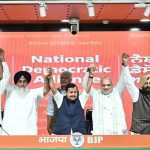
After weeks of deliberations and speculation, Union Home Minister Amit Shah announced the alliance on Tuesday, coinciding with the Parkash Purab of Guru Nanak Dev. The announcement was made in the presence of BJP president Nitin Nabin and SAD president Sukhbir Singh Badal at the BJP headquarters in New Delhi.
Shah made it clear that the Akali Dal would remain the senior partner in Punjab, with the chief ministerial position going to the bigger ally if the alliance formed the government. His remarks indicated that Sukhbir Badal would lead the alliance in the state, although the parties have yet to announce a formal seat-sharing arrangement.
This will be the sixth Assembly election in which the two parties contest together. Their previous partnership, spanning five elections between 1997 and 2017, produced three governments in 1997, 2007 and 2012. The alliance’s return therefore brings back memories of a political arrangement that once appeared central to Punjab’s electoral landscape.
Yet the political circumstances have changed considerably. Although Shah announced that the two parties would jointly contest all 117 Assembly constituencies, the exact seat-sharing formula remains undecided. Under their previous arrangement, the BJP contested 23 seats while the SAD fielded candidates in the remaining 94.
The Akali Dal is expected to retain the larger share of seats, consistent with its position as the senior partner. The BJP, meanwhile, seems to have identified Assembly segments where it believes it has a stronger organisational presence and electoral prospects. Its assessment of individual constituencies, local leadership and the feedback of the Rashtriya Swayamsevak Sangh (RSS) could play an important role in negotiations.
The decision to reunite also reflects the political limitations confronting both parties. The BJP working hard to establish itself as a dominant force in Punjab’s rural constituencies while the Akali Dal has been attempting to recover its traditional political support after a difficult period.
The two parties had separated in September 2020 after the Centre introduced three contentious farm laws. The SAD which has historically drawn much of its political strength from farmers, faced considerable pressure over the legislation. Harsimrat Kaur Badal resigned from the Union Cabinet, and the party eventually withdrew from the BJP-led National Democratic Alliance.
The farmers’ protests continued for more than a year. In November 2021, Prime Minister Narendra Modi announced the repeal of the three laws, a decision that came on the occasion of Guru Purab. But the repeal did not immediately repair the political relationship between the former allies.
The 2022 Assembly elections highlighted just how much Punjab’s political landscape had shifted. Contesting separately, the BJP and SAD were pushed to the margins as the Aam Aadmi Party swept the polls, winning 92 of the 117 seats and forming the government. The Congress managed 18 seats, while the SAD was reduced to three and the BJP to just two.
The alliance’s electoral arithmetic has also changed since the parties last contested together.
In the 2022 Assembly elections, the BJP secured around 6.6 per cent of the vote, while the SAD received 18.38 per cent. By the 2024 Lok Sabha elections, the BJP’s vote share had risen to 18.56 per cent, although it failed to win any of Punjab’s 13 parliamentary seats. The SAD’s vote share fell to 13.42 per cent, but it retained the Bathinda constituency.
Since the split, the BJP has expanded its electoral presence, while the SAD has managed to reconnect with farmers’ organisations as it seeks to rebuild its traditional support base. Bringing these different political strengths together will require both parties to recognise the changed ground realities and adapt to Punjab’s evolving political landscape.
The BJP has also begun strengthening its organisational machinery in Punjab. Arun Kumar, the RSS joint general secretary responsible for the northern states, recently held a meeting with BJP leaders and urged workers to concentrate on around 11,900 polling booths ahead of the 2027 elections. The party believes that focused work in closely contested constituencies could improve its performance.
Former Punjab Chief Minister Captain Amarinder Singh has also been among those working towards bringing the two former allies together.
For Sukhbir Badal, however, the announcement carries an emotional significance that goes beyond electoral calculations.
Describing the alliance as more than a political arrangement, he recalled his late father, former Chief Minister Parkash Singh Badal, who had often spoken of the BJP and Akali Dal as inseparable partners. Sukhbir said the relationship was rooted in shared history and a commitment to Punjab, the country and the Sikh community.
Prime Minister Narendra Modi also welcomed the reunion, describing the partnership as a natural alliance. He recalled that it had been nurtured by former Prime Minister Atal Bihari Vajpayee, senior BJP leader LK Advani and Parkash Singh Badal. Modi expressed confidence that the alliance could provide people in Punjab with a government focused on development and public welfare.
But the political welcome has not been without criticism.
Punjab Chief Minister Bhagwant Mann took a swipe at the former allies, alleging that their reunion was aimed at protecting political families and securing electoral interests rather than serving Punjab. He pointed to their disagreements over the farm laws, Punjab’s water, Chandigarh and Sikh institutions, questioning how the parties could come together again after their bitter separation.
His criticism reflects the challenge facing the alliance. The farm laws may have been repealed but the political disagreements that led to the breakup cannot simply be erased by a joint press conference.
BJP president Nitin Nabin, meanwhile, described the partnership as a natural alliance, arguing that the two parties shared a bond among their leaders, workers and supporters. He said they would work together for Punjab’s development, drawing inspiration from the teachings of Sikh Gurus and the legacy of Maharaja Ranjit Singh.
Punjab Congress president Pargat Singh also questioned the reunion, arguing that the issues responsible for the breakdown of the previous alliance remained unresolved. He said the state’s interests should take precedence over the political ambitions of individual parties.
Within the BJP, however, the announcement has been welcomed as an important development. Punjab BJP president Kewal Singh Dhillon described the reunion as a historic step towards peace, progress and prosperity. Senior BJP leader and former state president Ashwani Sharma also welcomed the decision, saying the partnership could strengthen social harmony and brotherhood in Punjab.
The mixed reactions to the reunion show how much is at stake for both parties. The BJP and SAD are hoping that coming together will help them pool their organisational strength and win back sections of their traditional support base. Their political opponents, however, are already questioning how the two parties can put aside the differences that once drove them apart, particularly when several contentious issues remain unresolved.
Punjab is grappling with serious challenges, including drug abuse, unemployment, agricultural distress, financial pressures and concerns over law and order. Voters will want to know how the alliance intends to address these problems.
The BJP and SAD have shared power before and know the mechanics of governing together. But the Punjab of 2027 is not the Punjab of 1997 or 2012. The real test for the BJP and Akali Dal will be whether they can turn shared history into a credible political programme and convince voters that their return is about Punjab’s future.
As the 2027 Assembly elections draw closer, Punjab’s Dalit community is becoming an important focus…
There is something special about falling in love. It can turn ordinary moments into memories…
The BJP and the Shiromani Akali Dal (SAD) are close to reaching an agreement on…
The Aam Aadmi Party’s second list of candidates for the 2027 Punjab Assembly elections has…