





 Dr Kiran Deep

There is something special about falling in love. It can turn ordinary moments into memories that stay with us for a lifetime. Sometimes, a love story remains personal, shared only by two people. At other times, it becomes part of history. The relationship between Sonia Gandhi and Rajiv Gandhi is one such story.
While reading Sonia Gandhi’s book, Belonging: A Journey of Love, I found myself drawn to the story of two young people who had little idea of how dramatically their lives would change. Long before Sonia became one of the most influential women in Indian politics, and before Rajiv entered public life, they were simply a young couple trying to build a future together.
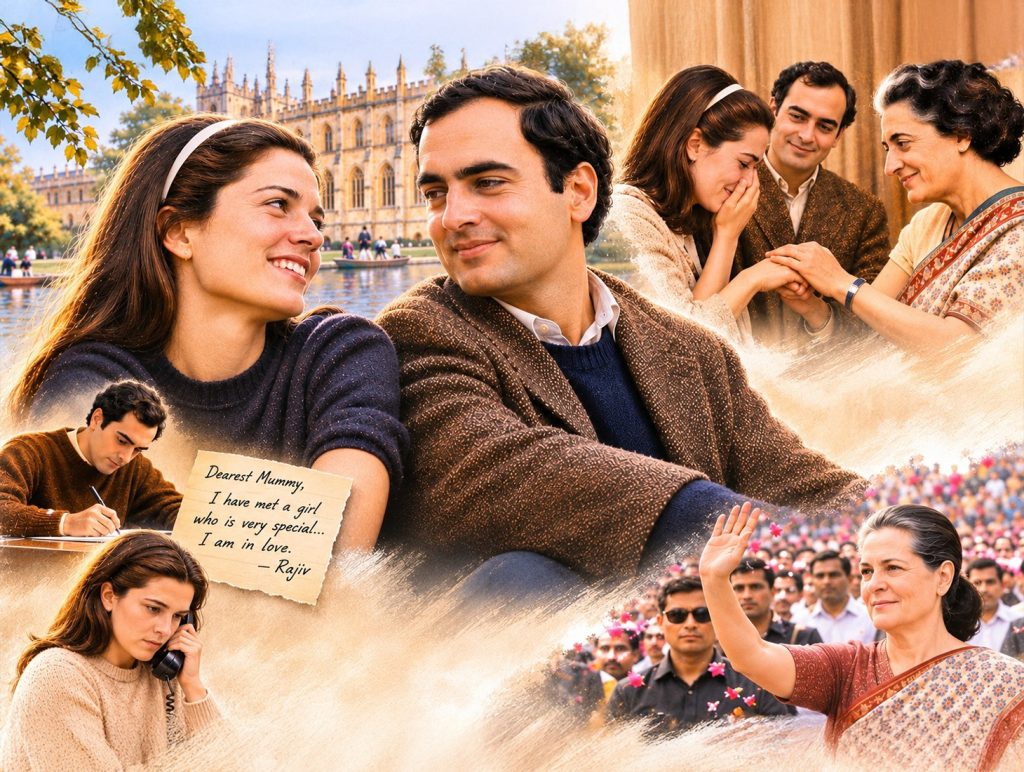
Sonia was 19 and Rajiv was 21 when they fell in love in Cambridge, England, in the mid-1960s. She was an Italian student who had travelled to Britain to learn English. Rajiv was pursuing his studies and enjoying a relatively quiet life, far removed from the political responsibilities that would eventually come his way.
For Rajiv, the relationship was not a passing romance. He appeared certain that he had found the woman he wanted to marry.
In March 1965, he wrote to his mother, Indira Gandhi, telling her that he had met someone very special. A month later, he was even more certain about his feelings. He told her that he was in love and wanted to marry Sonia.
Indira, naturally, had questions. Her son had known Sonia for a relatively short time. Would the young Italian student be comfortable in India? Could she adjust to a different culture and family? Would she be happy leaving her parents and home behind?
Yet Indira also knew what it meant to follow one’s heart as her own marriage to Feroze Gandhi had faced opposition from sections of her family. She understood that love could not always fit others expectations.
Rajiv, however, was not willing to change his mind. He knew what he wanted, and he wanted Sonia.
The meeting Sonia was nervous about
Indira eventually decided that she should meet the young woman who had become so important to her son. She turned to family friends P N Haksar, India’s Deputy High Commissioner in London, and his wife, who knew Rajiv and were fond of him.
The Haksars invited the couple to their residence, Sun House in Hampstead, in March 1965. They also took them to an Indian restaurant.
For Sonia, the meal was an unfamiliar experience. She struggled with the food and found the tandoori chicken particularly fiery. Rajiv helped her decide what to order. It was a small incident, but it offered a glimpse of the differences she would have to get used to if she eventually made India her home.
Indira later expressed her wish to meet Sonia. The opportunity came in June 1965, when she was in London.
For Sonia, the journey from Cambridge was anything but relaxed. She was nervous throughout. She knew how much the meeting meant to Rajiv and worried about the impression she would make on his mother.
The meeting, as Sonia recalls it, turned out to be much warmer than she had imagined.
Indira welcomed her and began speaking in French, a language they could both understand. She offered Sonia chocolates, complimented her black-and-white linen suit and asked about her family and education.
But Sonia was overwhelmed. The nervousness became too much for her and she suddenly began to cry.
Indira did not respond with formality or distance. She held Sonia’s hand, drew her closer and reassured her.
“Don’t be afraid, Sonia, I’m human, I too was once young and in love. I understand you perfectly well.”
It is one of the most touching moments in the book. For a brief moment, the political figure disappeared and a mother spoke to a young woman who was frightened of being rejected.
There was another small gesture that Sonia remembered. Before they left for a party that evening, she discovered that the hem of her long black dress had come undone. Indira took out her travel sewing kit and stitched it herself.
It may seem ordinary, but such gestures often leave a deeper impression than grand expressions of affection. Sonia had arrived fearing the meeting. She left having experienced an unexpected warmth.
Winning Indira’s acceptance did not mean that everything was settled. Sonia still had to face opposition at home.
Her father, particularly, was uncomfortable with the relationship. He had traditional expectations and was not prepared to accept that his daughter might marry an Indian man.
When Sonia returned home at the end of the academic term and her father grew uneasy about her insistence on going back to Cambridge. His concerns deepened when letter from the principal of her language school raised questions about how seriously she was taking her studies.
When he eventually learnt about Rajiv, he strongly opposed the relationship and refused to allow Sonia to return to Britain.
For the young woman, it was a painful period. She was caught between her family and the man she loved. She spent days crying and trying to persuade her mother to speak to her father.
Rajiv was also finding the separation difficult. He continued writing to Sonia and tried to find ways of convincing her family. In his letters to Indira, he expressed his loneliness and frustration. He feared that Sonia might not be allowed to return to Cambridge and that their relationship could be lost because of circumstances beyond their control.
Eventually, Sonia’s mother stepped in. Her landlady in Cambridge, Picina Norris, an Italian woman married to an Englishman, also helped because she understood the family’s background and spoke their dialect.
After considerable resistance, Sonia’s father agreed to let her return to Cambridge. Rajiv was waiting for her at Dover station, accompanied by Picina.
Their reunion brought an end to a difficult separation. They were together again and could return to the life they had been building.
My memories of covering Sonia Gandhi
My interest in Sonia Gandhi’s story is not limited to what I have read in her book. I have followed her political journey as a journalist for more than 25 years, and some of my own memories are closely connected with the years when she became one of the most powerful figures in Indian politics.
During my internship with Aaj Tak, I would often request senior journalists to take me along to important political events. I was curious and eager to learn. Whenever something significant happened in politics, I wanted to be there, observe how experienced reporters worked, listen to their questions and understand how they covered a story. Every such opportunity was a learning experience.
By 1998 and 1999, 10 Janpath had become one of the most closely watched addresses in Delhi. Journalists would often wait outside late into the night, hoping to pick up some indication of what was happening inside.
Sonia Gandhi was emerging as a powerful centre of authority in the Congress. Senior party leaders, including chief ministers, were keen to meet her. But before seeking an appointment, some would first enquire through her political advisers and close associates about her mood.
Was she in a good mood? Was she angry? Would it be the right time to meet her?
There was also concern about how their meetings might be reported in the newspapers, particularly The Hindu. It was widely known in Congress circles that Sonia read the newspaper in the morning. Leaders were conscious of the coverage they might receive and preferred not to walk into a meeting after an unfavourable report.
Over the years, I covered her rallies and roadshows during Lok Sabha and Assembly elections. One incident from the 2004 Lok Sabha campaign in Haryana has stayed with me.
It was in Sonipat. I was standing at a spot where Sonia Gandhi’s roadshow was expected to pass in the morning. But the convoy was delayed and she eventually arrived much later in the evening.
Congress leader Kumari Selja was also travelling in the convoy.
People had been waiting behind wooden barricades for hours. As Sonia’s vehicle approached, the crowd suddenly surged forward. The barricades gave way under the pressure.
Some people told me they had waited all day because they wanted to touch Sonia Gandhi, whom they affectionately called Gauri Madam.
Within moments, the situation became chaotic. Police resorted to a lathi charge to control the crowd, while security commandos rushed to protect Sonia. Selja was also caught in the crush and fell as people pushed towards the convoy.
It was difficult to believe how quickly an election roadshow could turn into such a chaotic situation. The woman whose first meeting with Indira Gandhi had once made her so nervous was now drawing crowds that were difficult even for the security personnel to control.
I was working with an English-language daily at the time and was stationed in Panipat. Filing a report from an outstation location was not easy in those days. Cybercafes were often the only option. Internet connections were painfully slow, and many computers had just 128MB of memory.
I managed to send my report before the deadline. It appeared on the last page of the newspaper but my byline was missing. I returned to Panipat late that night. For a young journalist seeing a report published without one’s name was disappointing. But the experience itself remained with me, as did the extraordinary scenes I had witnessed that evening.
This is what makes Belonging: A Journey of Love particularly interesting to me. It is not simply another book about Sonia Gandhi or the Congress party. It is an opportunity to hear her speak about events that she experienced at close quarters.
The book also deals with deeply personal and historic episodes, including the assassinations of Indira Gandhi and Rajiv Gandhi, the 1984 anti-Sikh violence and her experiences as the mother of Rahul and Priyanka Gandhi.
These are events on which she offers her own memories and interpretations. Readers may agree or disagree with her account, but there is value in hearing the perspective of someone who lived through them.
Senior BJP leader Sanjay Tandon on Monday flagged off the 18th Mata Vaishno Devi Yatra…
Amritsar: In the narrow lanes of Thathera Bazaar, the sound of a hammer striking metal…

With de-addiction admissions rising by 164 per cent and nearly 45 per cent of Punjab’s…
The Punjab government has announced a one-time settlement (OTS) scheme offering a 100 percent waiver…