






 PTI
PTI
New Delhi, April 9
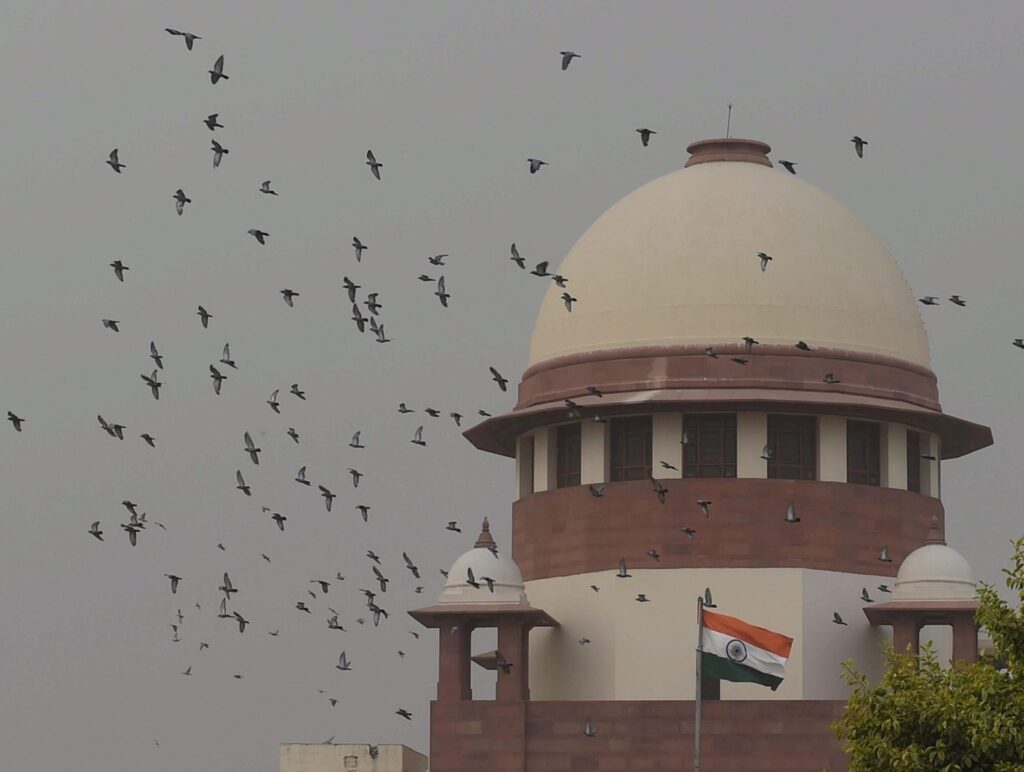
The Supreme Court on Thursday observed that access to temples and maths should not be restricted to a single denomination, warning that excluding sections of Hindus from places of worship could damage the faith and deepen social divisions.
The remarks came from a nine-judge Constitution bench during a hearing on petitions linked to women’s entry into religious places, including Kerala’s Sabarimala temple, and the wider question of how religious freedom should be interpreted across faiths.
The bench comprises Chief Justice Surya Kant and Justices B V Nagarathna, M M Sundresh, Ahsanuddin Amanullah, Aravind Kumar, Augustine George Masih, Prasanna B Varale, R Mahadevan, and Joymalya Bagchi.
During the proceedings, Justice B V Nagarathna said there was a concern that allowing denominational temples to exclude other worshippers could have wider consequences for Hinduism itself.
She referred to the earlier Venkataramana Devaru ruling and said that if access to temples were limited only to one section or denomination, it would be “not good for Hinduism” and could prove counterproductive even for the denomination seeking such exclusivity.
“Everybody must have access to every temple and math,” she observed, while also noting that the court was, for the moment, setting aside the specific controversy surrounding the Sabarimala verdict.
Justice Aravind Kumar agreed, saying that such exclusionary practices could divide society.
Senior advocate C S Vaidyanathan, appearing for organisations including the Nair Service Society, Ayyappa Seva Samajam and Kshetra Samrakshana Samiti, argued that a denominational temple could decide whether to allow broader access or restrict worship to members of that denomination alone.
He also submitted that if a temple chooses to serve only its own denomination, it should not seek financial support from the state, the public or private donors outside that community. Any law regulating such matters, he said, would still need to meet constitutional tests of public order, morality and health.
The bench noted that in the Devaru judgment, the Supreme Court had upheld the Madras Temple Entry Authorisation Act. That ruling had maintained that while the temple remained open to all Hindus, some ceremonial practices reserved for Gowda Saraswath Brahmins could still be constitutionally protected.
The current nine-judge bench has framed seven broader questions on the scope and limits of religious freedom, reflecting the significance of the issue beyond the Sabarimala dispute alone.
The matter has its roots in the Supreme Court’s 2018 ruling, when a five-judge Constitution bench, by a 4:1 majority, struck down the long-standing restriction on women aged between 10 and 50 entering the Sabarimala Ayyappa temple. The court had then held that the centuries-old practice was unconstitutional.
A year later, in November 2019, another five-judge bench led by then Chief Justice Ranjan Gogoi referred the larger issue of women’s exclusion at places of worship across religions to a bigger bench, saying broader constitutional principles on religious freedom could not be settled in the abstract without examining the facts of each case.
Thursday’s hearing made clear that the court is now grappling not only with gender-based exclusion, but also with a wider constitutional question: whether denominational control over worship can coexist with equal access in a plural society.
Devastating floods along the Nepal-Tibet border, reportedly killed 270 people so far, have once again…
Jabalpur, June 26 The Madhya Pradesh High Court on Thursday dismissed a defamation case against…
New Delhi, June 25 Prime Minister Narendra Modi on Thursday described the Emergency imposed in…
The Centre government has said that a passport has never been considered conclusive proof of…