







 Damini Sharma
Chandigarh, April 30
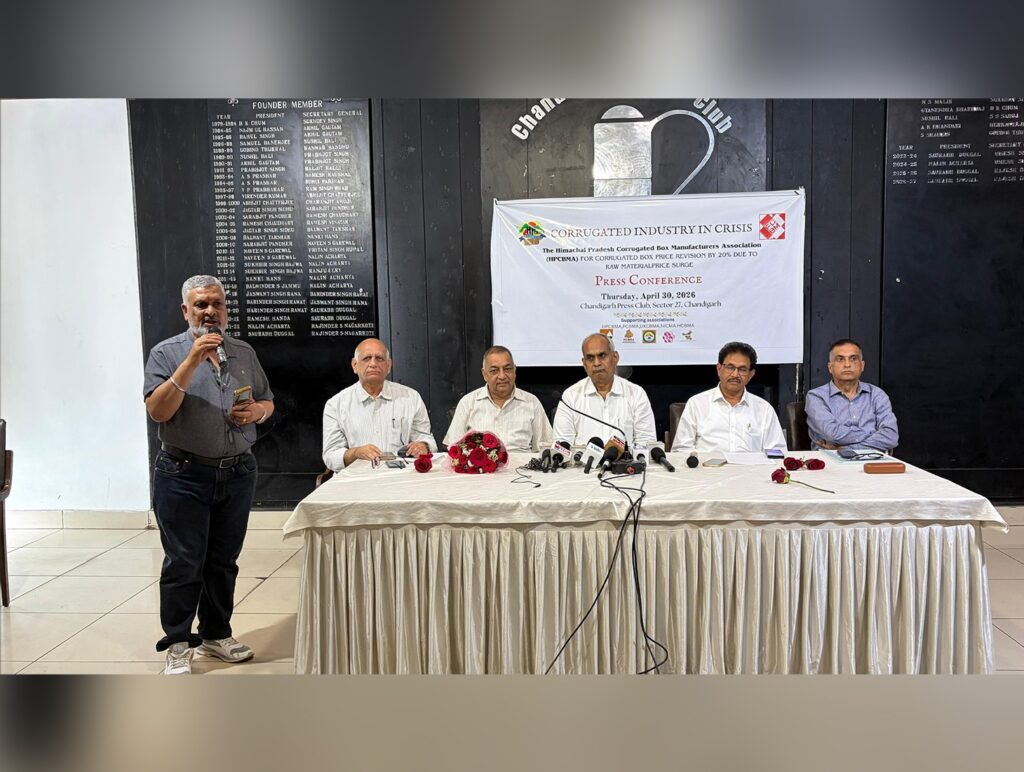
The Himachal Pradesh Corrugated Box Manufacturers Association (HPCBMA) on Thursday demanded a 20 percent increase in corrugated box prices to offset the sharp rise in raw material costs. Industry representatives said the sector is struggling under mounting financial pressure due to escalating expenses and delays in GST refunds.
While addressing press conference held at Chandigarh Press Club, president of the Federation of Corrugated Box Manufacturers of India (FCBM), Rajinder Bhatti, highlighted that the price of kraft paper—the primary raw material—has surged by 15–20 percent in recent months. As kraft paper accounts for nearly half of total production costs, the increase has significantly impacted manufacturers. He attributed the rise to global geopolitical conditions, supply chain disruptions, and volatility in international markets, he added. He further said that in addition to kraft paper, the cost of other essential inputs such as glue, ink, adhesives, and wires has risen by 30–40%, further increasing production expenses.
HPCBMA president Aditya Sood noted that rising electricity tariffs, labour costs, and raw material prices have made it difficult for many units to sustain operations. Former President Gagan Kapoor pointed out that LPG cylinder prices have jumped sharply in recent months, while supply shortages have reduced workforce availability by 25–30%.
The industry also flagged the inverted duty structure under the GST regime as a major concern. Leaders said higher taxes on inputs and lower taxes on finished goods have led to delays in refunds, blocking working capital and affecting cash flow. Representatives from various associations, including UPCBMA and NICMA, emphasized that small and medium enterprises are the worst affected.
They urged the government to address GST-related issues, expedite refunds, and provide policy support to stabilize the sector. The association warned that without timely intervention, the industry could face severe disruptions, impacting employment and the broader supply chain.
Industry leaders called for collaboration between policymakers and stakeholders, stating that prompt action could help the sector overcome the current crisis and remain competitive.
Devastating floods along the Nepal-Tibet border, reportedly killed 270 people so far, have once again…
Jabalpur, June 26 The Madhya Pradesh High Court on Thursday dismissed a defamation case against…
New Delhi, June 25 Prime Minister Narendra Modi on Thursday described the Emergency imposed in…
The Centre government has said that a passport has never been considered conclusive proof of…