








 Dr Kiran Deep
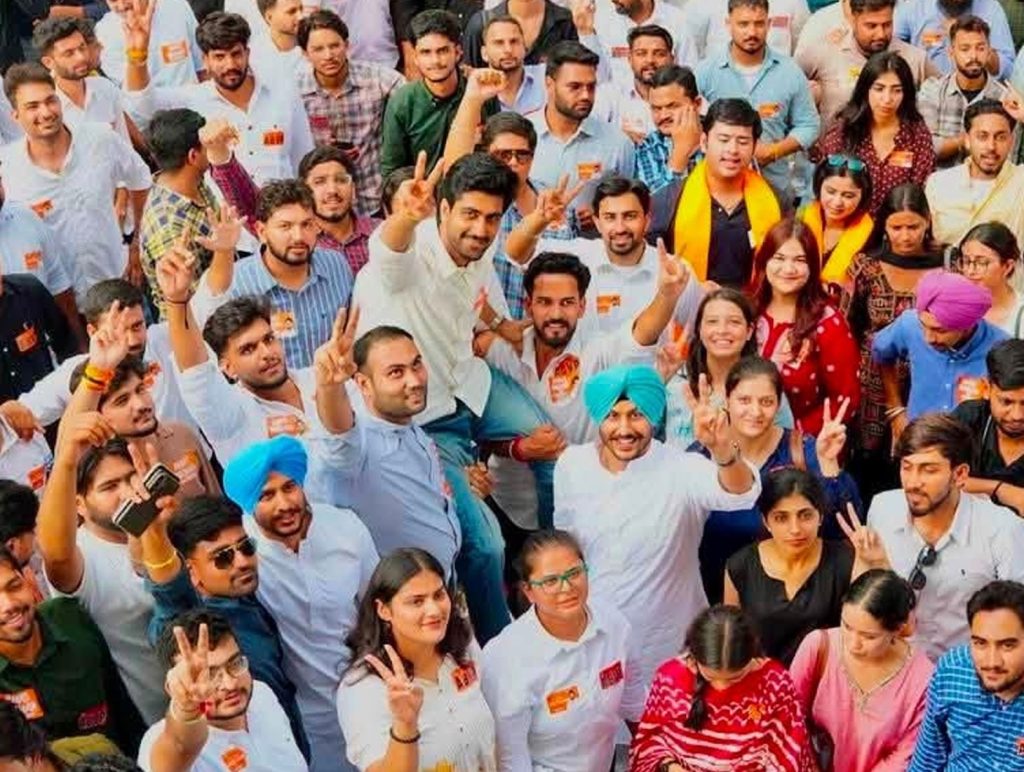

A student election at Panjab University would ordinarily have little consequence for Punjab’s wider political landscape. But the victory of ABVP candidate Ankit Bidhan has acquired a significance that goes well beyond the campus.
Bidhan won the presidency of the Panjab University Campus Students’ Council (PUCSC), securing a second consecutive victory for the ABVP. What has drawn political attention, however, is that he received support from the Students Organisation of India (SOI), the student wing of the Shiromani Akali Dal (SAD).
The episode has revived a familiar question in Punjab politics. Could the BJP and SAD, once close allies, eventually find their way back to each other?
There is no alliance at present. In fact, the BJP continues to insist that it will contest the next Punjab Assembly election on its own.
But politics is often revealed as much by small acts of cooperation as by formal announcements.
The ABVP-SOI understanding is therefore worth watching, particularly because BJP leaders have themselves drawn attention to it.
Bidhan, speaking after his victory, gave the result a broader generational meaning.
“This is not my victory alone, it is the victory of the entire Gen Z. Gen Z has proved that Modi ji and the ABVP have a place in their hearts,” he said.
It would be a mistake to treat a university election as a straightforward referendum on national politics. Student elections have their own dynamics, alliances and personalities. Yet political parties have clearly seen something worth celebrating in the result.
Union Home Minister Amit Shah congratulated the ABVP on its victory, describing the second consecutive win as evidence of young people’s faith in its “Nation First” ideology.
His message did not mention the SOI.
BJP National General Secretary (Organisation) B L Santhosh did.
“ABVP’s Sri Ankit Bidhan wins the Punjab University Student Union President’s elections convincingly. Second time in a row,” he wrote on social media.
He then added, “SOI also supported ABVP nominee in last 48 hours.”
That reference is significant because it comes at a time when the BJP’s official position remains that it intends to contest all 117 Assembly seats in Punjab independently.
Former Punjab BJP president Sunil Jakhar also described the result as a sign of changing political winds. He said the ABVP had created history by winning for a second consecutive year and specifically acknowledged the role played by the SOI.
Taken together, these reactions suggest that some in the BJP see the cooperation as more than an isolated student election arrangement.
But it would be premature to conclude that an alliance is around the corner.
The BJP leadership has repeatedly maintained that it will fight the Assembly election alone. Punjab BJP in-charge Satish Poonia reiterated that the party would contest all 117 seats on its own strength.
When yesterday media asked whether that effectively ruled out an alliance, Poonia’s response was unequivocal. If the party was preparing to contest all 117 seats, the message was clear.
So why does the alliance question keep returning?
The answer may lie in the electoral arithmetic.
The BJP and SAD were once partners in Punjab and at the national level. That relationship ended in 2020 when the SAD left the National Democratic Alliance over the central farm laws, which have since been repealed.
The political landscape has changed considerably since then.
In the 2024 Lok Sabha election, the SAD won just one of Punjab’s 13 seats, while its vote share fell from about 27% to around 13%.
The BJP did not win a seat in the state, but its vote share increased from roughly 9% to 18%.
The 2022 Assembly election had already exposed the decline of both parties. The SAD won only three of Punjab’s 117 seats, while the BJP secured two, Pathankot and Mukerian.
The Aam Aadmi Party, by contrast, won 92 seats and formed the government.
These numbers help explain why the question of a BJP-SAD understanding remains politically relevant.
For the SAD, the problem is one of declining electoral influence. A party that once played a central role in Punjab politics now faces the challenge of rebuilding its support.
For the BJP, the challenge is different. Its vote share has increased, but converting that support into Assembly seats remains difficult.
An alliance could, in theory, bring together two different kinds of political strengths.
But electoral arithmetic alone does not make an alliance.Harsimrat Kaur Badal, the SAD MP and wife of party president Sukhbir Singh Badal, has spoken in favour of an alliance with the BJP.
Former SAD minister Bikram Singh Majithia and others associated with the party have also advocated closer ties.That does not mean the SAD leadership has formally committed itself to a return to the BJP-led alliance.
It does, however, show that the idea has not disappeared.
And this is where the Panjab University result becomes interesting.
Political alliances are rarely created overnight. They usually emerge after a period in which leaders, workers and supporters begin testing whether cooperation is possible.
Perhaps the Panjab University election was simply such an exercise.
Or perhaps it was nothing more than a tactical arrangement dictated by the mathematics of a campus election.
There is no evidence yet to determine which interpretation is correct.
The wider political context, however, makes the speculation understandable.
Punjab is heading towards another Assembly election in a political environment that is very different from the one in which the BJP and SAD parted company.
The AAP’s 2022 landslide changed the state’s traditional bipolar political contest. The Congress remains a significant force, while the BJP has expanded its vote share despite its limited Assembly representation. The SAD, meanwhile, is attempting to recover from a period of severe electoral setbacks.
In such circumstances, every party has an incentive to reassess its strategy.
The BJP may believe it can expand further by contesting independently. The SAD may believe it needs to rebuild its own identity rather than return to an old alliance.
Both calculations are plausible.
That is why the BJP’s insistence on contesting all 117 seats should be taken seriously.
At the same time, the growing public discussion around cooperation between BJP-linked and SAD-linked organisations should not be dismissed altogether.
The contradiction is perhaps the most interesting part of the story.
At the state level, the BJP says it will fight alone.
At Panjab University, the ABVP and SOI found a way to work together.
One should not confuse a student election with state politics. But neither should one ignore what such an episode can reveal about the political space between two parties that were once allies.
The real test will come when seat-sharing, leadership, ideology and the farmers’ movement become part of any serious discussion about an alliance.
Until then, the Panjab University result is best viewed as a political signal rather than a political settlement.
It may mean nothing more than a successful campus-level arrangement.
But if similar cooperation begins appearing elsewhere, among workers, local leaders or political organisations, the interpretation could change.
For now, the BJP and SAD remain officially apart.
Yet Punjab’s politics has entered a phase in which old equations are being reconsidered.
The Panjab University election may not tell us whether the two parties will reunite.
It does tell us that the question is not going away.

The firing outside actor Tiger Shroff’s residence has renewed a troubling question. Is Lawrence Bishnoi…
Risks of exposing illegal mining on screen and in real life Watching Reporting Live on…
Sachin Pilot has brought rival leaders together, but public displays of unity must translate into…

Salian’s family asks the CBI to summon the former NCB Zonal Director as a key…