






 Disney Brar
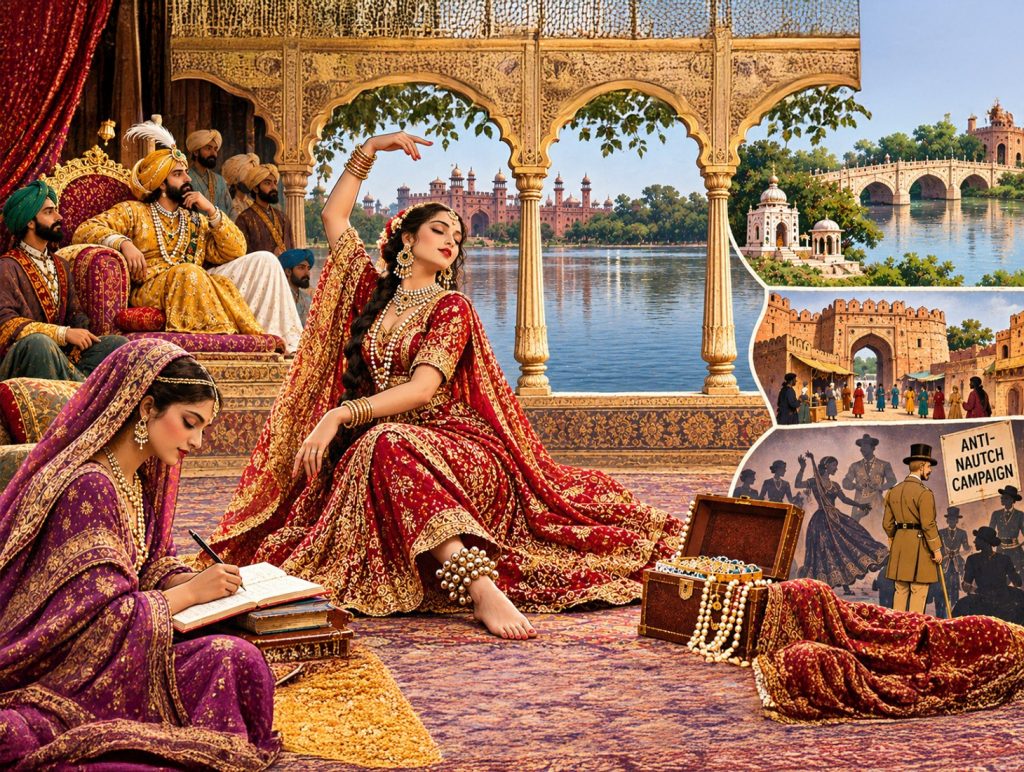

They held royal courts spellbound, built bridges, patronised places of worship and gave music a language of its own. Yet, the women who shaped Punjab’s cultural life were often denied the dignity of being remembered.
There was a time when the sound of ghungroos travelled through Lahore’s courtyards and the strains of a raag lingered long after a mehfil had dispersed. A woman’s command over music, poetry and conversation could hold a king’s attention. In Punjab’s royal courts, the tawaif was an artist, a cultural custodian and, at times, a woman of considerable influence. Yet, beyond the silk, jewels and applause lay a troubling contradiction: society celebrated her artistry while questioning her respectability.
Beyond Hira Mandi: Rediscovering Punjab’s tawaifs
Her music was welcome in the palace; her presence outside it was another matter.
To trace this forgotten world is to travel through a Punjab that existed before the Radcliffe Line divided its cultural geography — from Lahore’s Hira Mandi and the lanes of Amritsar to Multan’s Haram Gate and the princely courts of Patiala and Kapurthala. It is to recover a history in which women performers were not merely decorative figures but participants in music, patronage and public culture.
Perhaps no story captures this paradox better than that of Bibi Moran, the celebrated courtesan of Amritsar who became Maharaja Ranjit Singh’s wife. Her name, believed to have come from her peacock-like dancing, travelled far beyond the mehfils where she performed. The Maharaja’s affection earned her the title Moran Sarkar.
Her legacy extended beyond the royal household. At her insistence, a bridge was constructed over the Hansli canal on the Amritsar-Lahore route. Remembered as Pul Kanjri, or the Bridge of the Dancing Girl, the complex included a travellers’ rest house, a well, a tank and a garden. Moran also extended patronage across religious boundaries, contributing to a Bhairon temple and supporting a madrasa. A woman whose profession attracted social censure thus left her mark on the region’s religious and public landscape.
Another courtesan, Gul Begam, later known as Gul Bahar Begam, also entered Ranjit Singh’s household as his wife. Court records describe her wedding in September 1832, complete with elaborate ceremonies, music, dancing and gifts to performers. She later enjoyed influence at court and survived the Maharaja, receiving a pension under the British rule.
Beyond Lahore’s Hira Mandi
Lahore’s Hira Mandi has long dominated popular perceptions of the tawaif. But Punjab’s cultural map was much wider. Amritsar, Multan, Bahawalpur and Dera Ghazi Khan had their own histories of female performers, patronage and artistic exchange.
In Multan, the walled city’s Haram Gate neighbourhood, also associated with Bazar-e-Husn, occupies a fascinating place in this history. A 2026 study by historians Radha Kapuria and Asad Fatemi brings renewed attention to Murad Bakhsh, an eighteenth-century courtesan whose life unfolded amid the political turbulence of south-western Punjab.
Her story survives in Jaur-o-Jafa, a Persian memoir written in 1806 by Muhammad Raza Khan, a Durrani aristocrat from Dera Ghazi Khan with whom she shared a complicated relationship. Illustrated with miniature paintings, the manuscript offers glimpses of courtiers, musicians, messengers and powerful patrons.
A voice that refused to remain silent
Another extraordinary figure emerged from Lahore’s performing world in the nineteenth century. Piro, a Muslim woman associated with the city’s courtesan community, challenged the religious and social conventions of her time by joining Guru Gulab Das and the Gulabdasi sect at Chathianwala, near Lahore.
Piro also told her own story through her 160 Kafis, expressing her experiences, spiritual convictions and the tensions surrounding her identity. Drawing on Bhakti and Sufi thought, her poetry challenged the religious and social boundaries through which society sought to classify her.
When respectability silenced the mehfil
The 19th century gradually transformed the world that sustained these performers. The annexation of Punjab in 1849, the decline of older courtly patronage and the rise of colonial and middle-class notions of respectability altered the cultural standing of hereditary women performers.
Anti-nautch campaigns and reform movements increasingly conflated trained courtesans, hereditary musicians and other women in the entertainment economy, judging public female performance through the lens of morality.
The consequences were profound. The kotha, once a space of musical training, literary exchange and connoisseurship, was reduced in public imagination to a symbol of sexual transgression. Women who had cultivated classical music and dance saw their social worlds shrink as newer, more respectable forms of public musical culture emerged.
Yet Punjab’s musical history cannot be told without them. Its classical traditions, musicians and evolving musical lineages were shaped by networks of performers, patrons and connoisseurs that included hereditary women artists. Even the emergence of the Patiala gharana in the early 20th century belongs to this wider story of musical exchange and changing patronage.
The border divided the land, not the memory
Partition in 1947 fractured Punjab’s shared cultural geography. Lahore, once connected to Amritsar, Multan and other centres through overlapping networks of music and patronage, became part of another country. Migration, changing tastes and new social realities further displaced the old mehfils and their networks.
Cinema later gave the tawaif a second life, dressing her in brocade, placing her beneath chandeliers and portraying her as a tragic heroine of unfulfilled love. But this image often obscured the historical woman: the trained vocalist, poet, entrepreneur, traveller and negotiator of her own circumstances.
The women who held kings spellbound
Punjab remembers the grandeur of its courts, the refinement of its music and the splendour of its mehfils. It remembers the melodies, but seldom the women who gave them a voice.
They were applauded in their time, judged by the society around them and marginalised by the histories that followed. Their art travelled across generations; their names did not.
And somewhere between the fading notes of a forgotten raag and the silence of an old kotha lies a question worth asking: how much of Punjab’s cultural inheritance have we preserved, and how much have we chosen to forget?

Bollywood’s familiar refrain, “Mard ko dard nahi hota”, has perhaps outlived its cinematic moment to…
Horn OK Please. Buri Nazar Wale Tera Munh Kala. Maa Da Aashirwad. Mitraan Da…
There is something special about falling in love. It can turn ordinary moments into memories…
Amritsar: In the narrow lanes of Thathera Bazaar, the sound of a hammer striking metal…