




 Disney Brar
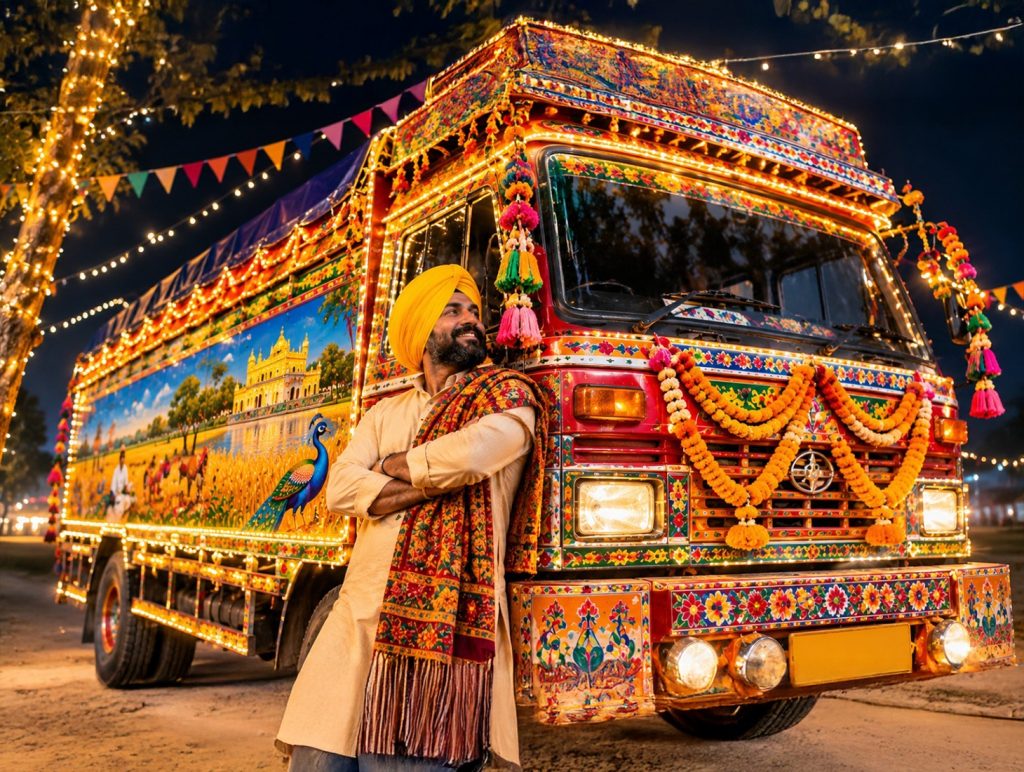

Horn OK Please. Buri Nazar Wale Tera Munh Kala. Maa Da Aashirwad. Mitraan Da Truck Baliye. On Punjab’s highways, poetry rarely sits between the pages of a book. It is painted across the backs of trucks, splashed in bright colours and carried from one destination to another, driven at 80 kilometres an hour. Every slogan has an attitude, every illustration has a story and every decorated cabin holds a little piece of the person behind the wheel.
Watching a brightly painted truck pass by is an experience in itself. The colourful lettering, floral borders, peacocks, religious symbols, portraits and playful one-liners are impossible to miss. Even today, amid the rush of highways and the uniformity of modern vehicles, these moving canvases command attention. They are unmistakably desi, unapologetically expressive and, in Punjab, unmistakably Punjabi.
But behind the colour and swagger lies a quieter story — of drivers who spend much of their lives away from home, and of painters and artisans whose hands have turned an everyday mode of transport into a distinctive expression of popular culture.
In Punjab, a truck is rarely just a vehicle. It is an extension of the person who drives it, carrying his personality, pride, faith, humour and a sense of belonging. Its decoration is not merely an embellishment; it is a language of its own, spoken through paint, patterns, poetry and familiar phrases.
On highways cutting through fields, mandis, industrial towns and border villages, these trucks carry more than commercial cargo. They transport fragments of Punjab’s cultural imagination.
A moving canvas with a Punjabi soul
Look closely at a decorated truck and an entire visual vocabulary unfolds. Bright floral borders, peacocks, eagles, mountains, religious imagery, portraits, geometric patterns and elaborate lettering compete for attention. Some trucks feature ornate metalwork, while others wear colourful fabric curtains, decorative lights, fringes, tassels and mirrors.
The artwork often extends from the rear doors to the sides, cabin panels and even the windshields. Every available space becomes an opportunity for expression. A familiar face, a religious blessing or a cheeky line can turn an otherwise ordinary vehicle into something instantly recognisable.
The tradition has deeper roots than its contemporary, flamboyant appearance suggests. Across the Indian subcontinent, vehicles and animals were decorated long before motorised transport became commonplace. As trucks became an important part of the region’s transport economy in the mid-20th century, their decoration evolved from functional lettering and simple messages into increasingly elaborate displays of colour and craftsmanship. The precise origins of modern truck art remain debated, but its visual language draws from folk imagery, religious beliefs, popular cinema and local traditions.
Rolling Through Time: Punjab’s Love Affair with Truck Art
In Punjab, the language of truck decoration has acquired its own flavour. Punjabi lettering, familiar rural imagery, references to the pind, religious blessings and the unmistakable Jatt swagger often find their way onto these moving canvases.
Talking to The North News, Satwant Singh of Ludhiana, whose family has been painting trucks for three generations, says, “The cabin is the most personal part of a truck. Often a driver’s home away from home, it is transformed with colourful upholstery, photographs, religious symbols, little keepsakes and carefully arranged personal belongings. What may appear to an outsider as an ordinary working space becomes a familiar sanctuary for drivers who spend weeks travelling along unfamiliar roads.”
Rupinder Sran, another truck painter from Sirhind, echoes this sentiment, “For a driver who may be away from his family for long stretches, decorating his truck is also a way of making the road feel less anonymous. A photograph, a blessing or a familiar phrase can offer a sense of comfort and connection.”
For the driver, a freshly decorated truck is a matter of pride. For the artist, it is a canvas. And for the passer-by, it is a fleeting exhibition that moves at the highway speed.
When the back of a truck becomes a storyteller
Perhaps the most memorable feature of Punjab’s truck culture is its lettering. The backs of these vehicles have long doubled as informal noticeboards, carrying everything from blessings and warnings to declarations of love, humour and identity.
Some messages are meant to ward off the evil eye, others to invoke divine protection. A few are playful, cheeky or deliberately dramatic. Together, they offer a glimpse into the humour, beliefs and everyday vocabulary of the people who travel the highways.
Buri Nazar Wale Tera Munh Kala remains one of the most recognisable expressions associated with Indian trucks. Horn OK Please, meanwhile, has become almost synonymous with road travel in the country. Alongside these familiar lines are Punjabi-flavoured declarations that reflect a driver’s personality and pride.
Some commonly encountered expressions and creative examples that capture this spirit include:
Not every inscription is intended to be profound. Sometimes, a few words are enough to make a passer-by smile. At other times, a simple blessing carries the weight of a driver’s hopes for a safe journey and a peaceful return home.
Painted in Punjab, Driven Across India
And perhaps that is what makes Punjab’s truck art so enduring. Beyond the bright colours, elaborate motifs, witty one-liners and familiar slogans lies a world of memories, faith, identity and aspiration. Every painted truck carries a little piece of the person behind its wheel, travelling through changing landscapes while keeping familiar fragments of home alive. As highways widen, vehicles modernise and the language of transport evolves, these rolling canvases continue to tell stories that no road map can capture. For in Punjab, a truck is rarely just a truck; it is a moving expression of life, livelihood and the undying desire to leave a little colour wherever the road leads.
There is something special about falling in love. It can turn ordinary moments into memories…
Amritsar: In the narrow lanes of Thathera Bazaar, the sound of a hammer striking metal…
With de-addiction admissions rising by 164 per cent and nearly 45 per cent of Punjab’s…
The Punjab government has announced a one-time settlement (OTS) scheme offering a 100 percent waiver…