






 Disney Brar
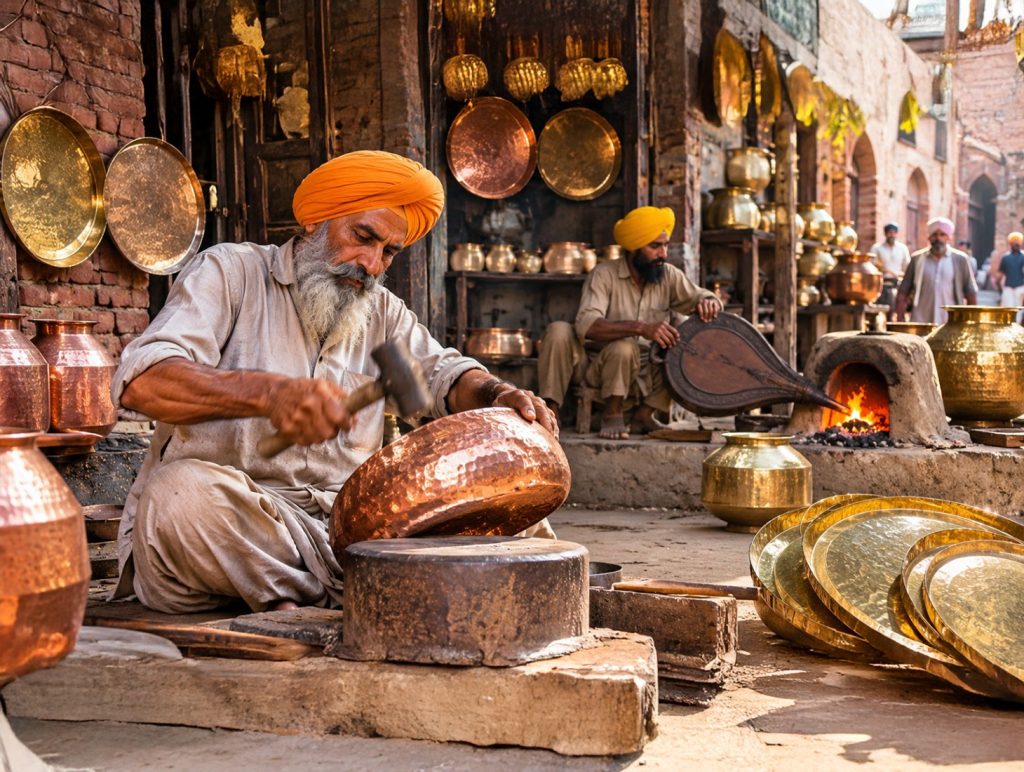
Amritsar: In the narrow lanes of Thathera Bazaar, the sound of a hammer striking metal is becoming increasingly rare. Behind the brass degs, copper vessels and hand-beaten utensils lies a troubling reality: a centuries-old craft is struggling to survive, not because its skill has disappeared, but because making a living from it has become increasingly difficult.
The crisis acquired fresh urgency following Punjab Governor Gulab Chand Kataria’s visit to Thathera Bazaar in April this year, when he called for the promotion of the craft and said the historic market should be developed as a Heritage Bazaar and tourist destination. But for the artisans, the bigger question remains: will heritage recognition translate into regular orders, fair wages and a future for their children?
A UNESCO honour, but no guarantee of survival
The numbers tell a sobering story. Jandiala Guru has witnessed a decline in the number of artisans from around 1,500 to barely 100. Of the four rolling units that once supplied brass sheets to the workshops, only one is reportedly operating once a fortnight.
At the heart of the crisis is a changing market. While machine-made utensils from Moradabad in Uttar Pradesh and Jagadhari in Haryana have adapted to contemporary tastes, Jandiala’s artisans have largely remained associated with traditional products such as degs, dhonas, paraats and pateelas. Cheaper plastic, aluminium and stainless steel have further squeezed their demand.
The Old Papa, a century-old utensil store in Bazaar Kaserian, Jandiala Guru, established by Ashwini Kumar Vij’s great-grandfather, offers a telling glimpse into the gradual decline of the traditional craft. Recalling the days when business was flourishing, Vij says the change has been stark.
“There was a time in the 1980s when four rolling machines would run at full capacity, day and night, to meet the demand for brass sheets that the ‘thatheras’ moulded into utensils. Today, we have just one, and even that is used very rarely. It is almost on its last legs,” he says ruefully.
Several traditional artisans, he says, have shut down their workshops due to a lack of funds, government assistance and access to bank loans. Their children, unwilling or unable to carry forward the family trade, have moved into other professions or migrated abroad, leaving behind a dwindling community of skilled craftsmen.
“The bazaar has been accorded heritage status, and so have the ‘thatheras’, but there is no real support — neither financial nor even vocal. This has led to the unfortunate closure of workshops and the gradual disappearance of the craft,” Vij says.
He rues the absence of meaningful government intervention, alleging that successive governments have failed to provide financial assistance or introduce measures to help artisans sustain their traditional skills.
“Not a single government has come forward to help the ‘thatheras’ continue their art. Not a single penny has come forth so far. This heritage craft is sadly breathing its last,” he says.
Jandiala Guru in Punjab, Jagadhri in Haryana and Moradabad in Uttar Pradesh remain associated with the production and sale of hammered brass and copper utensils. But in Jandiala Guru, the concern goes beyond the decline of a traditional industry. It is about whether the generations-old skill that gave this town its distinct identity will survive at all.
Kultej Singh, an artisan who once worked at the Thathera Bazaar, attributes the decline of this glorious craft to the failure to adapt to changing times. Recalling an era when artisans had more work than they could handle, he says the traditional craftsmen continued making large utensils such as degs, dhonas, paraats and pateelas, while manufacturing hubs like Jagadhri and Moradabad embraced machine-made utensils that were cheaper and more contemporary in design.
“People gradually shifted to plastic and aluminium utensils, which were far cheaper than the handcrafted products we made. Our traditional methods could not compete with the affordability and changing appeal of factory-made alternatives,” he says.
The craft itself is extraordinary. Recognised by UNESCO in 2014 as Intangible Cultural Heritage of Humanity, it involves heating brass and copper sheets over small underground furnaces, repeatedly hammering them into shape, joining the pieces and polishing them by hand. The knowledge is traditionally passed from one generation to another.
But a UNESCO inscription cannot pay a household’s electricity bill, finance raw material or persuade a young artisan to reject a better-paying job.
Jandiala Guru does not need another ceremonial appreciation of its heritage. It needs a functioning market, direct access to buyers, affordable raw materials, design support, skill training and a transparent financial support mechanism.
The proposed Heritage Bazaar must therefore be judged not by how attractive its gates and streets look, but by how many workshops remain open, how much artisans earn and how many young people choose to stay in the profession.
If the hammer falls silent in Jandiala Guru, Punjab will lose more than an old way of making utensils. It will lose a living tradition — one that no plaque, tourist brochure or UNESCO certificate can recreate once its practitioners are gone.
With de-addiction admissions rising by 164 per cent and nearly 45 per cent of Punjab’s…
The Punjab government has announced a one-time settlement (OTS) scheme offering a 100 percent waiver…
From the smoky furnaces of Hoshiarpur’s villages to the old gur mandis of Ludhiana and…
From mustard fields and organic farms to tractor rides, traditional kitchens and village courtyards, Punjab…