






 Dr Kiran Deep
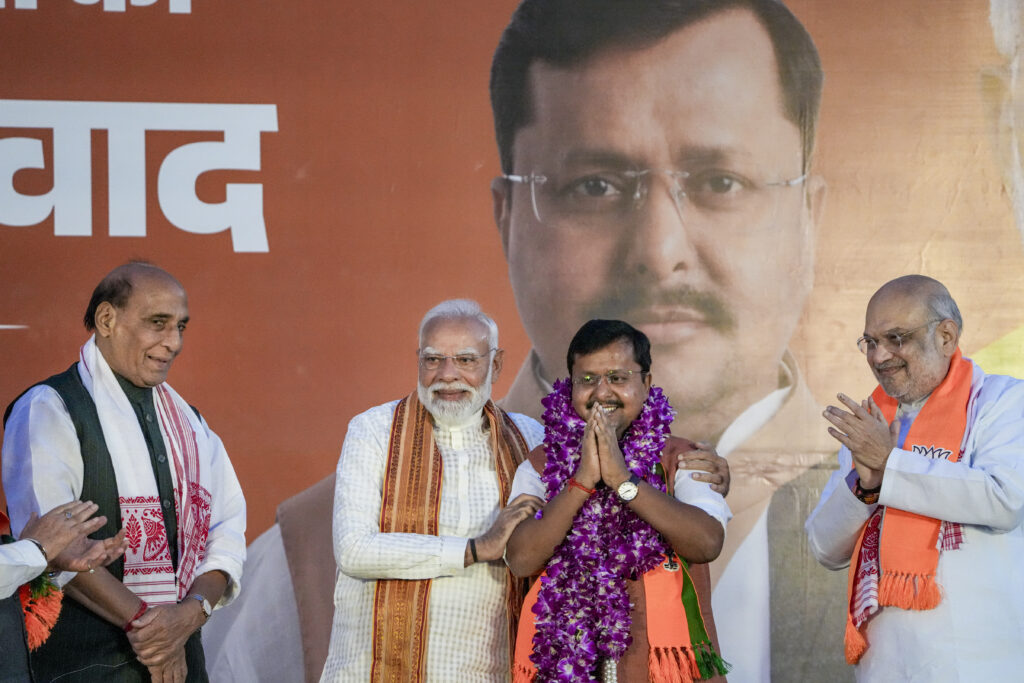

By mid-morning on Monday, the scenes outside BJP offices across India had already answered the question that Indian politics had been asking for decades. Workers were dancing in the streets. Sweets were being distributed with the abandon of people who had stopped daring to hope and suddenly found themselves proven wrong. From Delhi to Guwahati, from Lucknow to Chennai, the party’s offices had transformed into something between a celebration and a release. It was the collective exhale of an organisation that had tried, failed, regrouped and tried again in a state that seemed constitutionally resistant to them.
The polling numbers had already signalled that something extraordinary was unfolding. Voter turnout in West Bengal was historic, the kind of figure that experienced election-watchers treat not as a data point but as a weather system, carrying within it the energy of an electorate that had collectively decided this moment mattered. High turnout in Bengal has historically favoured whoever carried the momentum. This time, that momentum belonged to the BJP.
And then the results confirmed what the dancing had already assumed. The Bharatiya Janata Party had won 206 seats and was leading in one in West Bengal’s 294-member assembly, clearing the majority mark of 148 with authority rather than relief. Mamata Banerjee’s Trinamool Congress, which had governed this state without pause since dismantling the Left’s formidable machine in 2011, had won 81 seats.The BJP’s success in West Bengal and Assam is being linked to a steady consolidation of Hindu votes.
The celebrations outside those offices were not merely the ordinary noise of electoral success. They were the sound of something structural and permanent giving way. The result carries a weight of historical meaning that goes considerably beyond seat tallies and vote shares. The BJP traces its ideological roots in Bengal directly to Syama Prasad Mookerjee, the founder of the Bharatiya Jana Sangh in 1951, the party that formally reconstituted itself as the BJP in 1980. Mookerjee was not a peripheral figure in India’s post-independence story. He opposed with absolute conviction the permit system that required Indian citizens to seek official permission merely to enter Kashmir, a condition he regarded as an open wound inflicted on the very idea of national unity. He was detained for 45 days for defying Article 370 and died in custody in 1953, a death that shook the country and ultimately accelerated the dismantling of the permit system he had died protesting. That his party now governs the state he considered home adds a dimension to this result that no seat count can fully capture.
What makes Bengal’s political past so striking is the sheer durability of its governments before they collapsed. The Communist Party of India (Marxist) governed here for 34 unbroken years, the longest continuous run of elected left-wing government anywhere in the democratic world. When Mamata Banerjee finally dismantled that machine in 2011, she accomplished it not through counter-ideology but through sheer organisational persistence, a coalition assembled carefully from the poor, the marginalised and the quietly aspirant, and a personality that communicated genuine belonging rather than administrative remove.
Her government then reinforced that foundation with targeted welfare delivery. Lakshmir Bhandar placed monthly financial support directly into women’s households. Kanyashree and Rupashree addressed girls’ education and marriage costs in concrete and administered terms. These were not campaign commitments that evaporated after polling day. They were functioning benefits that reached real families, and they constructed a loyalty base that the BJP found effectively impenetrable as recently as 2021, when the party had genuinely expected to cross the finish line and did not.
Prime Minister Narendra Modi, speaking to supporters in the aftermath of the results, chose to interpret the outcome partly through the prism of the recently defeated women’s reservation bill — a constitutional amendment seeking to reserve one-third of legislative seats for women, which fell short of the required two-thirds majority in the Lok Sabha, receiving 298 votes against the 352 needed. Modi argued that the parties which blocked the amendment had now been held accountable by voters, particularly women. The argument is politically convenient and analytically questionable. Election results are almost never reducible to a single legislative episode, and attributing a multi-factor state-level swing to one parliamentary vote demands a considerable leap of faith. Nevertheless, the framing is revealing. It signals precisely how the BJP intends to consolidate this moment by drawing sharp moral distinctions that cast its opponents as enemies of women’s empowerment, irrespective of the actual parliamentary arithmetic.
The BJP had tried before. The BJP’s success in West Bengal and Assam is being linked to a steady consolidation of Hindu votes.thing it possessed. Its most compelling voices, its prime minister, its full organisational machinery. It won seats, generated noise and came up short. Bengal was the state that held. And then, on this particular Monday, with sweets being distributed outside offices across the country, it did not hold any longer.
What separated this campaign from its predecessors was not ambition, the party has never lacked that, but granular and almost uncomfortable specificity. The BJP’s Sankalp Patra, described by Home Minister Amit Shah as a blueprint for a golden Bengal, was unusually precise in ways that Indian election manifestos routinely are not.
Women voters, who constitute nearly half the electorate and had historically been Banerjee’s most reliable base, were promised a monthly allowance of three thousand rupees, reservation of 33 per cent in government employment, including police positions, and free travel across all public transport. Young people confronting unemployment were offered monthly stipends of three thousand rupees alongside fifteen thousand rupees toward competitive examination preparation, with age relaxation of up to five years extended to those caught in the state’s recruitment scandals affecting teaching and police appointments. State government employees frustrated by dearness allowance rates that lagged persistently behind central equivalents were promised parity and Seventh Pay Commission implementation within 45 days of a BJP government assuming office. Farmers were told the state would supplement the central PM-Kisan scheme by three thousand rupees annually, bringing the total to nine thousand rupees per family.
These figures were not invented to impress audiences in Delhi. They were calculated to move specific voters in specific constituencies across a state of extraordinary diversity, and the historic turnout figures suggest they did precisely that.
The party was equally careful to project seriousness beyond welfare commitments. The manifesto outlined a new AIIMS, an IIT, an IIM and fashion institutes for North Bengal. A modern cancer hospital. Four new townships. Deep-sea ports at Tajpur and Kulpi. A ten-year transformation plan for Kolkata aimed at making it globally competitive as a living city. A heritage tourism designation for Darjeeling. A spiritual circuit dedicated to Chaitanya Mahaprabhu. A cultural centre for Rabindranath Tagore. A Vande Mataram museum. Committees of retired Supreme Court judges to investigate past political violence and crimes against women, with the Sandeshkhali incidents specifically referenced as a flashpoint that had crystallised public anger toward the outgoing government.
Narendra Modi’s campaign carried matching precision. He spoke of the RG Kar Medical College rape and murder case, which had ignited sustained public protest and raised corrosive questions about the state’s law enforcement response, telling voters that people had not forgotten and that women deserved a government that treated their safety as governance rather than optics. He addressed silk farmers in Murshidabad whose livelihoods had withered under what he characterised as deliberate governmental neglect. He pushed for a Uniform Civil Code within six months of taking office, framing it as a move toward a single civic standard applied without distinction across communities and an end to what he called appeasement politics.
And then came the individual result that sharpened everything into focus.
Among the most striking moments of an already remarkable night was the defeat of Mamata Banerjee herself in Bhabanipur, the constituency she had long treated as personal and politically secure. It was Suvendu Adhikari, once among her most trusted lieutenants and the most consequential defection the TMC has suffered, who beat her there by a margin of fifteen thousand votes. That result does not merely represent a seat changing hands. Adhikari defeated the person who built the organisation he left, in the place she considered safest, by a distance that eliminates any argument about a narrow or accidental outcome. For Banerjee, it is not simply a political defeat. It is a reckoning of an unusually personal kind, delivered by someone who once sat at the same table.
The BJP pressed this argument across several years with considerable discipline, insisting that Bengal’s development was being sacrificed to political calculation and that the state’s people were paying a real economic price for the choices of their leadership. The historic turnout on polling day, and the results that followed it, suggest that argument finally found sufficient purchase among enough voters to shift the outcome decisively.
The election carried its shadows alongside its celebrations. Opposition parties alleged that the Election Commission of India had removed lakhs of names from electoral rolls across multiple states, including West Bengal, under criteria they described as arbitrary, grouped under the term logical discrepancy. They argued that the Special Intensive Revision exercise had generated exclusions too numerous and too rapid for courts to meaningfully reverse before polling day arrived. The BJP and Election Commission stronly rejected those allegations firmly.
The BJP now arrives at Nabanna, the state secretariat in Howrah, holding simultaneously the advantage it spent years arguing voters were being denied, which is alignment between state and Centre. The development that could not flow freely under a divided mandate can now flow, the party insisted throughout its campaign. That case was accepted at the ballot box, during an election in which turnout records suggest an electorate that took the choice unusually seriously. The obligation now is to make the argument demonstrably true in terms that ordinary Bengali households can weigh against their own lived experience.
The commitments are specific, written down and public. The Uniform Civil Code within six months. Dearness allowance parity within 45 days. Transparent government recruitment. Infrastructure that transforms rather than decorates. Structured support for farmers, women, young people and pensioners. These are not the vague aspirations that incoming governments traditionally shelter behind while finding their footing. They are timed, costed and on record.
Prime Minister Narendra Modi chose his words with deliberate care when he took to X after the results had settled. He titled his post with three words that carried the weight of an entire political journey. The Lotus Blooms in West Bengal. It was not the language of a party celebrating a routine electoral victory. It was the language of a movement that had waited decades for a single moment and had finally arrived at it.
In the post that followed those four words, Modi described the 2026 West Bengal Legislative Assembly election as one that would remain unforgettable in the country’s democratic memory. He attributed the outcome to what he called the power of the people and the BJP’s unwavering commitment to good governance, framing the result not as a party triumph but as a collective verdict delivered by ordinary Bengali men and women who had chosen change over continuity. He closed that opening thought with a gesture of humility that was notable coming from a leader whose party had just recorded one of its most consequential victories anywhere in India. He bowed, in his own words, to every person in West Bengal.
What followed was a promise rather than a proclamation. Modi acknowledged the scale and weight of the mandate the party had been given and spoke directly to the responsibility it carried with it. He said the BJP would do everything within its power to fulfil the dreams, hopes and aspirations of the people of the state, words that were public, recorded and now impossible to quietly set aside. He closed with a commitment that was notable for the breadth of its reach, pledging to build a government that ensures opportunities and dignity for people from every section of society, without exception and without distinction.

Salian’s family asks the CBI to summon the former NCB Zonal Director as a key…

What is it that stays with us after a cricket match is over? Sometimes,…
New Delhi, September 14 Improving political, diplomatic and military engagement between India and China…

Imagine this: It’s 12:01 am, you open Instagram and instead of reels, you get…