







 Manjari Verma
Delegation highlights dignity, inclusion and technology in vocational education
Chandigarh, September 9
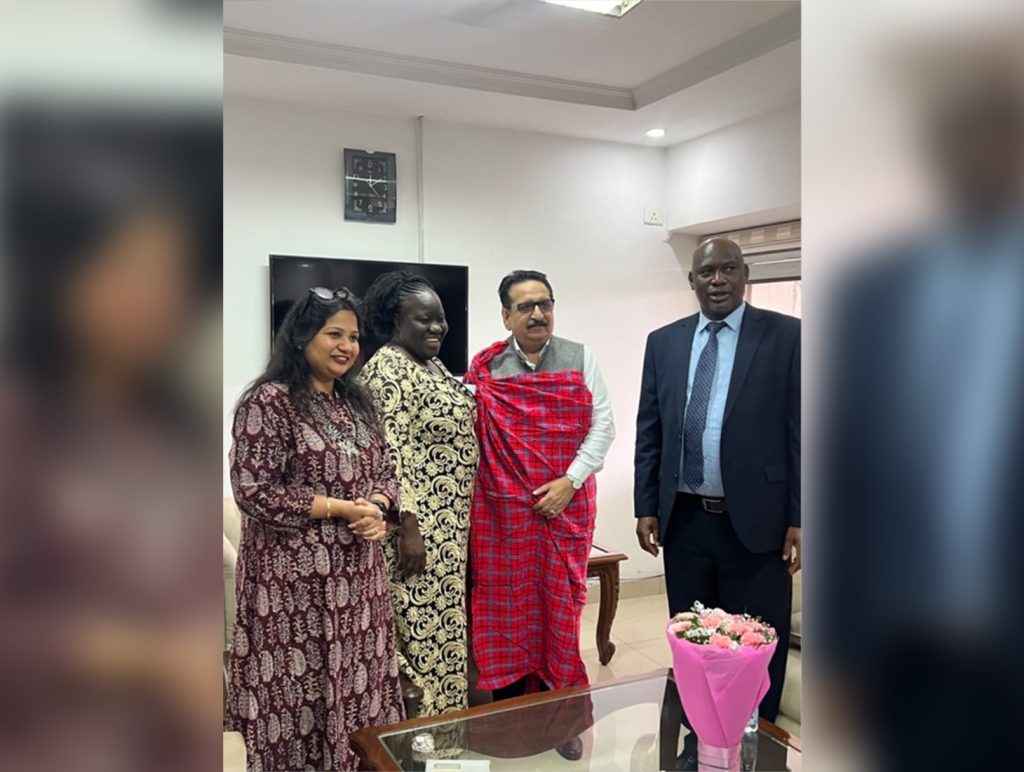
A high-level Kenyan delegation from the Technical and Vocational Education and Training Curriculum Development, Assessment and Certification Council (TVET CDACC) visited the Punjab State & Chandigarh (UT) Human Rights Commission (PSHRC) on Wednesday to explore India’s experience in linking human rights with education, youth skilling, technology, digital inclusion and capacity building.
The delegation was led by Professor Kisilu Kitainge, Chief Executive Officer, TVET CDACC, and included senior officials associated with research, assessment and certification, finance and planning. Disha Rana Jaswal, Director, Africa Projects, upGrad Education Private Limited also accompanied the delegation.
The interaction focused on strengthening vocational education through a human-rights-based approach, ensuring equal access to opportunities, promoting digital inclusion and exploring responsible applications of Artificial Intelligence (AI) in curriculum development, training, assessment and certification.
Addressing the delegation, Justice Sant Parkash, Chairperson, PSHRC, emphasised that education and skill development must be founded on equality, dignity and non-discrimination. He stressed that economic circumstances, disability or social disadvantage should not prevent young people from accessing education and opportunities.
Justice Sant Parkash also underlined the need to ensure that technological advancement does not create a new digital divide. He said disadvantaged young people without adequate access to technology and digital resources must not be left behind.
TVET gives people dignity, skills and a sense of belonging
Explaining the importance of TVET in Kenya, Professor Kisilu Kitainge said vocational education plays a critical role in giving young people who may have been excluded from mainstream education another opportunity to participate in the economy.
He said TVET provides practical skills that can enable people to secure employment or become self-employed, while also improving their self-esteem and sense of belonging.
TVET is a way of making everybody belong and feel appreciated
Professor Kisilu Kitainge said the impact of TVET can be seen in almost every aspect of daily life—from plumbing and furniture to clothing, food, vehicle repair and other essential services. Talking to The North News, he said, “Everything we have is TVET. Yet the people who facilitate them are sometimes ignored and marginalized.”
He said Kenya wants to use TVET to restore dignity and recognise the contribution of every skill, adding that “every skill counts”.
AI seen as a tool for inclusion and flexible learning
Professor Kitainge also highlighted the growing role of AI in transforming vocational education. He said AI could help break curriculum into manageable learning units and make education more flexible according to the learner’s time, availability and circumstances.
He said AI could also make assessment more flexible by allowing different tools to measure the same competencies, while accommodating learners with different needs.
According to him, technology could support accessibility through features such as larger fonts and other assistive tools, while digital certification could allow learners to access authentic certificates remotely.
He further highlighted the potential of simulation technology in skills training, particularly where institutions have limited resources. Simulated environments could allow learners to practise skills repeatedly without consuming large quantities of physical materials, thereby reducing training costs.
He said such technology could help bridge inequalities between well-resourced institutions and marginalised or remote training centres.
Kenya-India collaboration in skills development
Professor Kitainge said there were significant opportunities for Kenya and India to collaborate through joint training programmes, exchange of trainers, curriculum development and sharing of best practices.
He pointed to Kenya’s experience with Recognition of Prior Learning (RPL) as one area where the two countries could learn from each other.
He said trainers and institutions from Kenya and India could jointly develop programmes for the international market, with courses delivered either synchronously or asynchronously.
“We may collaborate to train each other. We may collaborate to develop training programs together that are offered for the world market.”
He said the experiences of both countries in reaching learners in remote and diverse communities could provide valuable lessons for future cooperation.
Disha Rana highlights success of blended learning model
Disha Rana Jaswal, Director, Africa Projects, upGrad Education Private Limited explained how the partnership with TVET CDACC developed during the COVID-19 pandemic.
She said the pandemic exposed the limitations of an entirely physical, classroom-based TVET system, as training in many institutions came to a complete halt when learners could no longer gather in classrooms.
According to Rana, the experience demonstrated the importance of technology-enabled blended learning in keeping education and assessment systems functioning during difficult circumstances.
The partnership subsequently led to research and the development of a formal blended learning model. Initially, 10 programmes were selected and digitised for adaptation to the model.
Rana said the pilot produced a 100 per cent result, and five TVET institutions have now been onboarded to implement and scale the model.
She said the approach could particularly benefit young people in rural areas, young mothers and learners facing financial constraints because it reduces the amount of time they need to spend physically at an institution.
“They can earn while they learn and put food on the table while they are also learning and gaining the formal certification.”
PSHRC stresses grassroots youth participation
Padma Shri Jitender Singh Shunty, Member, PSHRC, highlighted the importance of youth participation, grassroots human-rights awareness and education that develops empathy, social responsibility and ethical values in addition to technical qualifications.
Speaking about the Kenyan delegation’s visit, Shunty said the Commission’s initiatives in education, healthcare, child safety and other areas had generated interest among the visiting delegation.
He referred to PSHRC’s campaigns concerning school-bus safety, including CCTV cameras, security guards, secure doors and emergency exits, as well as its campaign against fake visas and fraudulent travel agents.
Shunty said the exchange should work both ways, with Kenya and India learning from each other’s successful initiatives.
“What is good in our country, they will learn, and what they are doing well, we will learn from them.”
He described the growing international engagement of the Commission as a positive development and welcomed the Kenyan delegation on behalf of PSHRC.
Focus on fairness, accountability and accessibility
Justice Gurbir Singh, Member, PSHRC, discussed the legal and institutional dimensions of human rights in education and employment, including the emerging challenges associated with AI and automated decision-making. The discussion emphasised human oversight, transparency, accountability and protection of privacy and individual rights while deploying new technologies.
The delegation also showed interest in PSHRC’s engagement with young people through training, internships and awareness programmes. The Commission explained that its work extends beyond individual complaints to research, training, human-rights education, awareness, outreach and engagement with educational institutions.
India-Kenya cooperation on future-ready TVET
The meeting explored possible areas of future cooperation, including human-rights education in TVET curricula, youth empowerment, research, capacity building, digital inclusion, AI and human rights, fair assessment and certification, and accessibility for persons with disabilities.
The discussions underscored a shared view that the future of vocational education must go beyond employability alone. Skills systems must also ensure equality, dignity, accessibility and meaningful participation in society.
The interaction concluded with both sides recognising the importance of developing future-ready, technology-enabled, inclusive and accessible education and skill-development systems firmly rooted in human dignity and equality.
New Delhi, September 7 Defence Acquisition Council (DAC), chaired by Defence Minister Rajnath Singh, on…

Sometimes, a journey begins without a plan. There is no itinerary, no destination marked on…
Chandigarh, September 4 Punjab Chief Minister Bhagwant Mann will take the final decision on a…

New Delhi, September 4 Prime Minister Narendra Modi on Friday hailed ISRO’s successful launch of…