








 Disney Brar
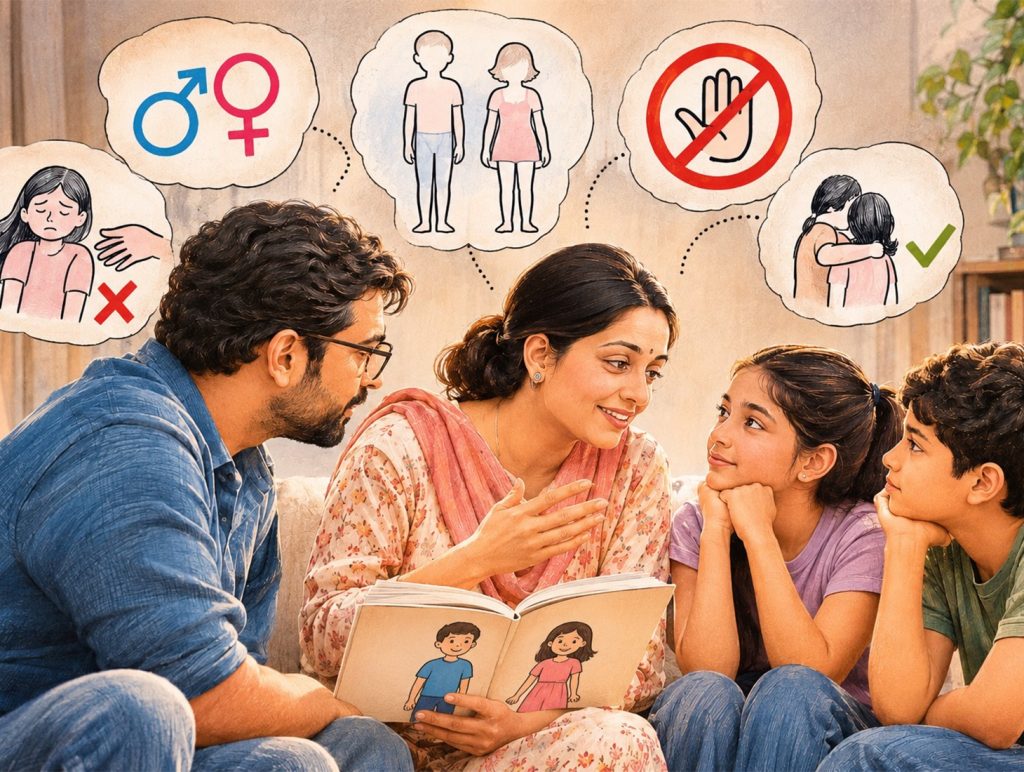
With 69,191 POCSO cases registered in 2024, over 2.45 lakh cases pending before fast-track courts at the end of 2025, and children increasingly exposed to an unfiltered digital world, India faces an urgent question: Is our silence leaving our children vulnerable?
We teach children to cross the road, recognise strangers, memorise emergency numbers and prepare for examinations. But how often do we teach them that their bodies belong to them? That they have the right to refuse an uncomfortable touch, that consent matters and that even someone they know and trust has no right to violate their boundaries?
In a country where conversations around sexuality remain wrapped in embarrassment, asking whether a child is sexually literate may sound provocative. Yet it is a question Indian parents, educators and policymakers can no longer afford to avoid.
The numbers make the urgency clear.
Little Minds, Big Questions: Why Sexual Education Matters
According to the National Crime Records Bureau’s Crime in India 2024 report, India registered 69,191 cases under the Protection of Children from Sexual Offences (POCSO) Act, involving 70,132 child victims. These accounted for approximately 36.9 per cent of the 1,87,702 registered cases of crime against children that year.
More disturbing is that in 96.6 per cent of cases involving penetrative and aggravated penetrative sexual assault under Sections 4 and 6 of POCSO, the accused was known to the child. The figure applies specifically to these categories of offences, not all POCSO cases. Known persons included friends, online acquaintances, neighbours, family friends and relatives.
These figures challenge a deeply rooted parental assumption: that danger necessarily comes from strangers. Familiarity, clearly, cannot be the only measure of safety.
The need to strengthen child protection has also received renewed attention at the national level. On November 4, 2026, the Union Cabinet approved the continuation of the Fast Track Special Courts scheme for another five years, from April 2026 to March 2031. The extended scheme provides for 850 courts across the country, including exclusive POCSO courts. At the time of the announcement, 779 courts were functional nationwide, of which 399 were exclusive POCSO courts. The initiative aims to expedite trials in rape and POCSO cases, reduce pendency and strengthen access to justice for survivors. However, alongside faster legal action, sustained awareness and age-appropriate education remain essential to preventing abuse and helping children recognise unsafe situations.
In Punjab, the conversation around child safety must move beyond laws, helplines and punitive action to include education about bodies, personal boundaries and consent. Official figures reveal the scale of the judicial challenge. Fast Track Special Courts in Punjab, which handle both rape and POCSO cases, registered 1,221 cases in 2024, disposed of 1,127 and had 1,561 cases pending at the end of the year.
As of April 30, 2026, Punjab had 12 functional Fast Track Special Courts, including three exclusive POCSO courts. While these courts play an important role in expediting justice, child protection must also focus on prevention through awareness and education.
Initiatives such as the Surakshit Bachpan Abhiyan, launched by the District Legal Services Authority in Jalandhar in October 2026, reflect the importance of taking child-safety education into classrooms. However, the larger challenge is to make these conversations continuous rather than occasional.
Children need to understand that their bodies belong to them, that they have the right to refuse unwanted touch, that uncomfortable secrets should be shared with a trusted adult, and that seeking help is never something to feel ashamed of.
For parents, educators and institutions, the message is clear: silence does not protect childhood. Age-appropriate education, open communication and accessible, child-friendly reporting mechanisms can help children recognise unsafe situations and develop the confidence to speak up.
Indian families often find it easier to discuss academic performance than bodily development. Puberty, menstruation, reproductive health and sexual curiosity are frequently postponed until a child is considered old enough.
But childhood has changed. Smartphones, social media, online gaming and unrestricted internet access expose children to inappropriate content, grooming attempts and online manipulation much earlier than many parents realise.
The internet is not waiting for parental permission to educate a child.
When children turn to unverified videos, anonymous online contacts or pornography for answers, they risk developing distorted ideas about bodies, intimacy and relationships. The answer is not to suppress curiosity but to provide age-appropriate, scientifically accurate information.
The challenge does not end with reporting abuse. Justice and institutional response remain equally important.
A July 2026 disclosure by the Union Ministry of Law and Justice revealed that 2,45,579 cases were pending before Fast Track Special Courts, including exclusive POCSO courts, as of December 31, 2025. These courts registered 1,43,936 cases and disposed of 66,500 during 2025.
As of April 30, 2026, 775 such courts, including 398 exclusive POCSO courts, were functional across 29 States and Union Territories.
These figures cover courts dealing with rape and POCSO cases together and should not be interpreted as POCSO-only statistics.
The pendency raises an important question: while India strengthens its legal machinery to respond to child sexual abuse, is it investing enough in preventing it?
A law can punish an offender and a court can deliver justice. But neither can replace the knowledge and confidence that may help a child recognise danger and seek help.
Online grooming, inappropriate messages, sexual harassment and the misuse of children’s photographs have added another dimension to child safety.
The POCSO Act recognises technology-facilitated forms of sexual harassment. Section 11 covers conduct such as repeatedly contacting a child through electronic means with sexual intent and showing pornographic material. Section 13 addresses the use of children in pornographic material through electronic and other media.
Artificial intelligence and deepfake technology have further complicated the picture. A child’s photograph can be manipulated and misused without their knowledge or consent.
Protecting children online, therefore, goes beyond restricting screen time. They must learn about digital boundaries, privacy, manipulation and the consequences of sharing intimate photographs.
Most importantly, parents must create an environment where children can disclose uncomfortable online interactions without immediately fearing punishment or losing access to their phones.
For years, child safety conversations have revolved around good touch and bad touch. While important, this framework alone is insufficient.
Children need to understand bodily autonomy, privacy and their right to refuse unwanted physical contact. They should know the correct names of body parts, understand private boundaries and recognise that nobody has the right to demand secrecy about an uncomfortable experience.
Consent begins with everyday interactions: respecting a child’s refusal to hug someone, accepting their discomfort and teaching them to respect the boundaries of others.
Sexuality education does not mean introducing adult concepts prematurely. For younger children, it means body safety, privacy and trusted relationships. For pre-teens, it includes puberty, menstruation and bodily changes. For adolescents, it expands to consent, healthy relationships, reproductive health and responsible digital behaviour.
The World Health Organisation’s March 2026 guidance on comprehensive sexuality education supports scientifically accurate, age-appropriate and progressive learning. Such education is not intended to encourage early sexual activity; evidence indicates that well-designed programmes can support informed decisions and reduce sexual risk-taking.
The responsibility cannot rest exclusively with parents or be outsourced entirely to schools.
India’s POCSO Act, 2012, protects every child below 18 years of age and mandates reporting of suspected or known offences. Section 19 requires any person, including a child, who knows of or apprehends an offence under the Act to report it to the Special Juvenile Police Unit or local police. The law also provides an exemption from punishment for children who fail to report.
But beyond legal obligations, schools must ensure that child protection education is meaningful rather than limited to occasional awareness sessions.
Are teachers trained to answer difficult questions? Do school counsellors have the resources to address concerns? Are parents involved in conversations about puberty and consent? Can children identify a trusted adult without fearing dismissal or humiliation?
These are questions that education authorities and institutions must confront.
Perhaps the biggest obstacle is not the absence of information but the discomfort of adults. Many parents grew up in households where sexuality was never discussed. They inherited silence and, often unknowingly, passed it on.
But children growing up in a hyperconnected world cannot be protected through silence.
Sexual literacy is not sexual permissiveness. It is about knowledge, dignity, safety and respect. Children must know that curiosity is natural, questions are welcome and abuse is never their fault.
We cannot place the entire responsibility for preventing abuse on children. Adults, institutions, digital platforms and law enforcement agencies have equally important roles. But we can give children the language and confidence to recognise inappropriate behaviour and seek help.
Perhaps the most important question parents should ask is not whether their child is too young to have this conversation.
It is whether they are too late in having it.
We are raising a generation that can navigate the digital world with remarkable ease. It is time we also raised one that understands its own body, respects boundaries and knows that its voice will be heard.
Because protecting childhood begins not with silence, but with a conversation.
Some flavours belong to the tongue. Others find a permanent home in the heart. Gold…
Seventy-six years ago, India gave itself a Constitution. Today, its greatest promise remains the dream…
The US has proposed additional tariffs of up to 25 percent on Indian goods, citing…

The Postgraduate Institute of Medical Education and Research (PGIMER), Chandigarh, will host the third edition…