







 Disney Brar
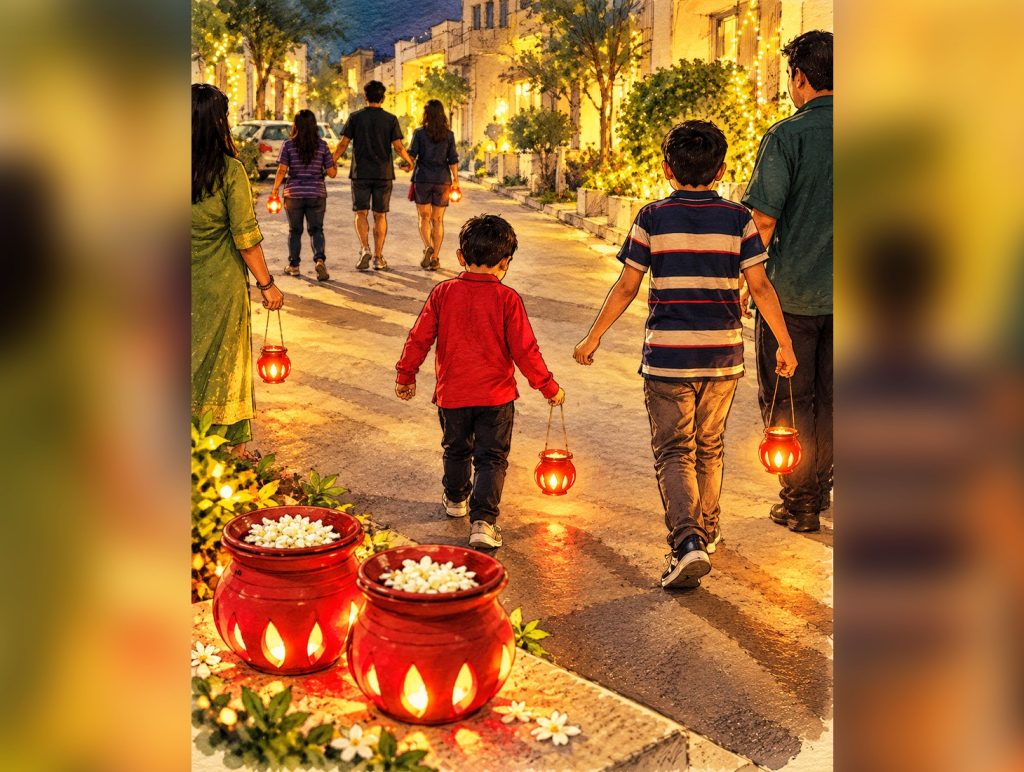
Chandigarh: Long before decorative lights transformed homes and markets into glittering displays during the festive season, the sight of children carrying small earthen lamps through neighbourhoods marked a special night in parts of Punjab and Haryana.
Known as Gadbade or Gadbadde, the folk tradition is associated with Sharad Purnima, the full moon night that falls in October or November. With a lit diya placed inside a specially crafted clay pot, children would step out into their neighbourhoods, singing traditional songs and visiting homes, where elders welcomed them with money, sweets or oil for their lamps.
For many, the festival was more than a ritual. It was an occasion that brought together children, families and neighbours, creating memories that have stayed with generations. One can safely call it our desi Halloween
The Gadbada, the earthen vessel at the heart of the celebration, is made from clay and designed with small openings that allow air to reach the diya placed inside. When lit, the lamp casts a warm glow through the openings, creating a distinctive visual effect.
The festival is particularly associated with the Puadh region, which includes parts of Punjab, Haryana and areas around Chandigarh. It has also been observed in villages and towns around Ropar, Ambala and other neighbouring regions, though customs vary from place to place.
On the night of Sharad Purnima, children would carry their Gadbade from one house to another, singing folk verses and asking for money or oil. Neighbours would offer coins, sweets and other small gifts, making the evening an eagerly awaited celebration.
The festival’s connection with Sharad Purnima also gives it spiritual significance. The full moon night is considered auspicious in Hindu tradition, and its moonlight is associated with purity and prosperity.
For children growing up in villages and smaller towns, Gadbade was often among the most exciting occasions of the festive season.
The excitement began well before the evening. Families would arrange the earthen pots, children would decorate them, and the diya would be prepared for the night. As dusk settled, groups of children would gather and begin their rounds of the neighbourhood.
The experience was not just about collecting money or sweets. It was about walking together, singing familiar songs, visiting relatives and neighbours, and being part of a shared community celebration.
In many ways, the festival reflected a simpler social life, where children could move freely through their neighbourhoods and where every household had a role in keeping the tradition alive.
Unlike festivals with elaborate written histories, Gadbade has largely survived through oral traditions and local customs. Its songs, practices and stories have been passed down within families, often through grandparents and parents who remember celebrating it during their own childhoods.
The tradition also reflects the close relationship between folk culture and everyday life in Punjab. Clay lamps, traditional songs, community participation and seasonal celebrations were once integral to the cultural calendar.
However, the festival is not celebrated uniformly across Punjab. While some families continue to observe it with enthusiasm, others may have heard of it only through stories told by older generations.
As villages have expanded into towns and cities, and lifestyles have changed, the tradition has gradually become less visible in many places.
Children today have different ways of celebrating the festive season, while urban neighbourhoods may no longer have the same close-knit community connections that once made such celebrations possible.
The disappearance of Gadbade from some neighbourhoods is also a reminder of how easily local traditions can fade when they are no longer practised or passed on.
Yet, the festival continues to survive in pockets of Punjab and Haryana, where families still remember the significance of the earthen lamp and the joy of children going from door to door.
In an age when festivals are increasingly marked by elaborate decorations, shopping and social media celebrations, Gadbade offers a glimpse into a different kind of festive experience.
Its charm lies in its simplicity — a clay pot, a small flame, a folk song and a community willing to participate.
The little lamps that carry Punjab’s forgotten folk tradition
Reviving the tradition does not necessarily require grand celebrations. Families can introduce children to the festival by decorating earthen lamps, sharing stories of how it was celebrated in earlier times and teaching them the traditional songs associated with it.
Schools and cultural organisations can also play a role by documenting folk traditions and organising activities that help younger generations understand their significance.
For a festival rooted in childhood memories and community participation, the most meaningful way to preserve it may simply be to celebrate it again.
As the full moon rises over Punjab during the festive season, the glow of a Gadbada serves as a reminder that some of the region’s richest cultural traditions are not found in grand celebrations, but in the small, shared moments that bring people together.
And perhaps, somewhere in a village or a neighbourhood, a group of children will still step out into the moonlit night, carrying their little lamps and keeping alive a tradition that deserves to shine.
By Manya Bhasin From catching a glimpse of the moon over FaceTime to having sargi…
Every talent deserves a chance to be seen and appreciated. Sometimes, all it needs is…
The Municipal Corporation has proposed a budget of over Rs 1.32 crore for the 55th…
A Pakistani Patton tank captured during the 1965 India-Pakistan war is displayed at the State…