







 Dr Kiran Deep


In politics, defeat is rarely just defeat. Sometimes, it is theatre. Sometimes, it is a strategy. And occasionally, it is both at once. The rejection of the women’s reservation bill, popularly framed as Nari Shakti Vandan Adhiniyam, falls squarely into that uneasy space. On paper, it is a legislative loss for the ruling NDA government led by Prime Minister Narendra Modi. But in the realm of political messaging, it may well prove to be something else entirely, a carefully leveraged setback.
The numbers were never ambiguous. The government lacked the two-thirds majority required to push through a constitutional amendment. With 298 MPs voting in favour and 230 against, the outcome was mathematically predictable. The 352-vote threshold was always out of reach without opposition support. The defeat of India’s long-debated women’s reservation bill in parliament marks a rare legislative setback for the government of Narendra Modi, but one that is already being recast as a political opportunity.
The proposed constitutional amendment, which sought to reserve 33 per cent of seats for women in legislatures beginning in 2029, fell short of the required two-thirds majority in the Lok Sabha. While 298 MPs backed the bill, 230 opposed it, well below the 352 votes needed for passage.
The arithmetic had long been clear. Despite holding 293 seats, the ruling National Democratic Alliance needed support from opposition parties to pass the amendment. That support never materialised.
Following the vote, Amit Shah adopted a markedly sharper line, directly accusing opposition parties of blocking women’s empowerment.
“Today, a very strange scene unfolded in the Lok Sabha,” he wrote, naming Congress, the Trinamool Congress, DMK and the Samajwadi Party. “Rejecting the bill that would grant 33% reservation to women, celebrating it, and raising victory cries over it is truly reprehensible and beyond imagination.”
He added, “Now, the women of the country will not get the 33% reservation in the Lok Sabha and state assemblies, which was their right. The Congress and its allies have done this not for the first time, but repeatedly. Their mindset is neither in the interest of women nor of the country.”
Shah also warned of electoral consequences. “I want to tell them that this insult to Nari Shakti will not stop here; it will travel far and wide. The opposition will have to face the ‘wrath of women’ not only in the 2029 Lok Sabha elections, but at every level, in every election, and at every place.”
Yet the political significance of the bill lies less in its defeat than in how it is likely to be deployed.
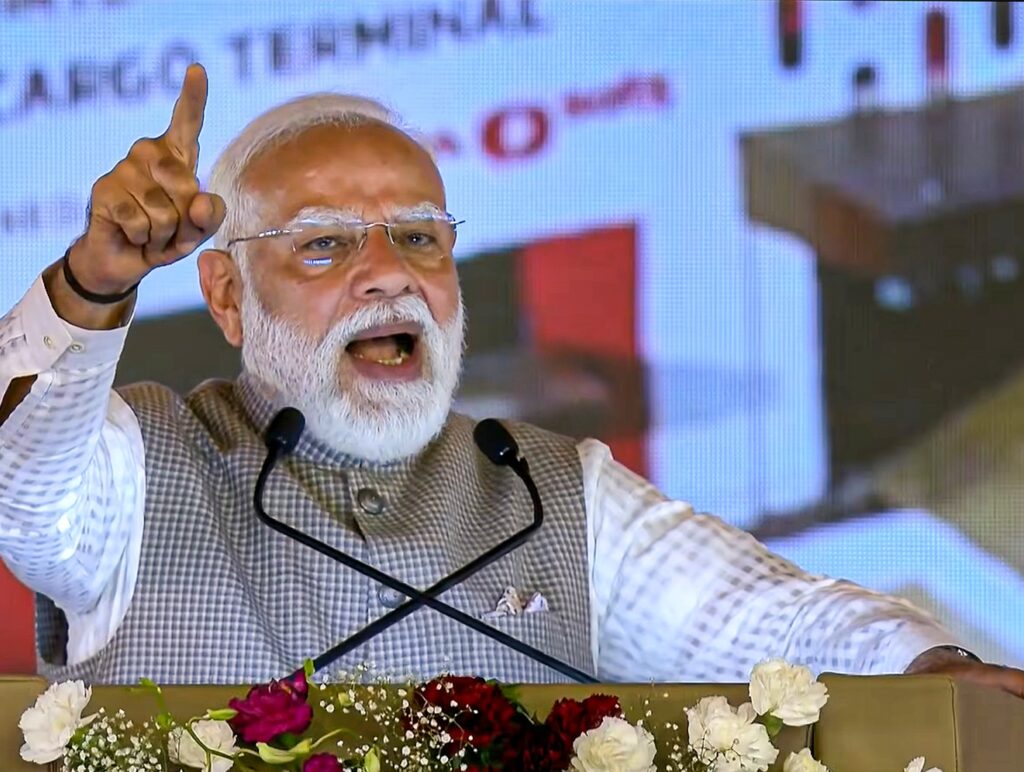
In the run-up to the vote, Narendra Modi framed the legislation as both a democratic necessity and a moral test. “I would say to all the Members of Parliament… Keeping in mind the memory of your mother, sister, daughter, wife in your home, listen to your conscience,” he said in a public appeal. “This is a great opportunity to serve the women power of the country, to honour them.”
He went further, urging lawmakers not to “deprive them of new opportunities”, adding that the amendment would strengthen both women and Indian democracy. “Come… let us together create history today. Give the women of India… the country’s half population their rightful due.”
The tone reflected a broader attempt to elevate the bill beyond partisan politics, though that effort ultimately failed to bridge divisions.
During the parliamentary debate, Amit Shah sought to persuade opponents by offering an amendment that would increase Lok Sabha seats by 50 per cent across states and union territories, a move tied to the broader delimitation exercise underpinning the bill. “The women’s reservation amendment bill will fall flat if the opposition does not vote in its favour. But women of the country are watching who the obstacle is,” he said.
Home Minister further argued that resistance to delimitation effectively meant opposing an increase in seats for historically marginalised groups. “In a way, those opposing delimitation are also opposing the increase in SC and ST seats,” he said, while also highlighting disparities in voter representation across constituencies.
The opposition, however, rejected the government’s framing.
Rahul Gandhi described the bill as a political manoeuvre rather than a genuine attempt at reform. “This is not a Women’s Reservation Bill and it has nothing to do with women,” he told the Lok Sabha. “This is an attempt to change the country’s electoral map, using and hiding behind India’s women.”
He went further, calling it “anti-OBC, anti-SC-ST” and “against the South, North-East, North-West, and small states”, arguing that it risked deepening regional and social imbalances. “We will neither let anyone’s rights be snatched away, nor let the country be divided,” he said.
At the heart of the dispute lies the bill’s linkage to delimitation, a politically sensitive redrawing of constituencies based on updated population data. The proposed legislation would have expanded Lok Sabha seats from 543 to 816 to accommodate the quota, a structural shift with far-reaching implications for federal balance.
For the government, these changes were presented as necessary to operationalise women’s representation. For critics, they introduced uncertainty and raised concerns about timing and intent.
The immediate legislative fallout was swift. Parliamentary Affairs Minister Kiren Rijiju confirmed that two related bills on delimitation and amendments to union territory laws would not be pursued following the defeat, underscoring how tightly the measures were linked.
“This was a historic opportunity,” he said, adding that the government’s effort to secure women’s representation would continue. “We will not take rest till we ensure that the country’s women get reservation in the legislatures.”
In procedural terms, the episode marks the first time a bill under Modi’s government has been defeated in parliament. Politically, however, it may prove less damaging than it appears.
The BJP is likely to frame the outcome as evidence of its commitment to women’s empowerment, contrasted with what it will portray as opposition obstruction. With key state elections ahead, that narrative could carry electoral weight, particularly among female voters.
For the opposition, the challenge will be to shift the debate back to the substance of the bill and to persuade voters that its objections were rooted in principle rather than politics.
For now, the legislation has failed. But the contest over its meaning and its political afterlife has only just begun.

Salian’s family asks the CBI to summon the former NCB Zonal Director as a key…

What is it that stays with us after a cricket match is over? Sometimes,…

New Delhi, September 14 Improving political, diplomatic and military engagement between India and China…

Imagine this: It’s 12:01 am, you open Instagram and instead of reels, you get…