







 Jasriman Kaur
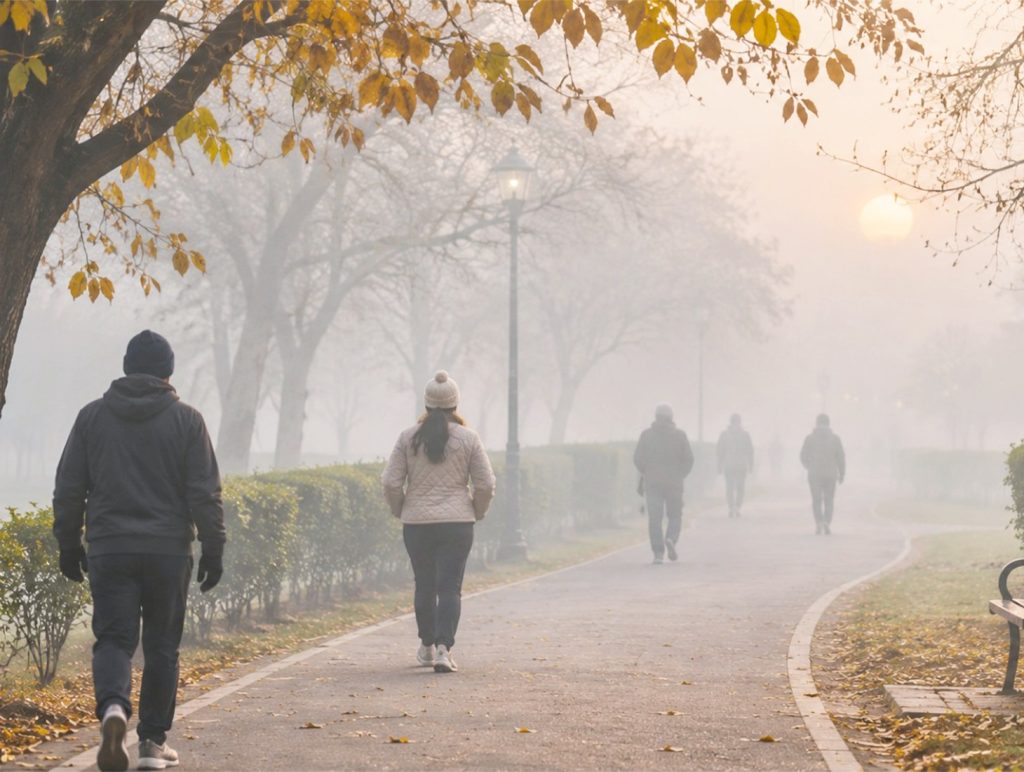
It is a familiar winter scene. The alarm rings, the shoes come out, a jacket is pulled on and the neighbourhood walking track begins to fill up. For many residents across Punjab and Chandigarh, a brisk morning walk is practically a ritual. But this winter, before congratulating yourself for getting out of bed early, there is one small detail worth checking: The air you are about to breathe.
Because while walking is good for the heart, lungs and overall fitness, doing it in heavily polluted air may defeat the purpose. And no, adding an extra round to your usual park circuit will not make up for breathing in a cloud of pollutants.
Farm fires, vehicular emissions, industrial activity and road dust continue to affect air quality across the region. The problem becomes particularly relevant in Punjab during the paddy harvesting season, when crop residue burning adds to the pollution burden.
According to the Commission for Air Quality Management (CAQM), Sangrur recorded 741 farm-fire incidents between September 15 and November 16, 2026, against 694 during the corresponding period last year. The district reported 52 incidents on November 16 alone.
Winter weather can make matters worse. Under unfavourable atmospheric conditions, pollutants may remain trapped close to the ground instead of dispersing, increasing the amount people breathe in during outdoor activities.
Your fitness routine needs an AQI check
Here is the catch! When you walk briskly, jog or climb uphill, your breathing becomes faster and deeper. This means you may inhale more polluted air than you would while sitting indoors or walking at a relaxed pace.
Fine particulate matter, particularly PM2.5, is a concern because these tiny particles can travel deep into the lungs. Exposure can aggravate respiratory and cardiovascular problems, especially among people who already have underlying conditions.
“An early morning walk is not always healthy during winter. High pollution levels can make brisk walking or jogging harmful, so check the AQI and switch to indoor exercise when air quality deteriorates,” said a senior physician, speaking on the condition of anonymity.
The National Centre for Disease Control (NCDC), under the Union Health Ministry, lists symptoms such as coughing, wheezing, throat irritation and breathing difficulty among the health effects associated with air pollution.
Children, senior citizens, pregnant women and people with asthma, chronic obstructive pulmonary disease (COPD) or existing heart conditions need to be particularly careful. For them, a routine walk should not become a test of endurance against polluted air.
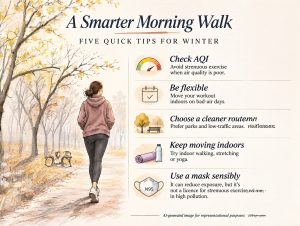
Five small changes for a smarter morning walk
First, make checking the Air Quality Index (AQI) as routine as checking the weather. The NCDC advises avoiding prolonged or strenuous outdoor exercise when the AQI is in the poor category (201-300). When it reaches the very poor category (301-400), outdoor physical activity should be avoided, particularly during morning and late evening hours.
Second, be flexible about timing. If the air quality is poor in the morning, consider exercising indoors rather than heading out simply because it is your usual walking hour.
Third, choose your route wisely. Parks and walking tracks away from busy roads, construction sites and industrial areas may offer a better setting. However, remember that a green park cannot magically cancel out poor air quality across the city.
Fourth, keep moving indoors. Walking around the house, stretching, yoga or a simple indoor workout can help maintain your routine when outdoor conditions are unfavourable.
And fifth, do not treat a mask as a licence to exercise in polluted air. A well-fitted N95 respirator can reduce exposure to particulate matter when outdoor travel is unavoidable, but it is not a substitute for avoiding strenuous activity during periods of high pollution.
Walk smart, not just early
The idea is not to give up morning walks or turn every winter outing into a weather investigation. It is to recognise that a healthy routine also needs a little flexibility.
So, before reaching for your walking shoes, take a moment to check the AQI. If the numbers are unfavourable, swap the park for an indoor workout and save the outdoor rounds for a better-air day.
After all, the goal is to return from your morning walk feeling refreshed, not wondering what exactly you have been breathing in.

Resident doctors from the Department of Community Medicine and School of Public Health at PGIMER,…

A mega health camp organised by the Gastroenterology Liver Forum in Chandigarh on Saturday brought…

In a significant achievement for the Postgraduate Institute of Medical Education and Research (PGIMER), Chandigarh,…

The Postgraduate Institute of Medical Education and Research (PGIMER), Chandigarh, has piloted AyushSaathi, a WhatsApp-based…