







 The North News
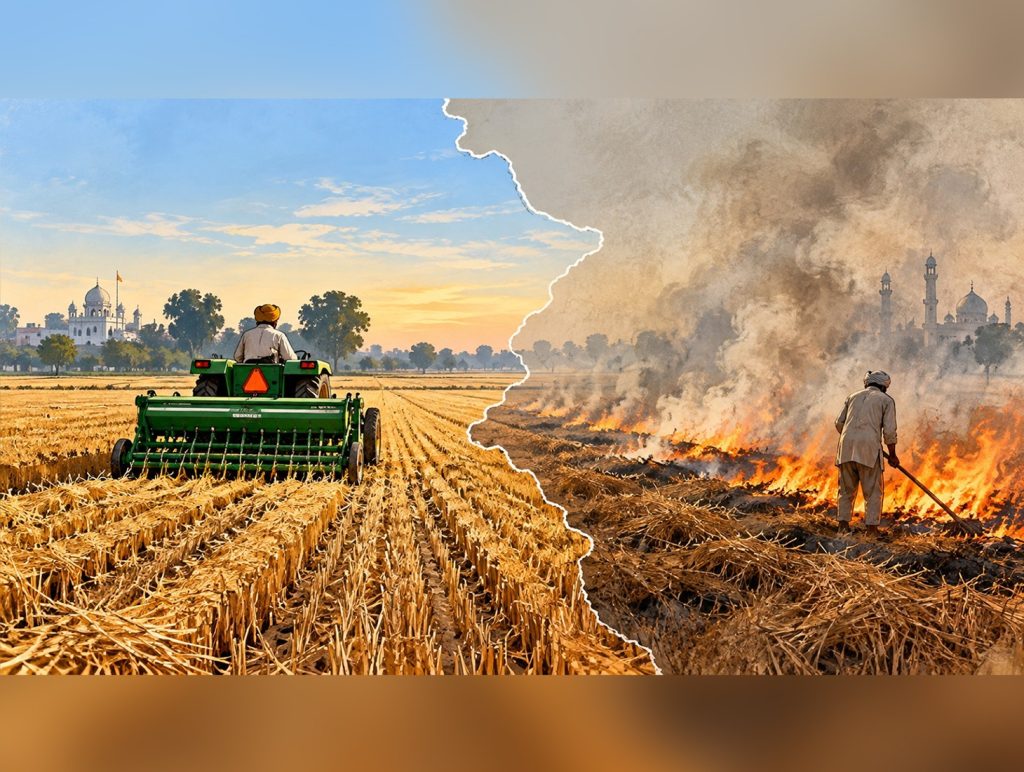
Every autumn, the paddy harvest leaves farmers across Indian and Pakistani Punjab with a narrow window of two to three weeks to clear fields and prepare for wheat sowing. With time running short, burning crop residue remains a quick way to clear land. Yet satellite data reveal a striking difference in fire detection trends on the two sides of the border, raising questions about what has worked in Indian Punjab and what lessons may be relevant for its neighbour.
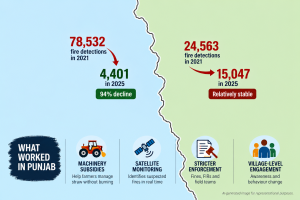
An analysis of active-fire data from NASA’s Fire Information for Resource Management System (FIRMS), using the Visible Infrared Imaging Radiometer Suite (VIIRS), found that fire detections in Indian Punjab fell from 78,532 in 2021 to 4,401 in 2025, a decline of about 94 per cent. In Pakistani Punjab, detections fell from 24,563 to 15,047 over the same period, following a comparatively stable trend after 2021.
These figures represent satellite fire detections, not verified stubble-burning incidents. They indicate the scale and direction of observed fire activity but cannot, on their own, establish the cause of the decline or confirm that every detected fire was linked to crop-residue burning.
Machinery, monitoring and enforcement
India’s Crop Residue Management scheme, introduced in 2018-19, has been a key part of efforts to reduce stubble burning. It provides eligible individual farmers with a 50 per cent subsidy on machinery, while eligible custom hiring centres can receive assistance of up to 80 per cent. These centres allow farmers to rent equipment instead of bearing the full cost of purchasing it.
Punjab received more than Rs 1,387 crore under the scheme between 2018 and 2022, followed by another Rs 500 crore in 2025. Equipment supported through these efforts includes Super Seeders, Happy Seeders, balers and straw rakes, which help manage crop residue without burning it.
Alongside machinery support, authorities have stepped up monitoring through satellite-based fire alerts, flying squads, nodal officers and the Parali Protection Force. Environmental compensation and restrictions have also formed part of the enforcement approach.
The decline in fire detections has occurred even as the area under paddy cultivation in Indian Punjab has remained broadly stable. This suggests that reduced fire activity cannot simply be explained by a substantial shift away from rice cultivation. However, the satellite figures alone cannot determine how much of the change resulted from machinery access, enforcement, weather conditions or other factors.
Behaviour matters as much as machinery
For Dhananjay Kumar, campaign manager at Manav Vikas Sansthan (MVS), reducing crop-residue burning requires more than providing equipment or imposing penalties.
“It’s a behavioral issue,” he says.
MVS has worked with farming communities through demonstrations and pre-harvest field days, helping farmers understand how residue-management machinery can be used in their fields. Its approach also involves Gurudwara committees, Kisan Mitra, village meetings, women and schools to build awareness and encourage local participation.
The challenge does not end with a successful demonstration. Farmers may need continued guidance and practical support before adopting unfamiliar methods across their fields. Access to machinery at the right time, its affordability and confidence in the results all influence whether alternatives to burning are used consistently.
Crop diversification presents another challenge. Moving away from paddy can be difficult when alternative crops offer uncertain prices or limited market access. Meanwhile, residue-management systems need reliable buyers and uses for straw to make non-burning practices economically viable.
These constraints matter on both sides of the border, although the scale of support, agricultural conditions and enforcement arrangements may differ.
Lessons across the border
The comparison does not establish that one policy or intervention alone produced Indian Punjab’s decline. Nor should the figures be read as a verdict on farmers in either region. The two Punjabs have different institutional and economic circumstances, and the satellite data do not capture every factor behind farmers’ decisions.
Nevertheless, the experience of Indian Punjab offers areas for further examination in Pakistan. These include improving access to residue-management machinery through subsidies and hiring centres, strengthening monitoring, and investing in village-level engagement that makes alternatives practical for farmers.
There may also be scope for cooperation through comparable fire-monitoring methods, exchanges between agricultural researchers and the development of markets for crop residue. Better-aligned data would help researchers distinguish changes in fire activity from changes in the way fires are detected and reported.
The central lesson is that reducing stubble burning requires a combination of accessible technology, credible enforcement and sustained community participation. Machinery can offer an alternative, but farmers need the means and incentives to use it. Enforcement can discourage burning, but lasting change also depends on viable options for clearing fields and managing straw.
The smoke has never respected the line between the two Punjabs. Efforts to reduce it should not be limited by that line either.
(The report has been contributed to The North News by Siddhima Sirohi, Manav Vikas Sansthan)

The Ministry of Information and Broadcasting has asked private satellite TV channels to strengthen editorial…
The Punjab Legislative Assembly has unanimously passed a resolution calling for safeguards to protect eligible…
A delegation from Nangal By Cycle (NBC) Trust met Bhakra Beas Management Board (BBMB) Chairman…

The controversy surrounding the alleged humiliation of Punjabi singer Daler Mehndi at a cultural event…