







 Disney Brar

As the year bends towards October and the air begins to acquire a faint nip, an intoxicating, vanilla-like fragrance assails the senses. There is something almost otherworldly about it, a heady sweetness laced with a hint of spice, reminiscent of cardamom. The scent drifts through the neighbourhood long before one thinks to look up and identify its source.
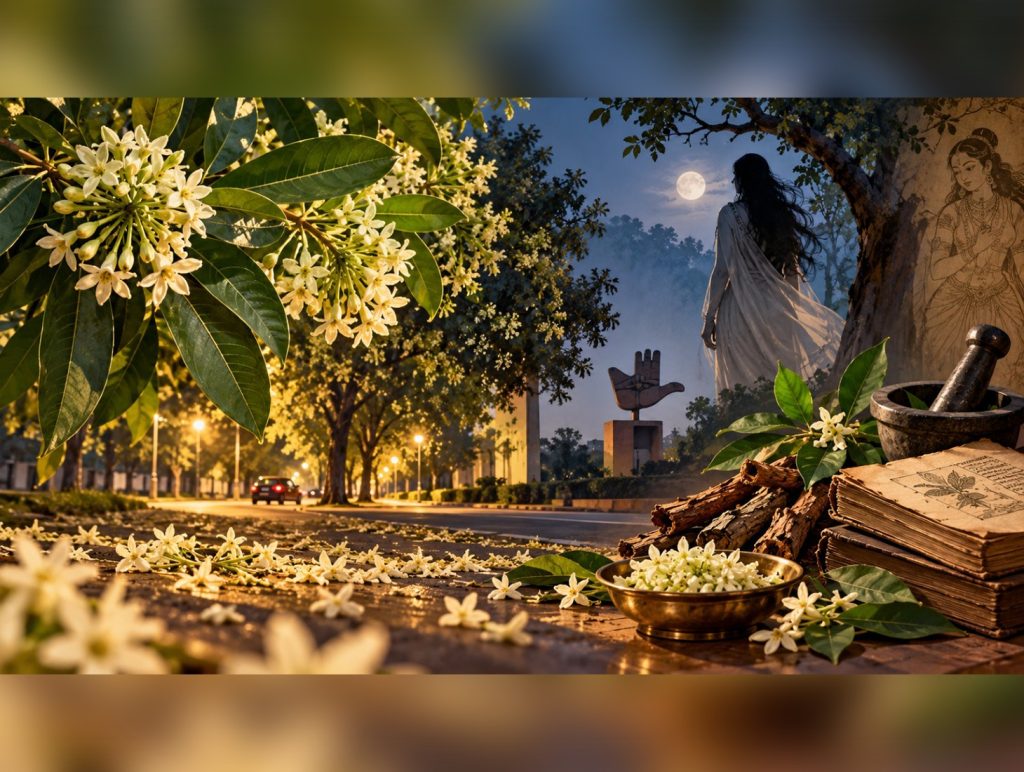
Just yesterday, during my night walk, I came upon a carpet of minuscule Saptaparni flowers strewn carelessly across the asphalt. Their delicate, greenish-white blooms had fallen silently from the branches above, leaving behind a fragrant trail that seemed to transform an ordinary stretch of road into something magical.
Saptaparni, a name that translates to seven leaves — sapta meaning seven and parni referring to leaves — is recognised by its distinctive whorls of leaves and clusters of small, pale flowers. Botanically known as Alstonia scholaris, the evergreen tree typically blooms during the cooler months, from around October to December in many parts of India. Also known as the ‘Indian Devil Tree’ and the ‘Blackboard Tree’, it has an unmistakable presence, particularly after dusk, when its flowers release their powerful perfume into the night air.
Some call them Halloween flowers, their appearance coinciding with the weeks around Halloween and extending well beyond it. Yet, for those who live among these trees, their fragrance is more than a seasonal curiosity. It is an announcement — of changing skies, lengthening nights and the approaching winter.
In Chandigarh, Saptaparni is a familiar feature of the urban landscape. Its foliage and seasonal blooms lend character to the city’s avenues, roadsides, institutional campuses, public greens and concrete plazas. The trees can be found in the Chandigarh Botanical Garden at Sarangpur, including its medicinal and herbal plant collections, as well as around Sector 17’s City Plaza, the Post Graduate Government College for Girls (GCG) in Sector 11 and several other sectors and road dividers.
There is something particularly enchanting about encountering these trees in a planned city of straight roads and geometric lines. Their branches offer shade by day, but it is after sunset that they reveal another personality: an invisible perfume that travels through the air, stirring memories, folklore and the imagination.
There are flowers whose beauty invites admiration, and then there are those whose fragrance seems to possess a life of its own. The Saptaparni belongs to the latter category.
Its yellowish-white flower clusters, with their almost overwhelming sweetness, have long been associated with supernatural lore. In Kerala, popular folklore links the tree to the Yakshi, a female spirit believed to inhabit certain trees and secluded natural spaces. The Yakshi occupies an intriguing place in the region’s cultural imagination — a being capable of appearing as a beautiful, alluring woman, yet concealing a darker, more dangerous nature.
The Saptaparni, in these tales, becomes more than a tree. It becomes a threshold between the familiar and the mysterious, the visible and the unseen.
One oft-repeated story tells of a Brahmin travelling through a dense forest of Saptaparni trees. As the sun begins to set, he encounters a beautiful woman dressed in a white sari. She asks him to accompany her home, explaining that it is growing late. He agrees, and by the time they arrive, night has fallen.
The woman offers him shelter. As the hours pass, her beauty and charm ensnare him, and he becomes hopelessly enamoured. In the darker versions of the tale, his obsession gradually consumes him; he loses his health and eventually dies, undone by his own desire.
Another strand of folklore imagines the Yakshi making her home in the Saptaparni tree. Elders, according to the telling, might interpret a man’s inexplicable decline in health as evidence of an encounter with one of these spirits.
Such stories are best understood as folklore rather than fact, but they reveal how deeply the tree’s powerful fragrance has entered the cultural imagination. There is an almost instinctive association between its heady perfume and seduction — between a scent that overwhelms the senses and a presence that appears impossible to resist.
The literary imagination, too, has found something compelling in the scent of the natural world. Kalidasa’s Raghuvamsa evokes the pungent odour associated with a wild elephant in rut, an image of instinct, desire and untamed power. The comparison resonates with Saptaparni’s intoxicating fragrance, though the precise botanical association should not be mistaken for a scientific explanation of the tree’s scent.
Long before the name became familiar to urban gardeners, the tree belonged to a world in which plants were not merely identified by their leaves and flowers but were woven into stories, beliefs and inherited knowledge. In the sixteenth century, Bhavamishra’s Ayurvedic compendium, Bhavaprakasha, recorded the tree under the name Saptaparni, reflecting its place in traditional botanical and medicinal literature.
If folklore casts Saptaparni as a temptress, traditional medicine gives it an altogether different identity: that of a healer.
Across generations, different parts of the tree — including its bark, leaves and other plant material — have found a place in traditional medicinal practices. In Ayurveda, Saptaparni has been valued for its bitter properties and has been associated with remedies for a range of ailments. Its bark, in particular, has a history of use in traditional preparations.
In parts of southern India, oral traditions describe rituals connected with the collection of the tree’s bark during the monsoon season. In one such account, the head of a household approaches the tree at daybreak and seeks permission before removing a small piece of bark. The bark is then used by the women of the household to prepare a concoction, which family members consume as protection against malaria.
The ritual is a reminder of the intimate relationship between communities and the natural world, when trees were regarded not simply as resources but as living presences deserving of respect. The act of seeking permission before gathering bark speaks of a belief in reciprocity: nature gives, but it must also be approached with care.
Such practices, however, belong to the realm of traditional knowledge and should not be confused with established medical treatment. Although Alstonia scholaris has been studied for its chemical constituents and potential medicinal properties, traditional preparations are not proven substitutes for modern medical care, particularly for serious illnesses such as malaria.
The tree’s medicinal legacy nevertheless remains an important part of its story. It reminds us that the natural world has long served as a repository of knowledge, observation and experimentation, even as modern science continues to examine which traditional uses stand up to rigorous evidence.
There is another, gentler identity attached to the Saptaparni — that of the Blackboard Tree.
Its wood has traditionally been used for making blackboards, slates and other lightweight wooden articles. The botanical name scholaris itself evokes its association with learning and scholarship, lending the tree an almost academic distinction.
But its connection with education reaches beyond its timber.
At Santiniketan, Rabindranath Tagore envisioned learning as something that should unfold in intimate communion with nature. Under the open skies and among the trees of the institution that eventually became Visva-Bharati University, education was imagined as a living experience rather than something confined to classroom walls.
The Saptaparni, known in Bengal as Chatim, acquired a special place in this tradition. Its leaves became associated with the university’s convocation ceremonies, where they were presented to graduates as symbols of learning and accomplishment. The practice, linked to Tagore’s educational philosophy, gave the humble leaf a significance far removed from its botanical identity.
For generations of students, the Chatim leaf has represented the completion of one journey and the beginning of another. It is a small, understated emblem of knowledge — a reminder that education, like a tree, grows quietly, sending roots into the earth even as its branches reach towards the sky.
There is also a poignant association between Tagore and the Chatim flower. Accounts of his attachment to the plant have included the claim that he wished to have it near him towards the end of his life. Whether encountered as a flower, a leaf or a memory of Santiniketan, the Chatim remains inseparable from the poet’s vision of a life lived close to nature.
It is fitting that a tree whose name is linked to scholarship should also have become a symbol of humility, contemplation and the pursuit of knowledge.
In Punjab, the Saptaparni’s arrival is written into the air.
There is no dramatic announcement, no sudden change of colour across the landscape. Instead, the season announces itself through fragrance. A familiar road acquires a new identity; an evening walk becomes an encounter with something unexpectedly beautiful. The flowers fall almost unnoticed, their pale clusters gathering at the feet of passers-by, while their perfume lingers long after the branches have disappeared into the darkness.
The air grows languid, carrying the last traces of autumn’s warmth. The light turns dappled, the evenings grow longer, and the first hints of winter begin to settle over the city. Somewhere above the streetlights, the Saptaparni continues to bloom, releasing its heady scent into the night.
Perhaps that is the tree’s greatest enchantment. It asks for neither attention nor admiration. It simply perfumes the world, quietly and generously, leaving us to discover it for ourselves.
And so, each October, as Punjab prepares to welcome winter, the Saptaparni returns like an old, half-forgotten memory. Its fragrance drifts through the streets, at once earthly and ethereal, conjuring tales of spirits, traditions of healing and the quiet wisdom of trees.
Long after the flowers have fallen, their scent seems to linger in the imagination — a reminder that some of nature’s most extraordinary gifts are invisible, recognised not by sight but by the way they make us pause, breathe deeply and feel, for a fleeting moment, that the ordinary world is touched by magic.

A Pakistani Patton tank captured during the 1965 India-Pakistan war is displayed at the State…

Her latest novel examines the complexities of loyalty, conflict and identity against the backdrop of…

Uttarakhand Minister Subodh Uniyal halts singer’s performance at Kunjapuri Mela; viral video captures onstage confrontation…

From 20-ft effigy in 1985 to towering Dussehra creations, Tejinder Chauhan’s four-decade journey blends craftsmanship…