





 Dr Kiran Deep


It was 2004 when I first travelled across Haryana to cover the Lok Sabha elections in Sonepat and Panipat districts. Journalism then belonged to a slower, rougher India. Internet speeds crawled. Filing a report from the field was often an act of patience mixed with desperation. Reporters waited endlessly for emails to send, sometimes silently praying that a story would finally land in the newsroom inbox before deadline. Taking 30 minutes or even an hour to transmit a single copy was routine.
The era of smartphones, instant uploads and live television dispatches still felt distant. For reporters travelling through small towns and dusty highways, cyber cafés were lifelines. I still remember one particular political rally where the Bharatiya Janata Party hinted that its alliance with the Indian National Lok Dal was nearing collapse. The rally ended late in the evening. Darkness had fallen, transport was uncertain, and the nearest cyber café became my only hope of filing the story in time. That cramped room full of flickering monitors and unstable internet connections became, for a few hours, the centre of Indian political reporting.
Back then, few would have imagined how dramatically Indian politics would change over the next two decades.
The BJP was still a party trying to expand beyond its traditional geography. In states like Haryana, it relied heavily on regional alliances to remain politically relevant. Its relationship with the INLD reflected a broader strategy that the party used across India. It first entered states through partnerships and then gradually built an independent political structure strong enough to govern alone.
Today, that strategy appears almost textbook in its execution.
The swearing in of Suvendu Adhikari as the Chief Minister of West Bengal marks more than just an electoral victory. It represents the culmination of a political project that the BJP has pursued relentlessly since Narendra Modi first became prime minister in 2014. For the BJP, Bengal was not merely another election. It was symbolic terrain. A state once considered politically impenetrable for the saffron party has now delivered it a historic mandate.
The ceremony itself reflected the scale of the moment. Modi attended alongside senior Union ministers, chief ministers from NDA ruled states and the BJP’s top leadership. The optics mattered. The BJP wanted the country to see Bengal not as an isolated victory, but as part of a larger national transformation.
The roots of that transformation can be traced back to the BJP’s victories in Haryana and Maharashtra in 2014. Those elections altered the political confidence of the party. Haryana, in particular, became a turning point. For the first time, the BJP formed a government in the state on its own and appointed Manohar Lal Khattar as chief minister. The victory was not accidental. It reflected a carefully designed social and electoral engineering strategy that consolidated non Jat voters and redrew the state’s traditional caste equations.
From there, the BJP’s map expanded steadily through Assam, Arunachal Pradesh, Manipur, Tripura, Bihar, Odisha and now West Bengal. Each state required a different political formula, but the broader template remained remarkably consistent with strong leadership projection, welfare driven messaging, nationalism, disciplined cadre mobilisation and relentless booth level organisation.
Critics often underestimate how deeply structured the BJP’s election machinery has become. Elections are no longer fought only through speeches and rallies. They are fought through data, neighbourhood networks, local influencers, ideological messaging and constant voter engagement. Politics has become hyper local. The BJP understood this earlier and more effectively than most rivals.
In many ways, the party operates with the precision of a corporate campaign while simultaneously maintaining the emotional appeal of a mass movement.
That combination has proved difficult for opposition parties to counter.
In Bengal and Assam, the BJP focused heavily on consolidating Hindu voters while also amplifying welfare schemes introduced by both the Centre and BJP ruled states. Issues such as the Uniform Civil Code, women’s reservation and illegal immigration from Bangladesh became major talking points during campaigns. The party repeatedly argued that Bengal required political change to achieve the kind of development visible in BJP governed states elsewhere.
The Rashtriya Swayamsevak Sangh, meanwhile, continued to play a central organisational role. The RSS rarely dominates headlines during elections, but its grassroots structure remains one of the BJP’s greatest political assets. Its volunteers work quietly in neighbourhoods, towns and villages long before formal campaigns begin.
Every ruling party, whether Congress in earlier decades or the BJP today, has used every available political tool to expand and preserve power. That is the nature of electoral politics everywhere in the world. Governments rise when voters become frustrated with incumbents and decide to gamble on a different promise.
What changes are the methods, the messaging and the political language of the moment.
The BJP’s supporters argue that the party succeeded because it connected aspiration with nationalism. Its critics argue that it mastered polarisation more effectively than development. But regardless of political preference, the scale of the BJP’s organisational rise since 2014 cannot be ignored.
The party retained power in Haryana for a third consecutive term in the October 2024 assembly elections, extending its decade long dominance in the state despite a strong challenge from Congress. Shortly afterwards, Nayab Singh Saini took oath as chief minister at Panchkula’s Dusshera Ground in the presence of Modi. The ceremony symbolised continuity and served as proof that the BJP’s hold over northern India remained firmly intact.
Yet politics is not sustained by strategy alone. It also survives on symbolism.
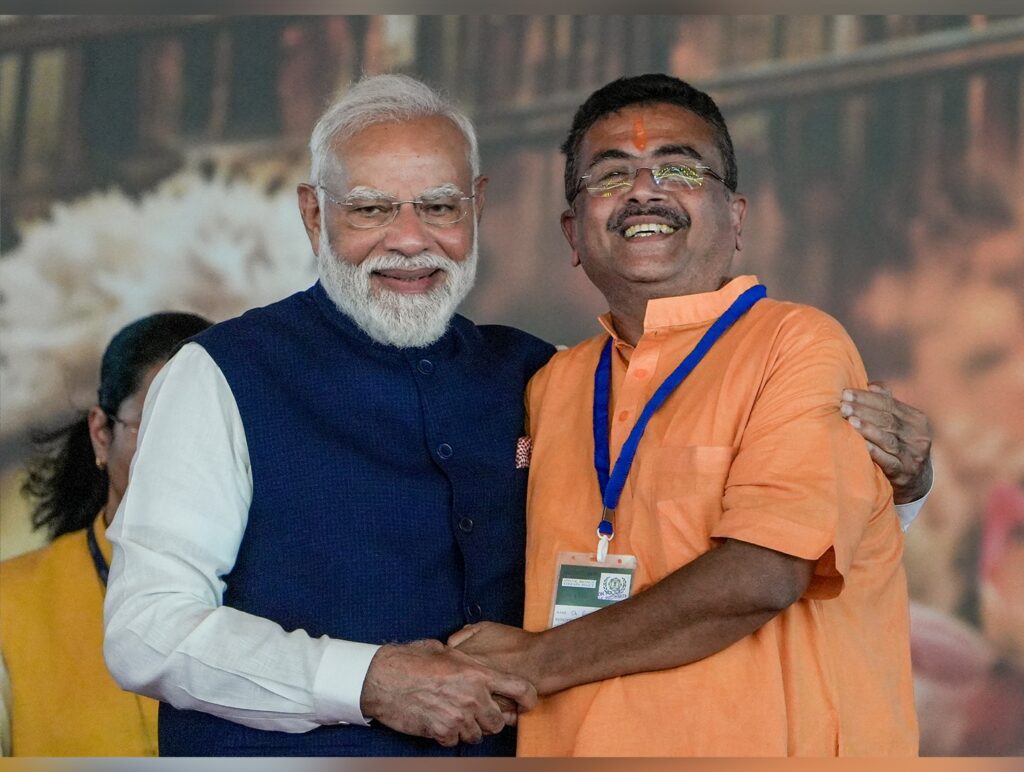
One of the most striking moments during Bengal’s swearing in ceremony had little to do with electoral arithmetic. Modi was seen touching the feet of 98 year old BJP veteran Makhanlal Sarkar before embracing him warmly on stage.
For the BJP, the moment carried deep historical meaning.
Sarkar belonged to an earlier generation of ideological workers who spent decades building the foundations of the movement long before the party became electorally dominant. According to the BJP, he was arrested in Kashmir in 1952 while accompanying Jana Sangh founder Syama Prasad Mookerjee during protests related to the hoisting of the Indian tricolour.
Successful political movements understand the importance of memory. They honour workers who carried the ideology when victory seemed impossible. Power may transform parties, but enduring political organisations know they cannot entirely disconnect themselves from sacrifice and grassroots labour. There is an old saying that power tests humility more than defeat does.
India’s political landscape is changing rapidly, and no dominance lasts forever. Regional parties remain powerful in states like Tamil Nadu and Kerala. But for now, the BJP appears to have understood something its rivals still struggle to grasp. Elections are not won only during campaign season. They are won patiently over years, booth by booth, district by district and narrative by narrative.

Salian’s family asks the CBI to summon the former NCB Zonal Director as a key…

What is it that stays with us after a cricket match is over? Sometimes,…
New Delhi, September 14 Improving political, diplomatic and military engagement between India and China…

Imagine this: It’s 12:01 am, you open Instagram and instead of reels, you get…