



 Dr Kiran Deep
The North News
Chandigarh, March 30
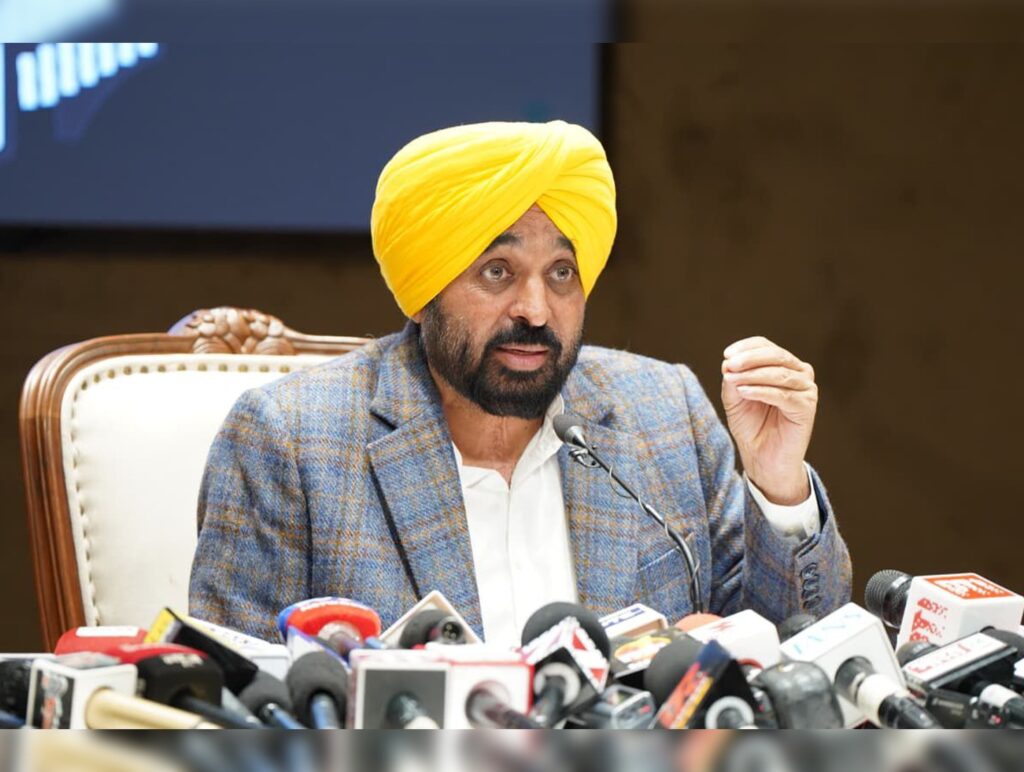
Punjab Chief Minister Bhagwant Mann has presented a four-year report card on the state government’s “Shiksha Kranti”, saying sweeping reforms have helped government schools in the state match private institutions in academic performance, infrastructure and accountability. Speaking on Monday as part of the “Shandaar Char Saal Bhagwant Mann de naal” series, Mann said education had become the “backbone” of Punjab’s development model, pointing to higher budget allocations, improved national rankings, teacher recruitment and expanded student support schemes.
He said Punjab’s education budget had risen from ₹12,657 crore in 2021–22 to ₹19,279 crore for 2026–27, describing it as evidence of the Aam Aadmi Party government’s long-term focus on the sector. Mann said the state was entering the “second phase” of its education overhaul with a ₹3,500 crore programme in partnership with the World Bank, which he described as the largest education reform initiative in Punjab.
Highlighting performance indicators, the Chief Minister said Punjab topped the National Achievement Survey 2024, with government school students scoring 18% above the national average. He also said 740 students had cleared JEE and 1,284 had qualified NEET in recent years. The government said 118 Schools of Eminence are being developed across the state, with 60 already operational. Mann said these schools offer multiple academic streams and coaching for competitive examinations including JEE, NEET, CLAT and armed forces preparatory courses.
He also said 24 lakh parents had taken part in mega parent-teacher meetings, which he described as a sign of greater community involvement in government schools.On student welfare, Mann said free bus services for girls had been introduced in Schools of Eminence and other government schools, with around 15,500 students benefiting. He added that free uniforms and timely textbooks were also being provided.
The chief minister said the state had recruited 14,525 teachers since April 2022 and regularised the services of 12,316 education department employees. He also highlighted overseas and domestic training programmes for teachers and principals in countries including Singapore, Finland and the United States, as well as leadership training at Indian Institute of Management Ahmedabad.
Mann said the government had expanded school infrastructure by hiring campus managers, security guards, sanitation workers and watchmen, while also providing high-speed fibre Wi-Fi in all government schools. He said new classrooms, science and computer labs, medical rooms, playgrounds and separate toilets had also been built.
The chief minister said Punjab had launched a “Business Blaster” scheme to encourage entrepreneurship among students, claiming participants had generated ₹70 crore through student-led ideas. He said Punjab was the first state to introduce entrepreneurship as a subject in Class 11.
In higher education, Mann announced what he called India’s first Digital Open University Policy-2026 and said a university named after Guru Tegh Bahadur would be set up at Sri Anandpur Sahib. He also said 10 new degree colleges were planned and that an online admission portal had been launched for government colleges.
The government also highlighted language and cultural initiatives, including mandatory use of Punjabi in official work under the Punjab Language Act, digitisation of Punjabi literature and the launch of the “Shabdmala E-Dictionary” mobile app.
Education Minister Harjot Singh Bains and other officials were also present at the event.
Two universities in Punjab. Two student protests. Two outbreaks of violence within days of each…
Chandigarh, September 28 Punjab Vidhan Sabha Speaker Kultar Singh Sandhwan paid tribute to revolutionary freedom…
Protest held at Patiala’s Phuhara Chowk as part of statewide demonstrations against alleged irregularities during…
Qaumi Insaaf Morcha announces two-day march to Takht Sri Damdama Sahib, seeks release of Sikh…