






 Disney Brar
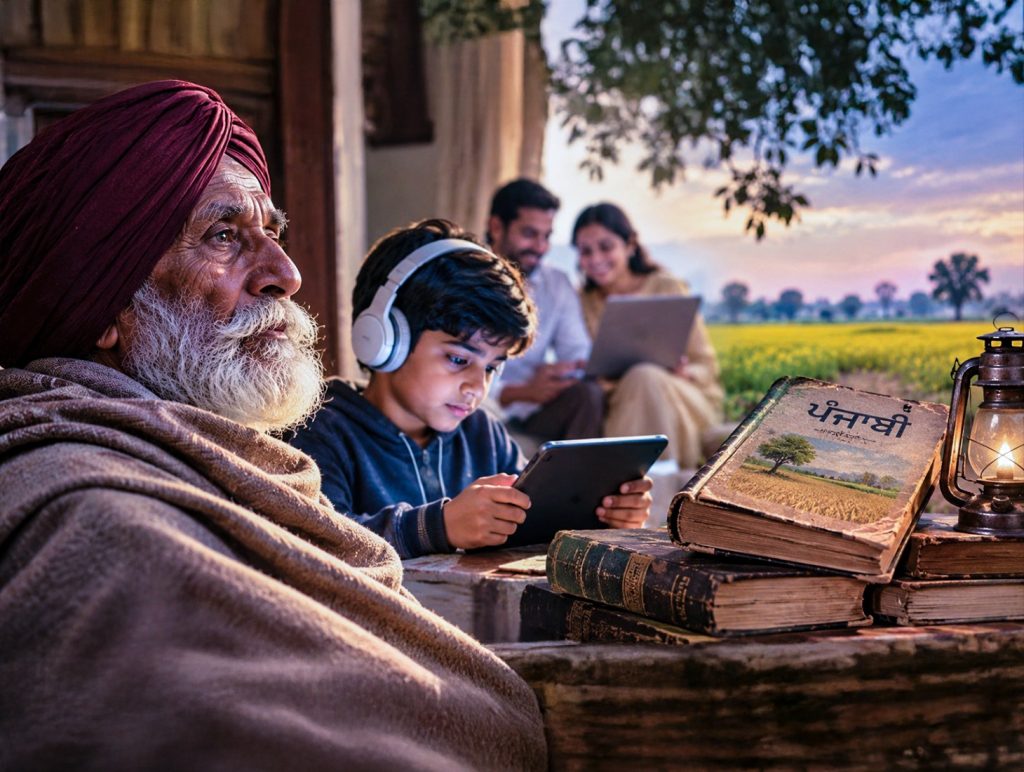
Punjab celebrates Punjabi on stage, but inside homes and classrooms, a generation is growing increasingly uncomfortable speaking it. Is the state’s cultural pride failing its own children?
A child in an urban Punjab household may recite the latest Punjabi song ruling the charts fluently, recognise popular Punjabi singers and follow comedy reels in Punjabi, yet struggles to narrate his day at school in fluent Punjabi. The response often comes in English, Hindi or a mix of all three.
The child understands Punjabi but may no longer be comfortable speaking it.
This is the contradiction confronting Punjab. While Punjabi remains prominent in music, films, weddings and political speeches, English and Hindi are increasingly dominating everyday conversations in many urban households.
The question is no longer whether Punjabi is culturally visible, but whether it is being spoken, read and passed on.
The Annual Status of Education Report (ASER) 2024, released in January 2025, highlights worrying gaps in foundational reading abilities among rural Punjab’s children.
Only 36.5 per cent of Class III children could read a Class II-level text. Another 14.9 per cent could recognise letters but not words, while 3.1 per cent could not recognise even letters.
The rural assessment covered 600 villages and 20,226 children across Punjab. Reading assessments were conducted in the language chosen by the child, including Punjabi or English, using the relevant reading tools.
Separately, Punjab Education Department figures cited in December 2025 indicated that only 47 per cent of government-school students in Classes III to VIII could read a complete story in Punjabi.
While these findings measure reading rather than spoken proficiency, they expose a serious weakness in children’s ability to access their mother tongue in written form.
The Punjab Learning of Punjabi and Other Languages Act, 2008, makes Punjabi compulsory from Class I to Class X, with subsequent amendments strengthening enforcement and prescribing penalties for violations.
Yet, compulsory teaching does not guarantee everyday usage.
In February 2024, the Punjab School Education Department issued a show-cause notice to a Cambridge School in Jalandhar following a complaint that Punjabi was not being taught there as a compulsory subject.
Earlier, in February 2019, the department had directed CBSE- and ICSE-affiliated schools to teach Punjabi and stop discouraging students from speaking the language during informal interactions.
The National Education Policy 2020 recommends mother-tongue or regional-language instruction until at least Grade V, preferably Grade VIII and beyond, wherever possible. The Union government’s NIPUN Bharat mission also emphasises foundational learning in familiar languages.
Punjab’s NIPUN Bharat state report records that 60 per cent of students have a home language matching their school’s medium of instruction. The remaining proportion underlines the importance of language alignment in early education, though it is not a measure of Punjabi fluency.
The shift is social as much as educational.
In many urban middle-class households, English is associated with confidence, professional success and upward mobility. Parents understandably want their children to become fluent in English, but this aspiration sometimes comes at Punjabi’s expense.
Children notice which language earns praise. They see parents switching to English while speaking to teachers, siblings conversing in Hindi and Punjabi being reserved largely for domestic instructions or grandparents.
English is often perceived as sophisticated, while Punjabi is unfairly stereotyped as less refined or unsuitable for formal settings.
The emotional cost is most visible within families.
For grandparents, Punjabi carries childhood memories, village histories, folk wisdom, humour and family stories. But a growing language gap can make these exchanges difficult.
A grandmother narrates an incident in Punjabi, but her grandchild struggles to respond. A grandfather uses an expression that loses its meaning in translation.
Language carries more than information; it preserves relationships, cultural memory and emotional connections. Losing fluency does not necessarily mean losing identity, but it can weaken access to the everyday experiences through which identity is passed on.
Punjabi enjoys considerable visibility through its music industry, cinema and social media. But cultural consumption is not language proficiency.
The language needs contemporary children’s books, graphic novels, science content, educational videos, gaming, podcasts and digital platforms that make it relevant to younger audiences.
In December 2025, Punjab’s Education Department announced that textbooks in Punjabi, Hindi and English would carry dedicated Gurmukhi alphabet pages from the 2026-27 academic session, aiming to strengthen script familiarity among nearly 60 lakh schoolchildren.
The initiative also raises questions about children’s familiarity with Gurmukhi and the extent to which they encounter Punjabi reading material beyond the classroom.
The answer lies partly in how little Punjabi, the children encounter beyond classrooms.
The debate returned in May 2026 when a language policy in Army Public Schools in Punjab triggered criticism.
Parents were reportedly informed that Sanskrit would be compulsory for the 2026-27 academic session, while students opting for Punjabi as an additional subject would require parental consent.
The Army Welfare Education Society cited curriculum standardisation for children of armed forces personnel frequently transferred across states. However, the controversy raised questions about regional linguistic identity and the place of Punjabi in institutions operating within Punjab.
The state Education Minister said the matter was being examined.
The episode exposed the tension between administrative convenience, national standardisation and regional language rights, highlighting that legislation and institutional priorities do not always align.
Preserving Punjabi cannot be left to schools and governments alone. Families must make it part of everyday communication.
Speaking Punjabi at home, reading stories with children, encouraging them to write and introducing them to contemporary literature can help restore its relevance.
Schools must move beyond grammar and examinations through debates, theatre, storytelling, creative writing and digital projects that encourage children to use the language.
The government must also measure outcomes: Can children read Punjabi passages and write coherent paragraphs? Are schools complying with compulsory teaching requirements? Are teachers adequately trained? Is Punjabi a language of communication or merely another subject on the timetable?
These questions deserve regular, publicly available answers.
The concern is not that Punjabi will disappear tomorrow, but that fluency may decline among children who understand the language without actively speaking it.
Punjab does not have to choose between English, Hindi and Punjabi. Children can be fluent in all three. Multilingualism should expand opportunities, not disconnect them from their family, community and history.
Punjab has recognised Punjabi as its official language and made its teaching compulsory in schools. But its commitment will be measured not by signboards, festivals or political speeches, but by whether children can read a Punjabi story, write in Gurmukhi and comfortably converse with their grandparents.
In a significant push to take Punjabi into the digital age, the Punjab Bhasha Vibhag has begun making its literary resources accessible for AI-driven applications. In October 2026, its director, Jaswant Singh Zafar, said the department had made hundreds of books and journals AI-ready, linked more than 10,000 library books to its website through the Punjab Digital Library, and added seven Punjabi dictionaries and seven subject glossaries. It has also developed the Shabdmala app to make Punjabi dictionaries, idioms and traditional expressions accessible through digital platforms. The initiative reflects an effort to preserve Punjabi’s linguistic heritage while making it relevant to younger, technology-driven generations.
A language does not always die when people stop speaking it altogether. Sometimes, it survives in songs, slogans and celebrations while quietly disappearing from ordinary conversations.
The last Punjabi-speaking generation may not be the one that stops understanding Punjabi. It may be the one that understands it perfectly but no longer knows how to speak it.
Punjab Youth Congress president Shubham Sharma Shubhi and several party workers were detained after allegedly…
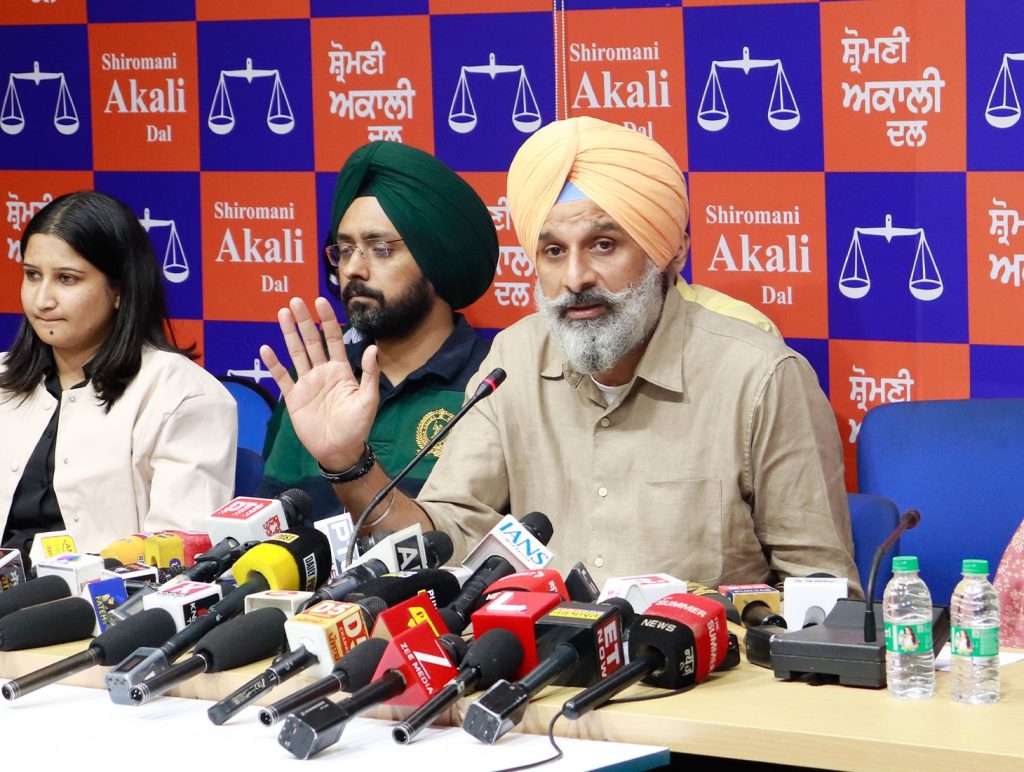
Shiromani Akali Dal (SAD) leader Bikram Singh Majithia on Thursday demanded a CBI probe into…
Punjab is at a critical crossroads, grappling with mounting debt, unemployment, drug abuse, organised crime…
The Punjab and Haryana High Court’s decision to stay the PCS recruitment process has triggered…