








 Dr Kiran Deep
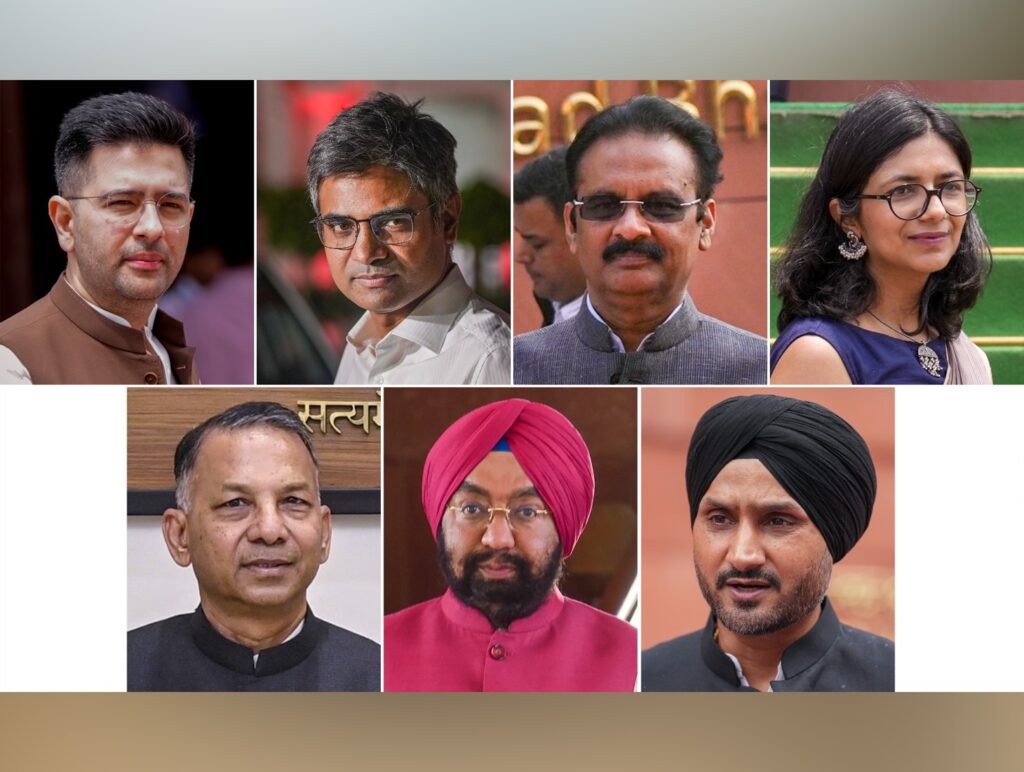


When MPs walk out, not one, not two, but seven, it stops being a personnel matter and becomes a political statement. The staggered departure of Aam Aadmi Party’s Rajya Sabha members is not merely an organisational inconvenience ahead of Punjab’s assembly elections. It is a signal flare, and the party would be reckless to dismiss it as noise.
The exits have arrived in chapters, each one louder than the last. Raghav Chadha, Ashok Mittal and Sandeep Pathak crossed over to the BJP in Delhi on Friday, received in full public view by BJP chief Nitin Nabin, a choreographed moment designed to sting. The remaining four, former cricketer Harbhajan Singh, Swati Maliwal, industrialist Rajinder Gupta, and entrepreneur Vikram Sahney, are expected to follow. The optics could scarcely be worse for a party that built its identity on moral clarity and mass trust.
For the BJP, this is an unearned gift arriving at precisely the right moment. Punjab’s political lines are already shifting, loyalties already restless. The spectacle of AAP shedding lawmakers feeds a narrative the BJP need not even construct, it writes itself. In politics, momentum is often manufactured from your opponent’s chaos, and the BJP is quietly making the most of it.
But the more urgent reckoning belongs to AAP. Before strategists map the damage, the party’s leadership owes itself and its voters an honest conversation about why people who once believed deeply enough to sit in Parliament are now walking away. Introspection is not a weakness. In this case, it may be the only political wisdom left available.
When senior BJP leaders lined up at their Delhi office to receive the incoming MPs, the choreography was deliberate. This was not a quiet administrative transfer of political allegiance. It was a public ceremony, designed to be seen, photographed and understood as a statement of consequence. The BJP got what it wanted: a moment that looked like arrival, not just defection.
The significance of who left matters as much as the fact of the leaving. Raghav Chadha was not a peripheral figure in AAP’s architecture. He was long considered one of the party’s most trusted operatives, a close associate of Arvind Kejriwal and a key presence in Punjab’s organisational and financial structure. At his peak, he was said to wield influence that at times exceeded that of the state’s own leadership. His departure does not merely weaken a flank. It signals that the inner circle itself has developed fault lines.
The party that swept Punjab with 92 seats is now watching the very people who built that victory walk out the door.
Sandeep Pathak’s exit compounds the loss. He was widely credited with engineering AAP’s extraordinary 2022 Punjab campaign, the one that delivered 92 of 117 seats and reduced the Congress to an afterthought. His profile, shaped by Cambridge, Oxford, MIT and a career at IIT, helped AAP project something unusual in Indian politics: a movement that was simultaneously populist and technocratic. His move to the BJP is not simply a numbers problem. It is a narrative problem.
The remaining departures carry their own layers of meaning. Harbhajan Singh brought sporting celebrity and mass recognition. Ashok Mittal, founder of Lovely Professional University, and Vikram Sahney, a Padma Shri awardee with an international profile, were part of AAP’s deliberate effort to broaden its leadership beyond career politicians. Rajinder Gupta, another Padma Shri recipient and prominent industrialist, added further heft to that project. Together, they were proof that AAP could attract credible non-political figures. Together, their exit suggests that credibility is no longer enough to keep them in.
To understand how far AAP has travelled from its peak, it helps to recall where it stood three years ago. In 2022, it did not merely win Punjab. It reshaped the state’s political order. The Congress was pushed to 18 seats, the Shiromani Akali Dal to three, the BSP to one, and the BJP managed just two. It was a mandate that suggested AAP was becoming a durable force in northern India, not just a protest vote made permanent.
That story has since grown complicated. The 2025 Delhi elections delivered a sharp reversal, with the BJP winning 48 of 70 seats. The defeat raised questions that could not be answered by blaming local conditions alone. They pointed to something structural: a party that had not yet built the organisational depth to hold ground once the initial wave of enthusiasm receded.
Punjab remains AAP’s last major stronghold, and Chief Minister Bhagwant Mann its most recognisable face in the state. The welfare model, subsidised electricity, health insurance, social programmes, has not been abandoned and continues to form the bedrock of the party’s electoral appeal. But welfare-driven governance, however genuine in intent, cannot by itself absorb the political cost of visible internal fracture. Voters read departures. They read silences. They read the gap between what a party says about itself and what its own members say when they leave.
Mann’s swift counter-offensive may be good politics. But it does not answer the harder question: why are they leaving at all?
Bhagwant Mann’s response was characteristically combative. He accused the BJP of engineering defections to destabilise a corruption-free government, questioned the grassroots relevance of the departing MPs, and alleged that the party’s discomfort with his administration ran deeper, rooted in its stance on sacrilege legislation. He has since sought an appointment with President Droupadi Murmu, accompanied by party MLAs, to press the case publicly. The counter-offensive is swift and loud, as it needed to be.
Yet swiftness is not the same as sufficiency. Chadha’s explanation for leaving, that the party had drifted from its founding principles, may be contested and self-serving. But it cannot simply be waved away. When founding-era figures use the language of betrayed principles, the burden falls on the party to demonstrate, not merely assert, that the principles remain intact.
There is also the unresolved question of authority. The relationship between Chandigarh’s elected government and the central party leadership, particularly Kejriwal and former deputy chief minister Manish Sisodia, has long been a subject of quiet tension. Kejriwal’s arrest in the liquor policy case, and the subsequent acquittal that nonetheless left legal proceedings unresolved, complicated the picture further. A party navigating the aftermath of its leader’s legal ordeal while simultaneously managing a state government is a party under extraordinary strain. That strain is now visible.
Punjab’s next assembly election is approaching, and the terrain has shifted. The BJP enters with momentum it did not have to manufacture. AAP enters with questions it cannot defer. For a party built on the promise of a different kind of politics, the most damaging accusation is not that it lost ground. It is that it may be losing the argument about who it is.
The introspection Mann’s party owes itself is not a luxury for after the election. It is the precondition for contesting it with credibility.

Salian’s family asks the CBI to summon the former NCB Zonal Director as a key…

What is it that stays with us after a cricket match is over? Sometimes,…

New Delhi, September 14 Improving political, diplomatic and military engagement between India and China…

Imagine this: It’s 12:01 am, you open Instagram and instead of reels, you get…