







 Disney Brar
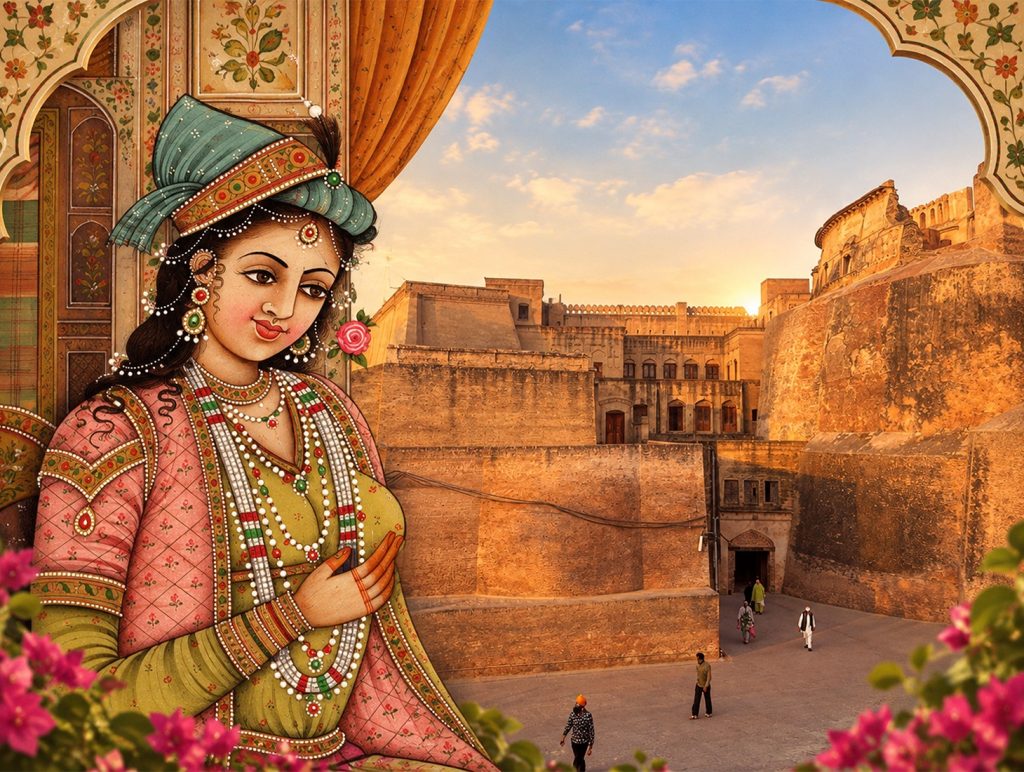

Bathinda nestles in its bosom, a 1600-year-old fort which is a protected monument maintained by the Archaeological Survey of India (ASI) where Razia Sultan was ensnared for love.
Bathinda, September 20
From plain sand dunes at one point of time to a bustling city and a junction, Bathinda has a rich historical legacy behind its being. Walking through the city once known as the Tabar-e-hind which means the Gateway to India, and passing through the labyrinthine lanes of the choc-a-block Dhobi Bazaar, which is the city’s most popular bazaar, one comes across a quiet serene corner where a sprawling 15 acres is home to the Qila Mubarak, a 100 feet high fort which links ancient India to Medieval India. What bears testimony to the fact that Qila Mubarak has withstood the vagaries of time and conquests is the fact that the walls are patched with at least seven different kinds of bricks used in different time periods spanning across history.
From the pages of history
Every emperor who conquered the fort left his indelible mark on its walls. The fort is also listed as the Monument of National Importance by the ASI. According to its records, the fort may have been built around the 6th century AD as a defence against the invading Hunas. The fort was also a strategic defence structure between Multan and Delhi, during the Mughal period, this fort was an important route to Lahore.
This place welcomes around close to 5000 visitors per day and offers a panoramic view of Punjab’s oldest city Bathinda from the ramparts of its red-bricked bastions. The fort houses a Moti palace, Rajmata palace and the Sheesh Mahal, it also had Razia Sultan, the first woman ruler of Delhi and the daughter of Iltutmish imprisoned here before her death in 1240 as she faced off with the Turkish nobility and lost the throne of Delhi in 1240.
Kille Ka Rahasya
Built between 90-110 AD by Raja Dab of the Kushana dynasty, it is one of the oldest surviving forts of India. It was besieged by Mahmud of Gazni in 1004 CE during his conquest of North India. The region then came under the control of the Chauhans in 1164 CE. Under Prithvi Raj Chauhan’s reign, Qila Mubarak was developed as a military bastion until it fell to Mohammed Ghori after his victory in the second Battle of Tarain (1192 CE). Ghori entered the walled fortifications of Prithvi Raj’s stronghold and defeated him. The fort was brought under the rule of the Delhi Sultanate when Ghouri’s army general Qutb Al Din Aibak became the first Sultan of Delhi in 1206 CE. The fort remained in the hands of the Mamluk dynasty and Razia Sultan became its first female commander.
It is believed that Malik Ikhtiyar-ud-din Altunia, the then governor of Bathinda under the Delhi Sultanate, fell in love with Razia Sultan but it was one-sided. He proposed and Razia refused. Her lover Yakut was already dead. So unable to process her refusal to his proposal, Altunia thought of winning her love by hook or by crook. So he attacked her entourage and imprisoned her in this very fort until she agreed to his proposal of marriage. However his hard-earned union was short-lived as the couple was assassinated on their way back to Delhi by the local villagers. One of the theories also states that while Razia Sultan was in prison here, the childhood friendship between Razia Sultan and Altunia took wings once again, they reconciled and raised an army and rebellion together against the ruling faction but failed.
The fort soon fell into decline after Razia Sultan’s demise, which coincided with the drying of the Ghagger river which had flowed free and wild there providing water for the use of the inhabitants of the fort. It was only in 1745 under Maharaja Ala Singh, also the founder of Patiala that the fort was inhabited again.
Witness to the changing tides of time
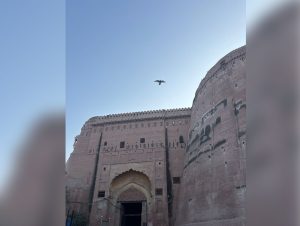
Talking about the construction of the fort, the 30-metre high fortification has 32 small and four large bastions jutting out from its four corners, out of which nine have been destroyed over the period of time, but the fort still remains a forbidding structure. The Rani Mahal of the fort where the queen had her chambers tucked right above the main entrance of the fort still has faded and dilapidated murals on its ceilings, although most of them are gone now. The fort was initially built with clay bricks. With time the mud bricks were replaced by Nanak Shahi and burnt bricks. But time has taken its toll on the fort and in the last few years several bastions of the fort have collapsed. One of the main bastions of the fort had partially collapsed in 2022. It has been restored back since then.
Talking to The North News, Ripudaman Kang, a banker from Rampura Phul, says, “I bring my family to this fort every Sunday when we pay obeisance at the gurudwara and also walk through the rich history buried here.” Echoing the same sentiments for this fort, Manjit Aulakh, a boutique owner who runs Seasons in Bathinda’s Dhobi Bazaar, says, “the whole vibe of this fort is very mystical and alluring. I just got drawn here by an unknown force initially and am a regular here now. Seems like I have a past relationship with this place.”
Commemoration of Guru Gobind Singh’s visit here
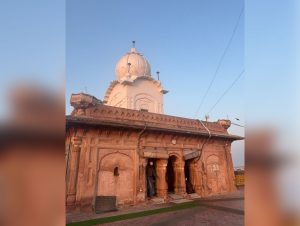
Also nestled within its walls is Gurudwara Qila Mubarak built in the 19th century by Maharaja Karam Singh of Patiala which highlights the 10th Sikh Guru Gobind Singh’s visit to this fort back in 1705 who briefly stayed here after the Battle of Muktsar at Khidrana, where the Sikh forces fought with the Mughals. The gurudwara was built back in 1835.
The wear and tear with time caused a partial collapse of the gurdwara along with one of its bastions and a temporary shrine was erected inside another part of the fort. But the old gurdwara was restored and the new shrine too sits pretty offering two gurudwaras inside the precincts of the fort. It is believed that whatever one earnestly prays for here is fulfilled. Ranjit Singh, who owns Singh travel agency in Dhobi Bazaar, says, “I visit this gurdwara everyday and till date whatever I have prayed for here has been fulfilled by my Guru’s blessings.” Agrees Harkishan Sidhu, a landlord from Bhucho Kalan, “I visit this gurudwara at least thrice every week. All my ancestors have been coming here and this gurudwara has been a witness to all my happy and sad moments in life.”
If you have not been here to witness the majestic beauty of this fort which houses a rich slice of our history first hand, then you should definitely plan a visit to Bathinda soon because as Martin Luther King Jr once said, “We are not makers of history. We are made by history.”
The fort is open daily for the gurudwara visits. The entry is free for all visitors. General timings for the fort is from 9 am-9 pm
Qila Mubarak, 4144, Qila Road, Old City, Bathinda, Punjab 151001

Actor opens up about fatherhood, family and work ahead of India Ke Top 1% premiere…

Priyanka Chahar Choudhary, Paritosh Tripathi, Sonakshi Batra, Farman Haider and other Zee TV stars come…

Rana Ranbir urges the audiences to set aside their ego and appreciate relationships while they…
Actor’s portrayal emerges as a major highlight as Punjab Government-backed theatre production makes its Patiala…