



 Disney Brar
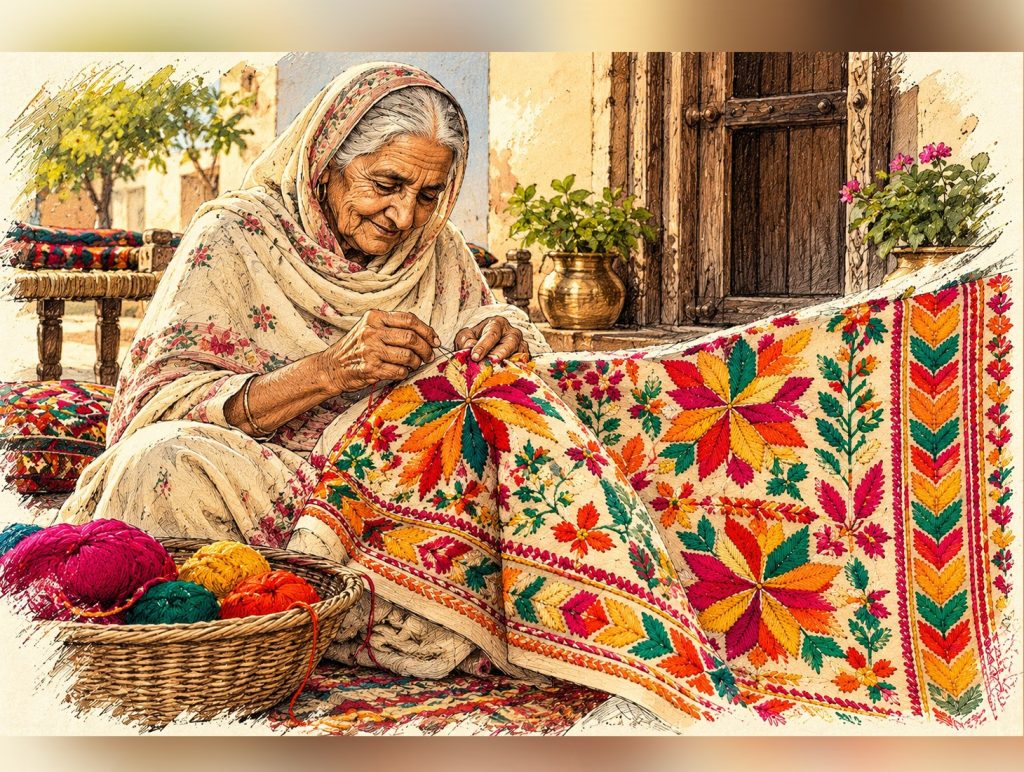

“Mavan te dheeyan ral baithiyan ni maaye, phulkari de dhageyan vich supne sajaye.” (Mothers and daughters sit together, weaving dreams into the threads of a Phulkari.)
There was a time when flowers did not merely bloom in the fields of Punjab. They blossomed on chaddars, travelled with brides to their new homes, rested on the shoulders of mothers and grandmothers during marriage ceremonies, and became a language of love stitched into cloth.
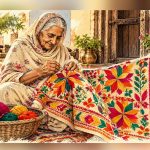
In old Punjab, a Phulkari was more than a garden of flowers. It was a feeling, a memory, a piece of home carried in colour. Picture a sunlit courtyard in a quintessential Punjabi village. The winter sun falls gently on a manji, a steel glass brimming with chah sits nearby, and an elderly woman bends over a piece of cloth, her fingers moving deftly with the ease of a song she has known all her life. Fiery reds, rich mustards, burnt oranges, bottle greens and rani pink threads travel across the length and the breath of the fabric, turning a simple piece of cloth into an heirloom.
Every stitch has a rhythm. Every motif carries a meaning. And every Phulkari holds a little piece of the woman who wove it.
In Punjab’s textile heritage, floral embroidery is closely associated with Phulkari — literally, the flowering of a cloth. The word comes from phul, meaning flower, and kari, referring to the work or craft of making it. Traditionally embroidered by women, often for weddings and significant family occasions, Phulkari was never merely about adornment. It was about belonging. It carried the blessings of a mother, the dreams of a daughter, the patience of a grandmother and the quiet pride of the women who shaped a household.
Professor Prabhdip Brar, Chairperson, UIFT & VD, Panjab University, Chandigarh, explains the cultural and artistic significance of the craft, “Phulkari of Punjab constitutes one of the subcontinent’s most sophisticated systems of embroidered textile production, wherein geometric and floral motifs are rendered through counted-thread technique on handspun khaddar, transforming utilitarian cloth into a dense visual field of symbolic and aesthetic value. Yet, unlike Banarasi brocade, Kanjeevaram silk, or Kashmiri pashmina—each of which has been systematically positioned within global luxury and heritage markets through institutional branding, design intervention, and curated narratives of authenticity—Phulkari has remained largely confined to the domains of domestic memory, ethnographic documentation, and ceremonial use. Its technical virtuosity, regional specificity, and capacity for contemporary reinterpretation have not been matched by an equivalent discursive or commercial infrastructure, leaving a living craft tradition under-articulated as a branded cultural product on the national and international stage.” And perhaps that is what makes the memory of Phulkari so tender today — its extraordinary beauty living quietly in the folds of family histories, waiting to be recognised beyond them.
Satnam Singh, who owns a Phulkari shop in Bathinda’s Dhobi Bazaar, believes the charm of the traditional craft lies in its human touch, “The beauty of the old Phulkari lies in its imperfections, too. The slightly uneven stitch, the unexpected combination of colours, the flower that seemed to grow a little differently from the one beside it. Nothing is mass-produced and nothing is done in a hurry,” he says. In those little imperfections lies its perfection. The hands know what the heart wants to say.
In an age of fleeting trends, factory-made prints and clothes designed to be worn once and forgotten, these embroidered flowers ask us to slow down. They remind us of a time when beauty took patience, when craftsmanship passed from one generation to the next, and when a piece of fabric could hold the warmth of an entire family.
For Neetu Sidhu, a homemaker from Amritsar’s Ranjit Avenue, Phulkari is not simply an embroidered textile but a cherished part of her family’s story. A passionate collector, she fondly remembers watching her grandmother stitch Phulkari pieces for her before her wedding, “For a Punjabi bride, the Phulkari is more than an accessory. It is a blessing draped around her shoulders, a reminder of the home she is leaving behind and the love she will carry into a new one. Elaborate baghs, with their dense, shimmering embroidery, transform entire surfaces of fabric into flowering fields, while other designs celebrate the beauty of everyday life through geometric patterns and bursts of colour. I am a proud owner of around 50 Phulkari’s which I will one day gift to my daughter when she gets married,” avers she. For Sidhu, her 50 Phulkari pieces are more than a collection. They are fifty little worlds, each carrying the colours, memories and emotions of a tradition she hopes to pass on to her daughter.
Satwant Kaur, an octogenarian from Village Kot Bhara near Bathinda, reflects on what makes the traditional craft so special — the time, patience and love woven into every thread, Talking to, The North News, she says, “What makes the old Phulkari truly special is the time it takes to actually weave it. There are no shortcuts, no rush to finish by a deadline. The women who embroider these Phulkari’s work stitch by stitch, often turning long afternoons into works of art. Their hands remember patterns, their eyes imagine colours, and their hearts give the cloth its meaning.”
Perhaps this is the quiet magic of Phulkari. It does not hurry. It does not demand attention. It simply blooms, one stitch at a time. Yet, Phulkari is not a story trapped in the past. Its colours continue to find their way into contemporary wardrobes, designer collections and modern interpretations of Punjabi identity. What once adorned village courtyards and bridal trousseaus now finds space on runways and in urban homes. The setting may have changed, but the soul of the craft remains rooted in the same soil.
Perhaps the good old Phulkari was never simply about flowers. It was about the women who made them bloom, the homes they brightened and the memories they left behind.Because some flowers do not fade with time. They are stitched into our inheritance, blooming quietly in the folds of a dupatta, in a grandmother’s trunk, in an old family photograph — and in the heart of Punjab itself.
And somewhere, in a sun-drenched courtyard, a woman is still stitching a flower into a piece of cloth, unaware that she is preserving an entire world. Somewhere in Punjab, in the soft light of an afternoon, those flowers are still blooming — not in the soil, but in the threads of a tradition that refuses to be forgotten.
The Chandigarh Administration has restricted Diwali firecracker use to a two-hour window, 8 pm to…
Gurdwara Sri Dukh Niwaran Sahib in Patiala, associated with the visit of the ninth Sikh…
From the comfort of a warm razai and the first cup of kadak chai to…
Punjab Day is observed annually on November 1 to commemorate the formation of the modern…