






 The North News
The North News
Chandigarh, June 25
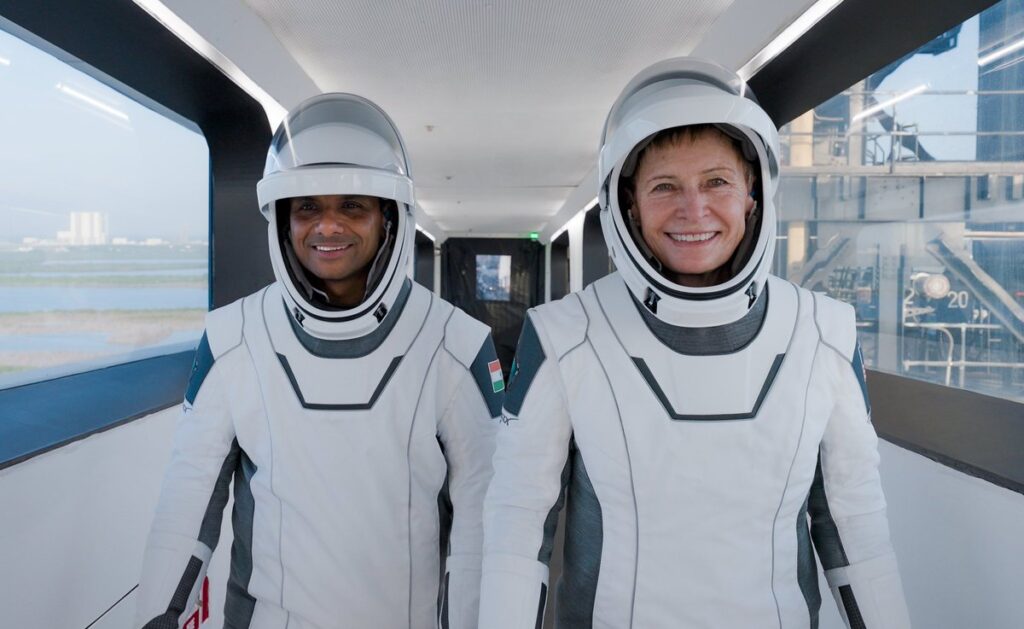
An international crew of astronauts launched into space on Wednesday aboard a private SpaceX mission, marking a significant milestone in commercial human spaceflight. Among them is India’s Shubhanshu Shukla, flying to the International Space Station (ISS) for the first time under a bilateral agreement between India and the United States.
The launch took place at 12:00 pm local time from NASA’s Kennedy Space Center in Florida. The Axiom Mission 4 (Ax-4), the fourth private flight to the ISS organised by Axiom Space, NASA, and SpaceX, lifted off from Launch Complex 39A atop a Falcon 9 rocket carrying a brand-new Crew Dragon capsule.
Commanding the mission is veteran astronaut Peggy Whitson, a former NASA spacefarer now heading human spaceflight at Axiom. Shukla, representing the Indian Space Research Organisation (ISRO), is serving as the mission’s pilot. Also on board are Sławosz Uznański-Wiśniewski, an astronaut with the European Space Agency from Poland, and Tibor Kapu from Hungary, the first to fly under the country’s new HUNOR programme.
The Dragon capsule is expected to dock with the ISS at 07:00 ET on Thursday. Once aboard, the astronauts will spend two weeks conducting scientific research, educational outreach, and commercial activities. The mission includes five collaborative science experiments and two STEM-focused demonstrations jointly developed by NASA and ISRO.
NASA and Russia’s Roscosmos had earlier cleared the mission to proceed after addressing issues in the ISS’s Zvezda module. Air pressure adjustments were made as a precaution, and both agencies confirmed conditions were safe for docking.
Shukla’s inclusion fulfils a 2020 promise made during a state visit by US President Donald Trump and Prime Minister Narendra Modi. His participation highlights India’s growing ambitions in global space exploration.
The mission also marks first extended ISS stays for astronauts from both Poland and Hungary, signalling a shift toward broader international participation in space, driven by Axiom’s commercial model.
Axiom’s long-term goal is to build the first commercial space station, expected to take over as NASA phases out the ISS later this decade.
New Delhi, September 17 India’s semiconductor ecosystem is expanding rapidly, opening new opportunities for innovation,…
New Delhi, September 17 Prime Minister Narendra Modi on Thursday thanked people across the country…
New Delhi, September 17 Reacting on passage of the sanctioning Russia and Iran Act in…
Six states sign Rs 15,624-crore pact; Delhi, Haryana and Rajasthan to bear state’s estimated power-component…