








 Dr Kiran Deep
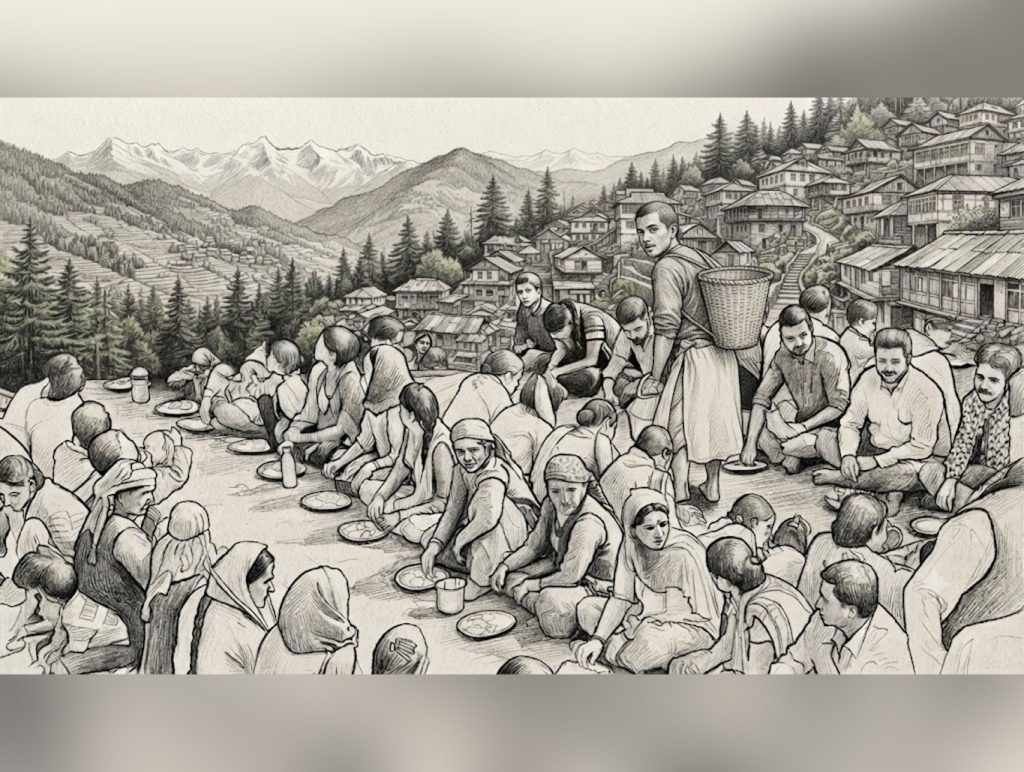

There are places you visit and there are places that stay with you.
Himachal Pradesh belongs to the second kind.
I have travelled through its mountains alone and with friends, driven its winding roads more times than I can remember and returned to Shimla again and again. Yet every journey has carried the same sensation that somewhere between the forest and the river, between the sudden turn in the road and the first glimpse of a distant mountain, Himachal begins to feel less like a destination and more like a place to which you belong.
The journey begins long before you reach the hills.
Leave Chandigarh and the landscape slowly changes. The traffic thins, the plains begin to fall behind and the road starts climbing. Then come the forests. Deodar and pine rise around the road, the air becomes cooler and cleaner and the noise of the cities gives way to something older, birds calling from the trees, water running somewhere below and the occasional rush of a waterfall appearing through the green.
There are little tea stalls along the way, often no more than a few chairs, a kettle and a handful of biscuits. You stop without much reason. Someone pours tea into a glass. You stand beside the road, look into the valley and realise that the stop itself has become part of the journey.
Himachal has a way of doing this.
It slows you down.
And somewhere along those roads, food begins to matter.
Not simply because you are hungry. Travel makes us hungry in a particular way. We remember some meals because they filled the stomach. We remember others because they became part of the landscape.
On the Chandigarh-Shimla road there are countless places to eat. Some disappear from memory almost as soon as the bill is paid. A few stay with you. Perhaps it is the tea, the warmth of a small kitchen, the view outside the window or simply the feeling that you have eaten something in the right place at the right time.
Food, at its best, does not interrupt a journey.
It completes it.
And if there is one food that seems to belong naturally to the mountains, it is Himachali Dham.
Botis and the great vessels
There is something almost theatrical about watching a Dham being prepared.
The cooking is done in large traditional vessels, with the Botis moving between them, knowing by experience when a dish is ready, how much spice is required and how the different preparations should follow one another.
This knowledge was not originally written down as a recipe book.
It lived in people.
It travelled from one generation to another.
The research literature on Dham describes the Botis and the traditional methods of preparation as an important part of this culinary heritage.
Today, that knowledge is spreading beyond hereditary cooks. More people have learnt how to prepare Dham, and restaurants in Shimla and elsewhere have begun serving versions of the traditional feast.
That has made Dham easier to find.
But it has not necessarily made it the same.
Because eating Dham in a restaurant is one experience.
Eating it at a wedding, a village celebration or a family gathering, sitting in a row while a Boti walks towards you with a steaming vessel, is another.
The setting becomes part of the taste.
A feast for life’s important moments
Dham belongs to occasions.
A marriage. A religious celebration. The birth of a child. The completion of a house. A family gathering. A festival. A moment when ordinary life pauses long enough for people to come together.
This is why Dham cannot quite be reduced to a list of dishes.
It is food attached to memory.
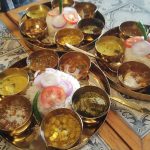
Dham as a traditional feast served at marriages, local festivals and special occasions.
The menu changes from one part of the state to another.
There is Kangri Dham. Mandiyali Dham. Bilaspuri Dham. Chambyali Dham.
The details differ, but the idea remains remarkably constant, food prepared in quantity, served communally and bound to an occasion.
A typical spread may include steamed rice, rajmah, maah ki dal, chana dal, sepu badi, kadhi, kale chane ka khatta and a sweet preparation such as boondi ka meetha or badana.
The food is deceptively simple.
There is no need for an elaborate restaurant presentation.
The beauty is in the layering.
The creamy richness of madra. The earthiness of lentils. The sharpness of khatta. The softness of rice. The sweetness that arrives towards the end.
And then, suddenly, the plate is empty.
But the taste remains.
The food that travels with the journey
There is another memory associated with Dham that belongs to the morning after.
When food remains after a family function, it may be eaten again the next day. Sometimes the preparations are brought together and reheated.
Something happens in that second cooking.
The flavours settle into each other. The food becomes darker, deeper, more familiar.
Perhaps this is why some of the best food memories are not of grand occasions at all. They are of what remained after everyone had gone home.
The feast had ended.
The food had not.
A story from Chamba
The history of Dham is difficult to separate from legend.
One account places its roots in Chamba and connects its evolution to the interaction between local ingredients and Kashmiri culinary traditions. The story tells of a Chamba ruler fascinated by Kashmiri food who sought to recreate those flavours using the produce available in his own kingdom.
From that meeting of traditions emerged dishes such as madra, which became an important part of the Dham tradition.
The peer-reviewed literature records this Chamba-Kashmir connection as part of the traditional account of Dham’s evolution, while also documenting the way the cuisine developed around local produce and the conditions of the Himalayan region.
Whether every detail of the story can be established historically is another question.
But perhaps food traditions do not survive because every part of their origin story can be proved.
They survive because people keep cooking them.
A taste of the hills
That is what makes Himachali Dham so compelling.
It tastes of a particular geography.
The mountains have always demanded something from those who live in them. Food had to work with what the land could provide, with the seasons and with the realities of distance and climate. Dham grew from that relationship between landscape and kitchen.
It is therefore impossible to separate the meal from the place.
The rajmah belongs to the hills.
The curd, spices and lentils carry the memory of mountain kitchens.
The long cooking belongs to a time when food was allowed to take its time.
And the communal serving belongs to a society in which a feast was not an individual experience.
You did not simply eat.
You participated.
Himachal has always seemed to me a place that rests in the soul.
Perhaps that is because its landscape does not merely ask to be seen.
It asks to be felt.
And perhaps Himachali Dham does the same.
It is not merely food.
It is a memory of the hills placed before you on a leaf or plate, one serving at a time.
The road brings you to Himachal.
The mountains make you stay.
And sometimes, if you are fortunate enough to find a real Dham along the way, the food tells you why you came.
What happened at Chitkara University on September 25 and what followed at Lovely Professional University…
Chandigarh, September 27 A protest erupted at Lovely Professional University in Phagwara late on Saturday…
Former Union minister says Election Commission decisions followed established procedures Kangra, September 26 Former Union…
New Delhi, September 26 Prime Minister Narendra Modi on Saturday paid tribute to former Prime…