








 Dr Kiran Deep
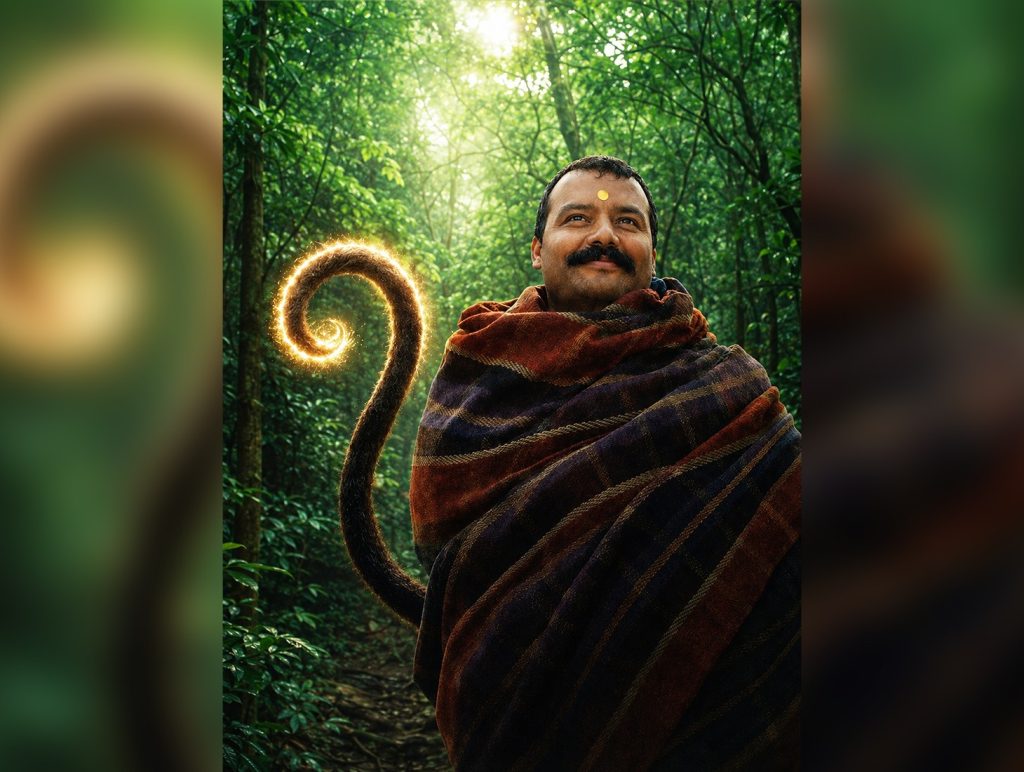

Sometimes, a journey begins without a plan. There is no itinerary, no destination marked on a map and no conscious decision to set out. Something simply happens a conversation, a book, a chance meeting or, sometimes, a movie ticket and before we know it, we find ourselves somewhere we were perhaps meant to be.
My journey with Hanuman Ansh, a film based on the life of Neem Karoli Baba, popularly known as Maharaj Ji, began rather unexpectedly.I had been watching reels from the film on social media. One reel led to another, and gradually curiosity turned into a desire to watch the entire film. I wanted to understand the story beyond those few seconds appearing on my phone screen.Then came a call from a family friend.
They were booking tickets for a movie and asked if I wanted to join them.
I did not have to think.
“Of course.”
Perhaps it was coincidence. Perhaps it was simply an invitation at the right moment. Or perhaps those who believe in a larger spiritual design would call it something else.Whatever it was, I found myself sitting in a cinema hall, ready to watch a film that I had already begun approaching with curiosity. But I did not expect the experience that followed.
Watching Hanuman Ansh is less about seeing Neem Karoli Baba on the screen and more about feeling a journey of faith, simplicity, love and self-discovery.
Neem Karoli Baba was not a new name to me.I had heard stories about him, his teachings and his ashram at Kainchi Dham in Uttarakhand. But like many people, I had first encountered his name partly through stories involving people who became global icons.One of the most fascinating is the story of Steve Jobs.
In 1974, at the age of 19, Jobs travelled to India with his college friend Daniel Kottke in search of spiritual answers. He spent several months travelling through the country, living simply and experiencing a life far removed from the technological world he would eventually help transform. His journey took him towards Kainchi Dham, the ashram associated with Neem Karoli Baba.
There was, however, a striking irony.
Neem Karoli Baba had died in 1973, a year before Jobs arrived.Jobs had reportedly been inspired towards the ashram after reading Ram Dass’s Be Here Now, a book deeply influenced by the author’s association with Neem Karoli Baba. Years later, another technology giant would speak publicly about Kainchi Dham.
In 2015, during his interaction with Prime Minister Narendra Modi at Facebook headquarters in California, Facebook founder Mark Zuckerberg spoke about Steve Jobs’ advice to visit an Indian temple. Zuckerberg subsequently visited Kainchi Dham.
These stories have helped introduce Neem Karoli Baba and Kainchi Dham to audiences far beyond India.But there is an important question here.Do we need Steve Jobs, Mark Zuckerberg or any other famous personality to validate a spiritual journey?
Perhaps not. Faith does not need a celebrity endorsement. Spirituality is personal. One person may discover it in a temple, another in a book, another while sitting quietly in nature and someone else may find it unexpectedly in a cinema hall.
That thought stayed with me as the film began. We are living through a peculiar age. We have more information than any previous generation, yet many of us seem to have less time for ourselves. Our phones constantly demand attention. Social media gives us an endless stream of opinions, images and advice.
We are connected to everyone — and sometimes disconnected from ourselves. Young people in particular are growing up in an environment of instant answers. Search, scroll, swipe and move on. But some questions cannot be answered in a few seconds.
Who am I?
What am I looking for?
What gives life meaning?
What is happiness?
What is faith?
These are questions that demand a journey rather than an answer.
Perhaps that is why stories such as that of Neem Karoli Baba continue to attract people.
When the screen disappears
As Hanuman Ansh progressed, something changed.
The cinema hall seemed to recede.
The screen remained in front of me, but the experience no longer felt like watching a conventional biographical film. Scene after scene, frame after frame, the story seemed to create a different atmosphere.
It was hypnotic in a quiet way.There was a feeling of entering another world — a world where simplicity mattered more than achievement, where nature was not merely scenery and where faith was not something to be explained but experienced.
The film takes the viewer through Neem Karoli Baba’s early life and his relationship with people, nature and the spiritual world.There are moments involving birds and trees, conversations with nature and an extraordinary sense of attachment to the world around him.
At the heart of it all are emotions that are remarkably simple, such as love, compassion, faith and trust. Perhaps that simplicity is precisely what makes the story resonate. In an increasingly complicated world, simplicity can itself become a form of wisdom.
Neem Karoli Baba was born Lakshman Narayan Sharma around the beginning of the 20th century in Uttar Pradesh. He later became one of India’s best-known spiritual figures and established Kainchi Dham in the Kumaon hills of present-day Uttarakhand.
The ashram was established in 1964. His followers came to regard him as Maharaj Ji, a figure whose teachings centred strongly on love, service, devotion and faith.
Yet Hanuman Ansh does not merely attempt to put a spiritual icon on screen. It attempts to take the viewer into a life. And this is where the performance of Shobinaw Satyaa becomes important. Satyaa’s association with the film itself is an unusual story. According to accounts of the film’s making, he initially joined the project as an assistant director rather than as the actor portraying Neem Karoli Baba. When the original actor became unwell and left the project, director Vishal Chaturvedi auditioned Satyaa and eventually selected him for the role.
What began behind the camera eventually placed him at the centre of it.His portrayal gives the character an important presence, helping the film move beyond narration and towards experience.
There are unusual stories surrounding the making of the film as well.Some people associated with the production have spoken about incidents they regarded as extraordinary or spiritually significant.Whether one considers such incidents coincidence, circumstance or something beyond explanation depends on one’s own belief.
And perhaps that is the beauty of faith.Two people can witness the same event and take away completely different meanings.One may see coincidence.Another may see a sign.A third may simply remain uncertain.
There is no need for everyone to arrive at the same conclusion.
For me, the film also brought back memories of three books that have stayed with me: Hermann Hesse’s Siddhartha and Paramahansa Yogananda’s Autobiography of a Yogi and Walking With Nanak by Haroon Khalid.
Both took me into worlds that were not simply literary.
They made me pause.They made me question.They made me look inward.And perhaps that is what good spiritual literature does. It does not necessarily give you an answer. Instead, it changes the question you are asking.Hanuman Ansh created a similar feeling.
The medium was different, but the destination seemed familiar.A book can take you on a journey.So can a person.So can nature.
And, sometimes, so can a movie.Among the many stories connected with the film, that of visually impaired singer Sunil Lodhi is particularly touching.From Madhya Pradesh, Lodhi has sung the bhajan Maine Tumhare Bharose Hanuman. He had previously performed bhajans on trains and in villages.
The film has given his voice a wider platform.There is something deeply moving about that.A film about faith becomes an opportunity for another person’s faith and talent to reach thousands more.It is a reminder that cinema can sometimes become more than entertainment.
It can become a bridge.Perhaps that is not the most important question.
Every film can be examined critically. There can be discussions about the screenplay, performances, pacing, production values and historical interpretation.
And those discussions are legitimate.But Hanuman Ansh seems to ask for another kind of viewing as well.
It asks the viewer to feel.That does not mean abandoning critical thought. It simply means allowing space for another dimension of cinema — the emotional and spiritual dimension.You can question the film and still be moved by it.You can disagree with aspects of it and still find something meaningful.You can approach Neem Karoli Baba from a position of faith, curiosity or even scepticism.The journey remains yours.
We all walk different paths
Perhaps that is ultimately what stayed with me after the film ended.We all have different journeys.Some find answers in books.
Some find them in relationships.Some find them in silence.Some in music.Some in prayer. Some in nature.And some may unexpectedly find a question they had been avoiding while watching a movie.The important thing is not necessarily the path.The important thing is that we walk.
Today, we often expect life to provide instant solutions. But the deepest questions of existence rarely offer instant answers.
They require time. They require experience.They require mistakes.They require silence.And sometimes, they require faith.
The journey is our own
There is so much to do in life, yet there is so little time.We spend much of that time looking outside ourselves — seeking success, recognition, approval, wealth and certainty.But there comes a point when we must turn inward.No one can undertake that journey for us.No one can tell us exactly what our life means.
No famous entrepreneur, spiritual leader, author or filmmaker can complete our search.They can only point towards a path.We have to walk it ourselves.Perhaps that is the most enduring thought I carried out of the cinema hall after watching Hanuman Ansh.The film did not necessarily give me all the answers.This reminded me that I still have questions and perhaps that is enough.Because a spiritual journey is not always about reaching a destination.Sometimes, it is simply about finding the courage to begin walking.
And sometimes, surprisingly, the first step begins with something as ordinary as a phone call asking:Do you want to watch a movie?

The firing outside actor Tiger Shroff’s residence has renewed a troubling question. Is Lawrence Bishnoi…

Risks of exposing illegal mining on screen and in real life Watching Reporting Live on…
Sachin Pilot has brought rival leaders together, but public displays of unity must translate into…

Salian’s family asks the CBI to summon the former NCB Zonal Director as a key…