







 Disney Brar
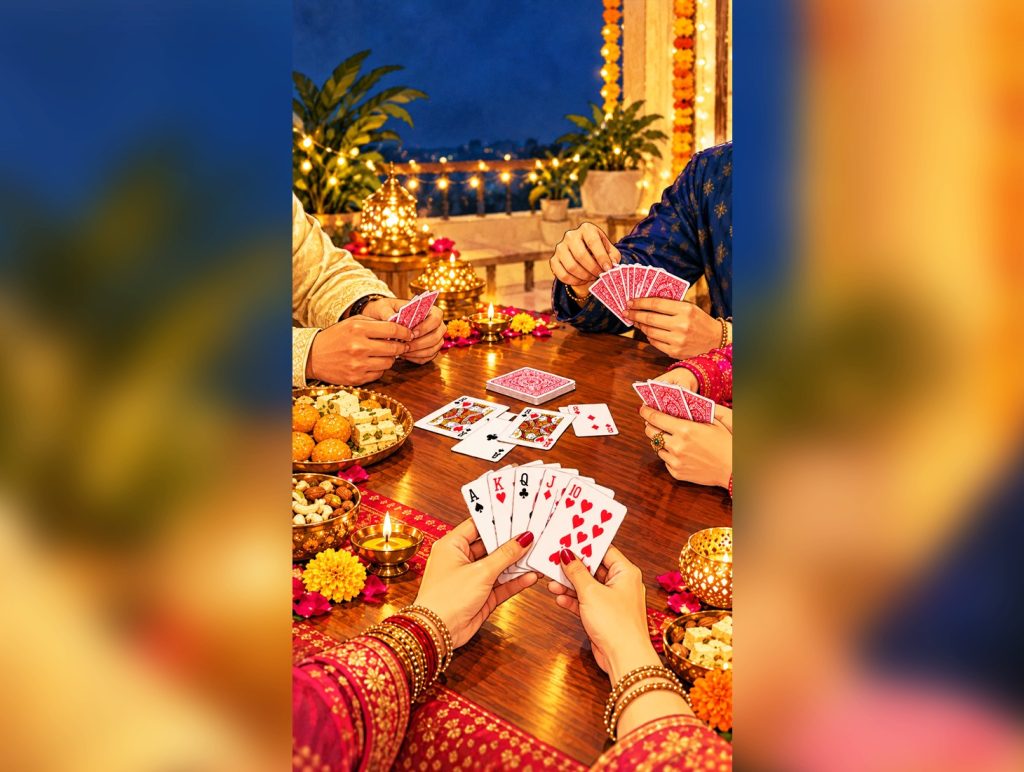

There is a particular kind of magic to Diwali evenings. The earthen diyas flicker at the entrance, marigold garlands frame the doorways, mithai is passed around in silver trays, and somewhere in the heart of a brightly lit home, a deck of cards is waiting to be shuffled.
The sound is unmistakable — cards sliding against one another, a burst of laughter from the corner sofa, someone calling for another round, and the familiar refrain of “Bas, yeh aakhri baazi hai.” Of course, it rarely is.
Diwali and cards have shared a long-standing cultural association in many Indian households. Often played among family and friends, the game becomes less about the money at stake and more about the company, the rituals and the stories that unfold around the table. For some, it is a tradition passed down through generations; for others, it is an excuse to gather old friends under one roof.
The origins of this association are often linked to Hindu mythology and folklore. Popular traditions connect card-playing during Diwali with Goddess Lakshmi and the hope of inviting prosperity and good fortune into the home. Stories also associate the festival with Goddess Parvati and Lord Shiva playing dice.
Over time, the humble deck of cards found its place alongside the more familiar symbols of Diwali. The teen patti table became as much a feature of some festive gatherings as the rangoli at the doorstep or the box of kaju katli on the dining table.
Every card party has its characters. There is the confident player who announces victory before the cards are even dealt, the quiet observer who suddenly wins a round, the friend who insists that luck is finally on their side, and the seasoned player who claims to have a foolproof strategy. There are whispered calculations, dramatic pauses, mock accusations of bad luck and triumphant celebrations over the smallest of wins.
The cards may be the centrepiece, but the real game is often played in expressions, gestures and conversations. A raised eyebrow can say more than a winning hand; a well-timed joke can turn a losing streak into the evening’s most memorable moment.
Shuffling Traditions: The Enduring Charm of Diwali Card Parties
In cities such as Chandigarh, where festive entertaining often brings together friends, neighbours and extended families, Diwali card parties have acquired their own social style. Some are intimate affairs around a coffee table, with home-cooked snacks and familiar faces. Others are elaborate gatherings with festive dress code, carefully planned menus, music, cocktails and tables set aside for different games. The scale may change, but the appeal remains the same: an evening that stretches beyond the usual boundaries of time.
For Mannat Sandhu, a fashion designer from Sector 2, Chandigarh, Diwali is as much about hosting memorable soirées as it is about celebrating the festival of lights. Her lavish annual card party, hosted at her plush home, is planned well in advance, with every detail carefully curated.
“I start planning my annual Diwali card party a month in advance and make sure to serve the best of cuisine, drinks and décor to my guests. The party often includes Sufi gayaki by renowned classical singers from the city,” she says, describing an evening where music, merriment and the age-old tradition of cards come together.
For city-based fashion designer Sanam Sharma, the festive season feels incomplete without the familiar ritual of card parties. “Diwali is incomplete without card parties. My friends and I host card parties for a week before Diwali, with the grand climax scheduled for Dhanteras. We have been doing this for years, and these parties are the icing on the cake when it comes to Diwali,” she says.
For Sangeet Bains, a businessman from Amritsar, the cards are merely an excuse to bring people closer. The real winnings are the memories made with family and old friends.
“Every year, Diwali parties are more like annual reunions with my extended family and friends from my school days. We start the parties a fortnight before Diwali and end up having the time of our lives,” he says.
Still, beneath the sparkle and sophistication, the sentiment remains familiar. Diwali is a festival of renewal, togetherness and hope. The cards simply add an element of unpredictability — a reminder that life, much like a game, rarely unfolds exactly as planned.
As the night grows late and the last few sweets disappear from the platter, the cards are finally gathered into a neat stack. Someone counts their winnings, someone else laughs off a loss, and another promises to host the next gathering.
Outside, the diyas continue to glow.
Inside, the stories linger — of lucky hands, unexpected victories, old friendships and the kind of laughter that cannot be planned.
Because the real jackpot of a Diwali card party may have little to do with the cards at all. It lies in the people gathered around the table, the traditions they carry and the memories they create, one hand at a time.
After all, fortunes may change with every shuffle, but the joy of coming together is the one tradition worth keeping.
A photograph can capture a moment, but for artist and photographer Diwan Manna, it can…

Chandigarh is gearing up for the SBI Green Marathon Chandigarh 2026 – Season 7, scheduled…
Journaling is more than just writing down your daily experiences; it is a powerful way…
The Bihar Foundation’s Punjab and Chandigarh Chapter has invited Punjab Governor and Chandigarh Administrator Gulab…