





 Dr Kiran Deep
New Delhi, April 18
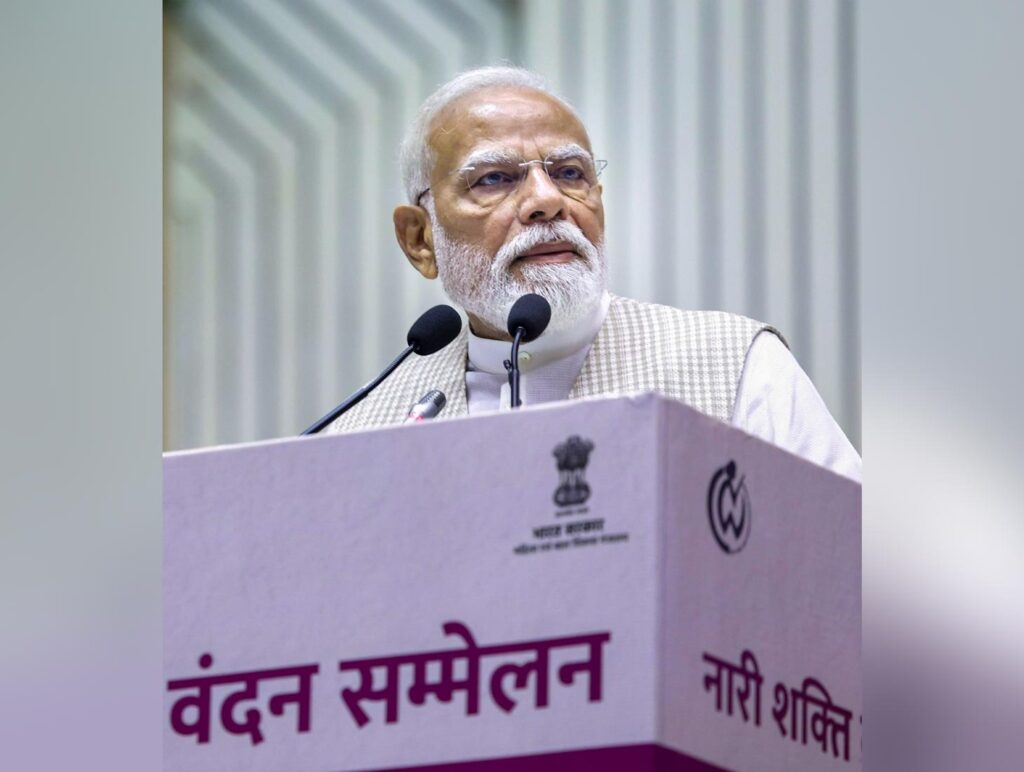
Prime Minister Narendra Modi on Saturday sharply criticised the opposition Indian National Congress, calling it an “anti-reform party” that obstructs efforts to strengthen the country, a day after a key constitutional amendment bill failed to pass in parliament.
In a televised address on Saturday, Narendra Modi accused Congress of misleading the public whenever reforms are proposed, saying the party “deploys its full force” to block measures aimed at national development.
His remarks followed the defeat of the Constitution (131st Amendment) Bill in the Lok Sabha. The proposed law sought to expand the number of seats in the lower house from 543 to 816 and enable 33% reservation for women in legislatures by 2029.
The prime minister said Congress had “missed an opportunity” to support women’s representation, arguing that its opposition reflected a broader pattern of resisting reform.
“Whatever reforms are necessary for 21st-century India, Congress opposes them and creates obstacles,” he said.
Narendra Modi also accused the party of weakening regional allies, alleging it had pushed smaller parties to oppose the bill. He described Congress as politically diminished and dependent on regional partners.
Listing past policies, the prime minister said Congress had opposed initiatives such as financial inclusion schemes, digital payments, the Goods and Services Tax, and the scrapping of Article 370. He also cited resistance to the criminalisation of triple talaq and proposals such as a uniform civil code.
Congress, he added, has opposed “one nation, one election”, changes to electoral rolls, reforms in waqf boards and citizenship measures under the Citizenship Amendment Act.
The bill’s defeat came after it failed to secure the required two-thirds majority in the Lok Sabha. Of the 528 members who voted, 298 supported the measure while 230 opposed it, falling short of the 352 votes needed.
The legislation had proposed a major expansion of parliamentary and state assembly seats to implement women’s reservation following a delimitation exercise based on the 2011 Census.
A special three-day parliamentary session, held from 16 to 18 April, had been convened to consider the bill.
Devastating floods along the Nepal-Tibet border, reportedly killed 270 people so far, have once again…
Jabalpur, June 26 The Madhya Pradesh High Court on Thursday dismissed a defamation case against…
New Delhi, June 25 Prime Minister Narendra Modi on Thursday described the Emergency imposed in…
The Centre government has said that a passport has never been considered conclusive proof of…