








 The North News
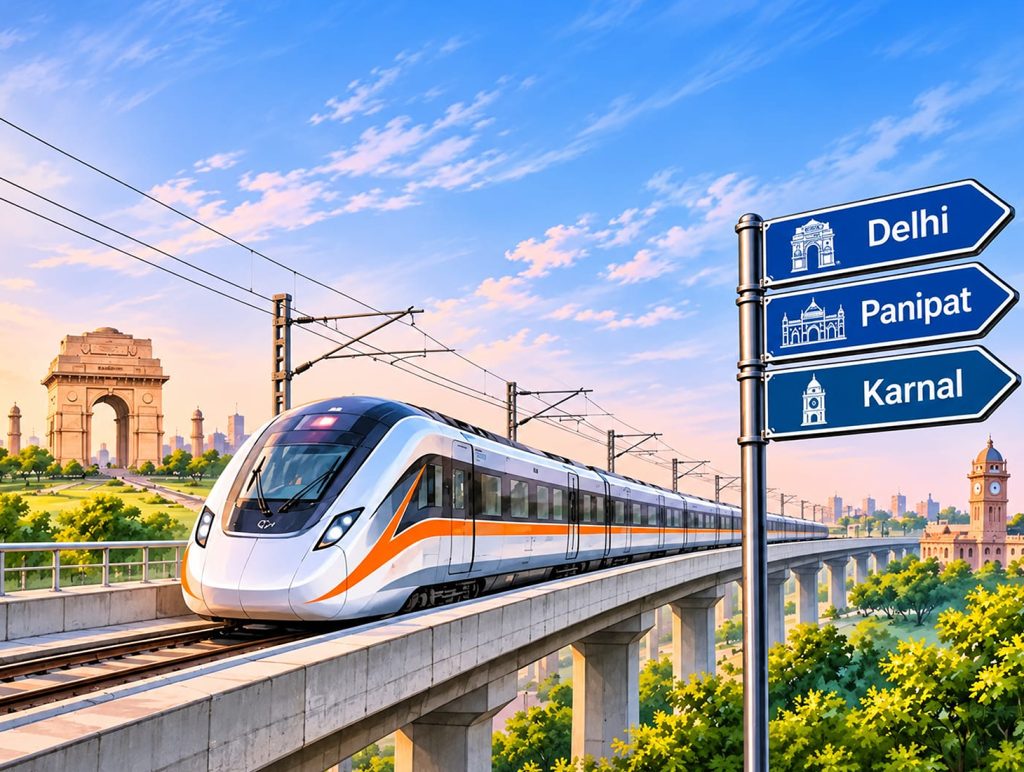
An hour on the train instead of nearly three hours on the highway could change the daily routine of thousands travelling between Panipat and Delhi. The proposed Namo Bharat corridor, connecting Delhi with Karnal through Sonipat and Panipat, promises to make long-distance commuting faster and bring North Haryana closer to the National Capital Region (NCR).
The 136.3-km Delhi-Panipat-Karnal Regional Rapid Transit System (RRTS) corridor will run from Sarai Kale Khan in Delhi through Kundli, Sonipat, Ganaur, Samalkha and Panipat before reaching Karnal. Targeted for completion by 2030, the project is expected to reduce the Delhi-Panipat journey to around 60 minutes from the present 2.5 hours by road. The Delhi-Karnal journey, currently taking 3.5 to four hours by road, could come down to approximately 90 minutes, according to the Haryana Government.
A wider job market, without changing cities
The biggest change could be in the relationship between where people live and where they work. Shorter journeys could make Delhi and other NCR employment centres more accessible to professionals based in North Haryana, reducing the pressure to move closer to workplaces.
The shift could also work the other way. Improved regional connectivity could make Sonipat, Panipat and Karnal more attractive locations for businesses looking beyond established NCR commercial centres. Easier movement of employees, clients and service professionals could support new commercial activity along the corridor.
Education and healthcare within easier reach
Connectivity to Delhi and major educational centres in Sonipat could expand access to universities, professional courses, coaching facilities and internships. The same advantage could extend to healthcare, particularly for patients requiring specialised consultations and treatment in the national capital.
Faster regional transport would not replace the need for better local facilities, but it could reduce the time and difficulty involved in reaching services available in larger cities.
Beyond faster trains
The economic impact could extend to Panipat’s textile industry, Sonipat’s manufacturing and educational hubs and Karnal’s commercial and agricultural sectors. Improved connectivity could strengthen business links, encourage investment and create demand for offices, retail spaces and housing.
Haryana’s Transit-Oriented Development policy, which brings the proposed alignment under a planned development framework, could further encourage mixed-use projects and commercial activity around transit stations.
Last-mile link will hold the key
The promised reduction in travel time will translate into everyday convenience only if stations are supported by affordable fares, feeder buses, parking and reliable local transport. Without effective last-mile connectivity, the advantage of a faster train could remain limited.
The proposed corridor is therefore about more than cutting the distance between Delhi and Karnal. Its larger promise lies in connecting North Haryana more closely with the region’s employment, education, healthcare and business networks, while allowing its cities to retain their own economic and residential identity.

Despite a more than threefold increase in corporate social responsibility (CSR) spending in the Northeast…

MINI India is set to bring the new-generation all-electric MINI Cooper SE to the country…

Bharat Sanchar Nigam Limited (BSNL) has introduced three voice and SMS-only prepaid recharge plans priced…

Motorola is set to unveil its Edge 70 Neo smartphone in India on Tuesday, November…