








 Disney Brar
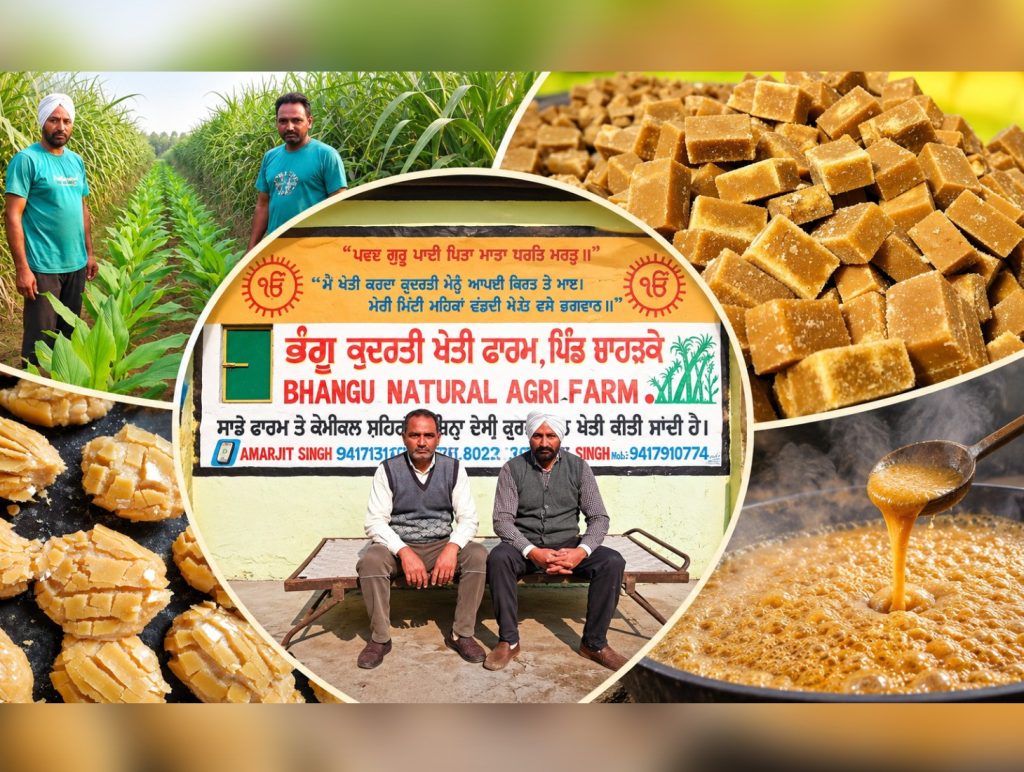
From the smoky furnaces of Hoshiarpur’s villages to the old gur mandis of Ludhiana and Jalandhar, Punjab’s traditional jaggery trade stands at a crossroads. As farmers and Punjab Agricultural University explore ways to revive gur-making, the age-old culture of the village kolhu is steadily losing ground.
Chandigarh: With the onset of winter, sugarcane harvesting is gathering pace across Punjab. Traditionally, this time of the year also marked the beginning of an age-old seasonal ritual in the state’s villages — the crushing of sugarcane in kolhus, the boiling of fresh juice in enormous iron kadais and the unmistakable aroma of freshly prepared gur filling the air. Today, however, this familiar rural landscape is gradually disappearing.
Gur, or desi jaggery, has never been merely a sweetener in Punjab. It is deeply woven into the state’s agricultural culture, winter cuisine and food traditions. Yet, as mechanised production, changing consumer preferences and competition from refined sugar reshape the market, the traditional village-based gur industry is struggling to retain its place.
Punjab, however, is not short of gur-making expertise. Hoshiarpur remains one of the state’s important production centres, particularly along the Dasuya-Tanda and Hoshiarpur-Hariana stretches. The Nawanshahr (Shahid Bhagat Singh Nagar) region is also recognised for its jaggery production. Faridkot’s Bargari belt and parts of Jalandhar’s sugarcane-growing countryside continue to contribute to the state’s traditional gur economy.
A 2023 Punjab government food-processing report identified more than 250 jaggery-making units in Hoshiarpur district, most of them following traditional processing methods. These small-scale enterprises, locally associated with the kulahdi or belna, represent an important rural activity, connecting sugarcane cultivation with local value addition.
As Kolhus Fall Silent, Punjab’s Traditional Gur Industry Seeks a Revival
The process of making gur carries generations of inherited knowledge. Freshly harvested sugarcane is crushed to extract its juice, which is filtered and transferred to large open kadais. The liquid is slowly boiled, clarified and continuously stirred until it reaches the desired consistency. It is then cooled and moulded into solid blocks or further processed into shakkar. In many villages, bagasse and other agricultural residues have traditionally been used as fuel for the furnaces.
For farmers, gur-making offered an alternative to selling their entire sugarcane harvest to mills. For villagers, it provided seasonal employment and an opportunity to purchase fresh produce directly from the source. Families would visit these units to taste warm gur and take home freshly prepared tikki gur and shakkar.
The changing fortunes of this traditional trade are also reflected in Punjab’s old markets. Ludhiana’s gur mandi in Chaura Bazaar, once associated with the trading of traditional jaggery, has gradually acquired a different commercial identity. Jalandhar’s historic gur mandi, whose origins have been traced to the late nineteenth century in earlier reports, has also witnessed a decline in the prominence of its traditional trade.
Signs of a revival
Despite these challenges, there are encouraging signs of renewed interest in traditional gur-making.
In March 2026, Punjab Agricultural University (PAU), Ludhiana, organised a two-day training programme on sugarcane processing and value addition in gur products. The programme focused on hygiene, quality control, packaging and improved production techniques. Earlier, its Krishi Vigyan Kendra in Kapurthala had conducted training sessions for jaggery producers, encouraging farmers to explore gur-making and other sugarcane-based products.
The renewed interest is not without reason. Amarjit Singh Bhangu, a farmer from Charke village in Jalandhar district, has demonstrated the growing market potential of traditionally prepared sugarcane products. His organic gur, shakkar and other products have reportedly been booked until March 2027.
Talking to The North News, Bhangu says social media has played a significant role in creating awareness about traditional gur-making and bringing farmers across the Doaba region together to save the old and traditional gur making tradition of Punjab.
“Thanks to the awareness created through social media, nearly 250 farmers from the Doaba, Majha and Malwa region have formed groups to promote the production of high-quality gur which comes in 75 varieties which is available with us. In fact, many farmers have now started setting up mitti diyan taudiyan, lakad diyan kadshiyan and lohe diyan kadaiyan to prepare fresh gur using traditional methods,” he says.
However, Bhangu also cautions consumers against purchasing adulterated gur sold at roadside stalls. He alleges that some vendors use spoiled or impure boora sugar in the preparation of gur instead of fresh sugarcane juice, raising concerns about the quality and safety of such products. He advises consumers to check the source and method of preparation before making a purchase.
Punjab’s Gur: A Taste of Tradition in Search of Revival
For those looking to buy Punjab-made gur, the Hoshiarpur-Dasuya-Tanda belt, Nawanshahr and Charke village in Jalandhar are among the areas worth exploring. Bargari in Faridkot is another known destination for traditional jaggery. However, consumers should prioritise identifiable local producers, check production and packaging details, and ask about the source of sugarcane and processing methods rather than judging quality by colour alone.
Scientific support could also play an important role in strengthening the traditional industry. PAU identifies CoPb 92, Co 118, CoJ 64 and CoJ 88 among the sugarcane varieties suitable for producing good-quality gur and shakkar. This highlights the potential of combining traditional expertise with scientific practices to improve the quality and consistency of the final product.
The larger challenge is to make gur-making economically viable for small farmers without compromising its traditional character. Better equipment, cleaner processing practices, dependable markets and stronger branding could help local producers compete with commercially manufactured products.
Gur continues to hold a special place in Punjab’s winter kitchens — whether in gur di chah, pinni, panjiri, gur de chawal or the seasonal celebrations of Lohri. Yet, the culture surrounding its preparation is becoming increasingly less visible.
Punjab may not be losing its appetite for gur, but it risks losing the farmers, artisans and village traditions that have given this winter delicacy its distinctive identity. Preserving this heritage will require more than nostalgia. It will need sustained institutional support, consumer awareness and, above all, a market that rewards the people who continue to make it.
The Punjab government has announced a one-time settlement (OTS) scheme offering a 100 percent waiver…
From mustard fields and organic farms to tractor rides, traditional kitchens and village courtyards, Punjab…
With Jalandhar and Mandi Gobindgarh recording an AQI of 336, Punjab’s pollution levels rise across…

Prime Minister Narendra Modi celebrated Diwali with security personnel at the CoBRA Operations Base at…