








 Manjari Verma
Chandigarh, September 13
For Kamla K. Kapur, Guru Nanak Dev is not merely a figure from history or the subject of spiritual scholarship. He is a companion, a guide and, in difficult moments, a source of direction.
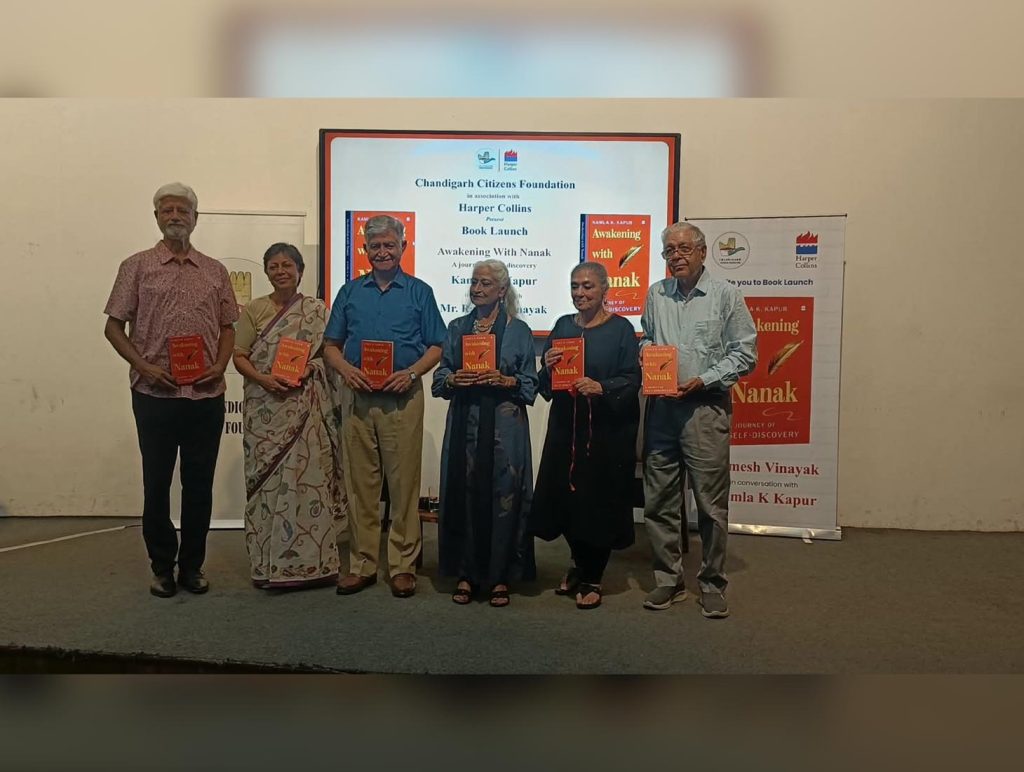
That deeply personal relationship forms the heart of her new book, Awakening with Nanak, which was released in Chandigarh at a session organised by the Chandigarh Citizens Foundation at the Government Museum and Art Gallery. The programme opened with a rendition on the rebab, recalling the instrument traditionally associated with Bhai Mardana, followed by performances by Bhai Baldeep Singh and young rebabi Gurdeep Singh.
In conversation with the Executive Editor of Hindustan Times, Kapur described the book as an account of an inner pilgrimage — one that moves towards the self and, ultimately, towards the divine.
The 21 essays bring together spiritual reflection, memoir, storytelling and lived experience. Kapur draws upon personal struggles, vulnerabilities and moments of uncertainty to examine how Guru Nanak’s teachings can be applied to everyday life.
The book acquired a deeply personal dimension when Kapur experienced a series of serious health problems while writing it. She recalled the onset of multiple autoimmune illnesses, necrosis of the bones and severe coronary disease.
Rather than treating these experiences as separate from her spiritual journey, she eventually understood them as part of the story she needed to tell.
“I realised when I was writing the ninth chapter that these experiences of illness were given to me precisely because I needed to weave them into the book,” she said.
For Kapur, Guru Nanak’s teachings became less an abstract philosophy and more a set of practical tools for confronting uncertainty, suffering and fear.
“My illness has bequeathed me the precious gift of time — to slowly and deliberately practice Nanak’s tools, to anchor myself in his words,” she writes.
That experience also shaped her understanding of healing. The pilgrimage described in the book is not about escaping life’s difficulties, but about turning inward and discovering a deeper sense of self.
Perhaps the most contemporary dimension of Kapur’s book is her attempt to connect Guru Nanak’s teachings with the anxieties faced by young people.
Stress, self-doubt, competition, comparison and the constant pressure to measure up have become familiar features of modern life. Kapur believes the teachings of the Sikh Gurus offer young people practical ways to confront these pressures rather than simply philosophical answers.
She said she has even received permission to write a book specifically addressing issues such as anxiety and fear through the teachings of the Gurus.
Recalling a response from her 19-year-old grandniece, Kapur said the young reader was able to connect with the material and felt that it spoke directly to her experiences.
For Kapur, that connection is important because young people should not have to wait until later in life to discover these teachings.
One of the practices she highlights is Naam, a concept that she says appears thousands of times in the Guru Granth. Rather than prescribing a single name or form of worship, she encourages individuals to discover a personal way of connecting with the divine.
She suggests beginning with something simple: setting aside a few minutes each day, sitting quietly, closing the eyes, breathing deeply, and repeating the name of one’s beloved or chosen spiritual figure.
“Breathing is the heart of the matter,” she said, stressing that the practice is simple but requires consistency.
For a generation accustomed to constant stimulation and comparison, the exercise is ultimately about creating a moment of stillness and reconnecting with oneself.
Another important idea explored by Kapur is contentment.
She recalls that when she was around nine or ten years old, she was asked what she wanted to become when she grew up. Her spontaneous answer was that she wanted “to be content”.
Only much later, while writing the book, did she begin to explore what contentment actually meant.
For Kapur, contentment does not mean abandoning ambition. It means accepting one’s present circumstances as the starting point for further growth.
She connects this idea to the modern tendency to compare oneself with others — a habit that can be especially damaging in the age of social media.
The constant exposure to other people’s appearances, achievements, and lifestyles can make individuals feel that their own lives are inadequate.
Kapur draws on Ralph Waldo Emerson’s observation that “envy is ignorance” and “imitation is suicide” to argue that each person’s journey is inherently different.
The challenge, therefore, is not to stop striving, but to stop measuring one’s worth against somebody else’s life.
Kapur also speaks of hukam, or acceptance of what unfolds in life.
She recalls that earlier she would become frustrated when prayers did not produce the outcomes she wanted. Over time, she came to see surrender differently.
“What I beg for now is good fortune, big happiness,” she said, explaining that she has moved towards accepting whatever happens in her life.
For her, surrender does not mean passivity. It means doing what one can while releasing the burden of believing that everything must happen according to one’s wishes.
This understanding becomes particularly significant in her discussion of death. Kapur devotes several chapters of the book to mortality, drawing on the teachings of the Gurus and her own encounters with the idea of death.
She argues that recognising life’s impermanence can itself change the way people live.
Kapur’s reading of Guru Nanak also centres on the idea of oneness.
She believes his message has renewed relevance in a world divided by religion, identity and social distinctions. Guru Nanak’s teachings, she argues, point towards one supreme power rather than separate gods belonging to different communities.
She also emphasises the universality of the human race and Guru Nanak’s rejection of social divisions.
Her discussion extends to gender as well. She argues that Guru Nanak’s teachings challenge rigid ideas about masculinity and femininity and call for greater gentleness among men.
For Kapur, knowing oneself means looking beyond the roles imposed by society — daughter, mother, Sikh, professional or any other identity — and asking a more fundamental question: who am I beneath all these roles?
The book also connects Guru Nanak’s teachings with environmental responsibility.
Kapur points to the Guru’s reverence for water, earth, and the natural world, arguing that environmental consciousness is not a modern Western discovery but has deep roots in Indian spiritual thought.
She believes this message should be introduced to children from an early age, particularly in a country facing serious pollution and environmental challenges.
The larger argument running through Awakening with Nanak is that spirituality need not remain confined to ritual or religious identity. It can become a practical way of navigating everyday life.
That is perhaps why Kapur’s conversation with Vinayak repeatedly returns to the idea of practice — breathing, reflection, contentment, surrender and the discipline of examining one’s own mind.
Her book, she suggests, is ultimately an invitation to begin that journey inward.
And for a generation searching for ways to cope with a world that rarely falls silent, Kapur’s interpretation of Guru Nanak offers a simple starting point: pause, breathe, look within — and begin the journey from there.

From celebrity selfies to everyday posts, everyone is getting an AI-powered ’80s makeover Chandigarh ,…

Mandy Takhar unveils the trailer of her upcoming film, ‘Tutt Paini English Ne’ at Jashan…

Author reflects on motherhood, grief, betrayal, healing & personal experiences that shaped her maiden book…

Actor couple Dan Dhanoa and Nandita Puri’s artistically done-up abode, Anchorage 42, is a…