








 Jasriman Kaur
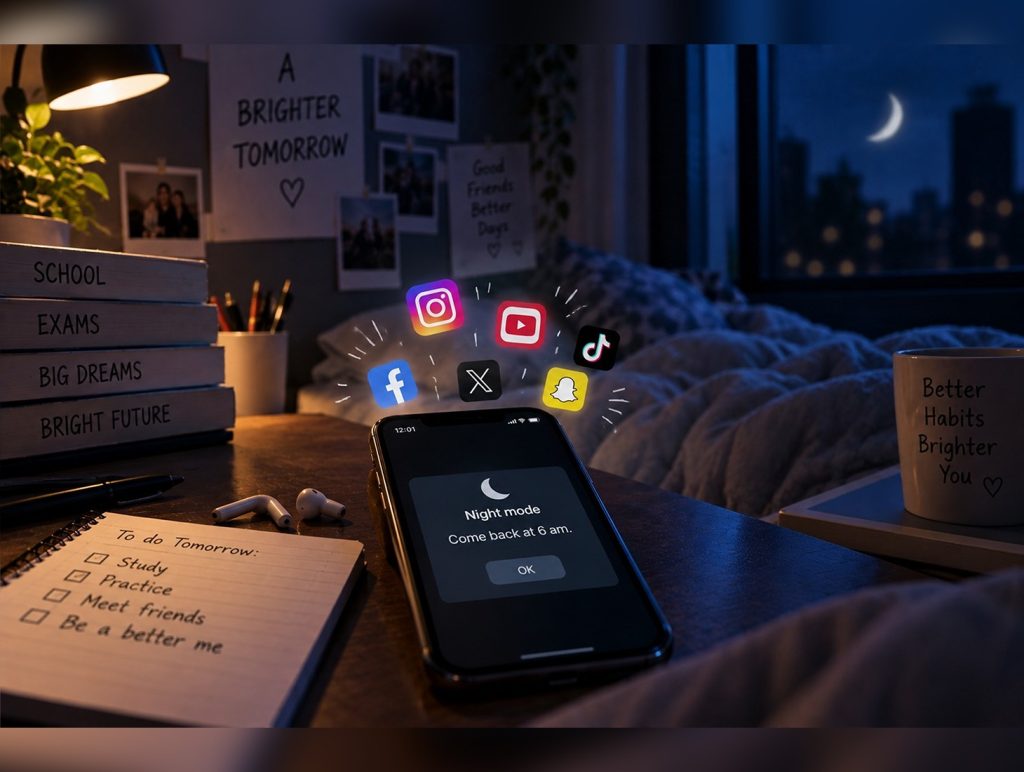

Imagine this: It’s 12:01 am, you open Instagram and instead of reels, you get a message: “Come back at 6 am.”
For teenagers in parts of the US, that could soon become a reality.
Meta has agreed to introduce a default midnight-to-6 am night mode for users Under 18 in participating US states and territories, along with a two-hour daily limit across Instagram and Facebook. Parents will have more control over these settings, while features such as feed, stories, explore and reels will be blocked during the night mode. Direct messages will still work.
At first glance, it sounds like a simple solution. Teenagers need sleep. Social media keeps them awake. So switch it off at midnight.
Because “just five minutes on Instagram” has become one of the biggest lies of the smartphone era.
One reel becomes 10, ten become 50 and suddenly it is 1.30 am. You tell yourself you will sleep after the next video. Then another one appears.
But there is another side to this story. Social media is not just about wasting time. For many teenagers, it is also where they learn, discover opportunities, follow interests, stay in touch with friends and find communities they may not have access to offline.
And that is what makes the debate less straightforward than simply asking whether teenagers should be on social media at night. The smartphone itself is now deeply embedded in young Indians’ lives. The Government’s Comprehensive Modular Survey Telecom 2025 found that 97.1 per cent of people aged 15-29 had used a mobile phone in the previous three months. Internet use stood at 94.3 per cent among those aged 15-24 and 93.6 per cent among those aged 15-29.
The same survey found that 68.7 per cent of 15-29-year-olds reported being able to perform online banking transactions, while 99.5 per cent of those with that ability said they could use the UPI. Around 85.5 per cent of households had at least one smartphone and 86.3 per cent had Internet access at home.
So, the phone is no longer just a device for watching reels or YouTube videos. For a large section of young India, it is a classroom, a bank, a communication tool, a workplace and a source of entertainment.
That is why the question cannot simply be whether teenagers should be allowed on their phones after midnight. It is also about who gets to decide what is healthy use: The parent, the teenager, the platform or the government.

There is a strong argument for parental control. Parents know their children better than an algorithm does. A family with a 14-year-old who struggles to sleep may want a strict night-time block. Another family may be comfortable with a teenager using the phone late for studying, working on a project or talking to family in another time zone.
And this is where a blanket rule can become complicated. A blanket two-hour limit cannot possibly understand all those differences. Two hours spent watching endless short videos is not necessarily the same as two hours spent learning a language, attending an online class or speaking to family.
But there is another problem.
Most teenagers are not going to voluntarily say, “I think I have spent enough time on Instagram or YouTube today. Let me switch it off.”
That sounds a little like putting a box of chocolates in front of someone and then blaming them for finishing it.
This is also where the platforms come into the picture. Instagram, Facebook and YouTube may work differently, but they are all competing for the same scarce resource: Our attention.
Every additional video watched, every scroll, every share and every minute spent on a platform creates another opportunity for engagement and advertising.
So, a mandatory night-time shutdown is not only a child-safety measure. From the platform’s point of view, it also means giving up hours in which users could otherwise be active.
But that does not mean every problem can be placed at the door of the platforms.
Parents have a role. Schools have a role. Teenagers themselves have a role. And governments have a role in setting reasonable standards.
The bigger question is what those standards should look like.
Meta’s settlement is interesting precisely because it goes beyond a clock. It includes stronger age assurance, hidden likes, controls over autoplay and an option for a non-algorithmic feed. That is important because the problem may not simply be how long teenagers are online, but what they are being encouraged to watch while they are there.
If a teenager spends two hours deliberately watching videos about mathematics, music or photography, that is a very different experience from two hours of an algorithm continuously serving increasingly engaging content.
And this brings us to another weakness in any single-platform solution.
The Internet does not stop at one app.
Meta itself has acknowledged this, calling on TikTok and YouTube to adopt similar measures because teenagers move between platforms. If Instagram or Facebook switches off at midnight but YouTube stays open, the scrolling has not necessarily stopped.
The teenager has simply moved to another app.
So, even a well-intentioned curfew can have a very simple loophole: The Internet is bigger than the app imposing the restriction.
That is why India should be careful about simply copying the American model.
Instagram already has Teen Accounts in India, with stricter privacy and messaging settings, a 60-minute usage reminder, sleep mode and parental controls. Parents can also set daily limits and block Instagram during specific hours.
These are useful safeguards, but perhaps they should be seen as part of a bigger digital-safety framework rather than the complete answer.
Perhaps the next step should not be a race to impose the strictest curfew. It should be about making safer digital habits the default across platforms, while still leaving reasonable room for parents and teenagers to make choices.
There should be stronger age assurance. Better parental controls. More transparency about recommendation systems. Easier ways to turn off autoplay. More meaningful warnings about excessive use. And, perhaps most importantly, safeguards that work across platforms rather than one app at a time.
Because if Instagram closes at midnight, Facebook follows and YouTube remains open, we have not really solved the problem.
We have only changed the app.
The real issue is not Instagram after midnight.
It is whether we are comfortable allowing platforms built around attention to compete with a child’s sleep, while also pretending that the phone has no genuine value in a young person’s life.
Maybe the real reset we need isn’t just an Instagram setting.
Maybe it’s a cultural one!
Punjab has heard promises to end its drug menace for years. The governments have announced…

The Congress has turned to Sachin Pilot in the hope of bringing its deeply divided…
“Aanewala Pal Jaane Wala Hai, Ho Sake To Iss Mein Zindagi Bita Do…” These…

Chandigarh, August 4 One phone call. A crying daughter on the other side desperately seeking…