


 The North News
The North News
(Kevadiya), Gujarat, October 31
Prime Minister Narendra Modi on Friday said that India’s first Prime Minister, Jawaharlal Nehru, prevented Sardar Vallabhbhai Patel from integrating the entire region of Kashmir into India, despite Patel’s wish to do so after the country’s independence in 1947.
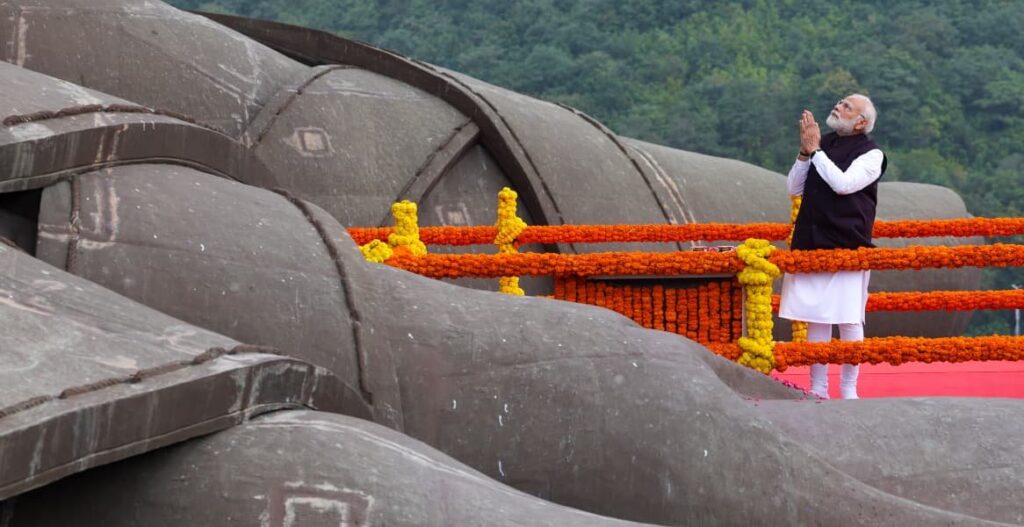
Speaking at the Rashtriya Ekta Diwas (National Unity Day) celebrations in Kevadiya, Gujarat, Modi said Patel’s vision for Kashmir was “stopped” by Nehru’s intervention. The event, held annually to mark Patel’s birth anniversary, featured a ‘Run for Unity’, a parade by security forces, and a tribute ceremony at the Statue of Unity, the world’s tallest statue dedicated to Patel.
“Sardar Patel wanted to unite the entire Kashmir with India, just as he did with other princely states, but then Prime Minister Nehru did not allow it to happen,” Modi said, addressing a large gathering at the monument site. He added that Kashmir’s separate constitution and emblem — decisions made during Nehru’s tenure — divided the nation and allowed Pakistan to occupy part of the territory and fuel terrorism.
The Prime Minister argued that both Kashmir and the rest of India had “paid a heavy price” for those early policy choices, accusing past governments of lacking “the courage and clarity” to defend national sovereignty.
“Sardar Patel kept the sovereignty of the nation as his top priority. Unfortunately, after his demise, the governments that followed were not serious about the nation’s sovereignty,” Modi said, citing “mistakes in Kashmir, challenges in the Northeast, and Naxal-Maoist violence” as consequences of weak leadership.
Modi contrasted Patel’s decisive approach with what he called the “spineless attitude” of previous administrations, saying his own government was working to “restore Patel’s vision” through a stronger, more unified India.
He also marked Patel’s 150th birth anniversary, unveiling a commemorative coin and a special postal stamp, and called the occasion a “festival of national unity” equal in stature to Independence Day and Republic Day.
Modi described Patel as a leader who believed in creating history rather than writing it, crediting him with uniting more than 550 princely states under the idea of Ek Bharat, Shreshtha Bharat (One India, Great India). “The resolve of New India is visible in every citizen’s commitment to unity,” he said.
Turning to internal security, Modi highlighted his government’s campaign against Naxal-Maoist insurgency, claiming that the number of affected districts had fallen from 125 before 2014 to just 11. He pledged to eliminate the threat entirely and said the “ideological and operational war” against extremists was now being won.
The Prime Minister also issued a warning about “foreign infiltrators,” alleging that they had “seized resources, altered demographics, and endangered national unity.” He accused earlier governments of ignoring the issue for “vote-bank politics” and said his administration had taken “decisive steps” to remove them.
In a broader reflection on political culture, the Prime Minister Modi said unity also meant respecting ideological diversity while rejecting “personal discord.” He accused previous governments of promoting “political untouchability,” claiming that leaders such as B.R. Ambedkar, Ram Manohar Lohia, and Jayaprakash Narayan were sidelined for ideological reasons.
He contrasted that approach with his own government’s, citing the creation of the Prime Ministers’ Museum, and the awarding of national honours such as the Bharat Ratna and Padma awards to figures across party lines, including Pranab Mukherjee and Mulayam Singh Yadav.
Modi accused the main opposition party of retaining a “colonial mindset,” saying it had inherited both “power and mentality” from the British. He claimed the party had once altered the national song, Vande Mataram, on religious grounds, calling the move “the beginning of India’s partition.”
The Prime Minister concluded by describing steps taken by his government to “remove colonial symbols,” including renaming Rajpath to Kartavya Path, redesigning the Indian Navy’s flag, and renaming islands in the Andaman archipelago after Netaji Subhas Chandra Bose and Param Vir Chakra awardees.
“India today stands united, confident and determined,” Modi said. “This is the India of Sardar Patel — strong, sovereign, and unbreakable.”
Six states sign Rs 15,624-crore pact; Delhi, Haryana and Rajasthan to bear state’s estimated power-component…

Did information allegedly held by Sushant Singh Rajput’s former manager about drug trafficking, child abuse…
New Delhi, September 14 Improving political, diplomatic and military engagement between India and China…
Chandigarh, September 14 Prime Minister Narendra Modi on Monday congratulated the Indian women’s cricket team…