Spread the news

The public confidence in democratic institutions depends not only on the decisions they take, but also on how openly those decisions are made and how willing they are to answer questions about them. The reports on differences within the Election Commission of India has brought that issue into focus.
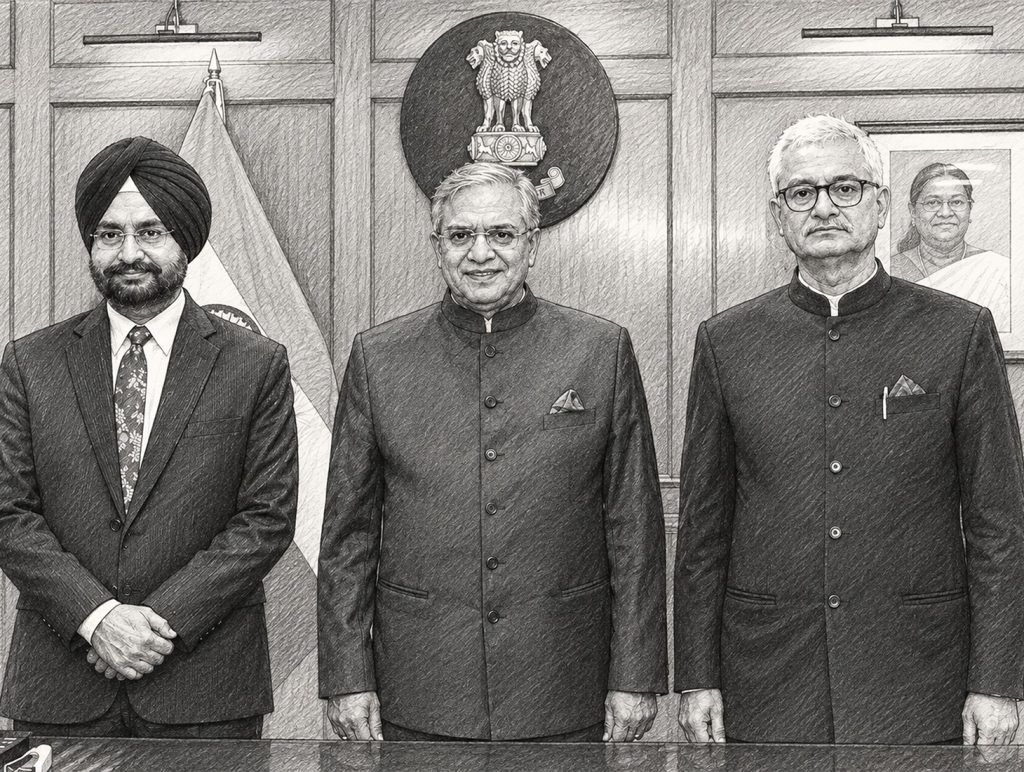
An investigation by The Indian Express reported that Election Commissioners Sukhbir Singh Sandhu and Vivek Joshi had formally raised objections at least 14 times over 10 months. Their concerns covered important aspects of the electoral process, including the revision of electoral rolls, the addition, deletion and restoration of voters, changes to Form 6 for new voters and access to electoral-roll databases.
The report also said the two commissioners had questioned what they described as the increasing centralisation of the electoral-roll database and raised concerns about the management of the technology supporting the rolls. They later wrote separately to the Cabinet Secretary about changes in the allocation of work relating to the Commission’s IT systems.
These developments raise questions that go beyond an internal disagreement.
The Election Commission is responsible for conducting elections and maintaining the integrity of the electoral process. Any questions about how voter information is managed, how names are added or removed, or how decisions are taken therefore have a direct public interest dimension.
But there is another important part of the story. It concerns journalism itself.
The investigative journalism is not simply about finding a story that will attract attention. Its purpose is to examine evidence, question systems and bring matters of public interest into the open.
That responsibility becomes particularly important when the subject is a powerful institution.
The media’s relationship with governments in India has never been simple. Governments and political parties have changed, and so have news organisations. At different times, sections of the media have faced criticism for being too close to those in power, while journalists and publications have also carried out investigations that have challenged governments and public institutions.
The principle should remain the same regardless of who is in office.
A journalist should not become a critic only when one political party is in government, nor should journalism become a defender simply because another party is in power. The responsibility is to examine decisions, verify facts and provide citizens with information they can assess for themselves.
That is the foundation of the watchdog role.The challenge has become greater as the news industry has moved towards social media, short videos and instant updates.
A story can now reach millions of people within minutes. But speed can also create pressure to publish before the facts have been properly checked.
A viral post is not an investigation.
A document still has to be examined. A claim still has to be verified. The people involved still have to be contacted. An institution facing criticism must be given an opportunity to respond.
These basic principles have not changed, even though the technology of journalism has.
The reporting on the Election Commission illustrates why documentary journalism remains important. The Indian Express investigation was based on internal communications and documents that, according to the newspaper, showed repeated objections by two commissioners over decisions and processes within the Commission.But the existence of an objection does not by itself establish that the objection was correct. Nor does an internal disagreement automatically establish wrongdoing.
That distinction is essential.
The journalism must separate what a document establishes from what someone alleges, and what is known from what remains uncertain.The Election Commission has rejected the suggestion that the reported differences amount to a breakdown in its functioning.
It has said that differing views are part of institutional deliberation and that decisions taken by the full Commission including those relating to electoral-roll revision and the Special Intensive Revision process, were unanimous.
That response is part of the story and should be reported alongside the objections raised by the two commissioners.This is where responsible journalism differs from advocacy.
The journalist’s task is not to decide the outcome for the reader. It is to put the evidence, responses and competing claims before the public as clearly as possible.
The controversy has also renewed attention on the way Election Commissioners are appointed.
On 23 September, the Supreme Court referred challenges to the 2023 law governing the appointment of the Chief Election Commissioner and other Election Commissioners to a larger Constitution Bench after a two-judge bench differed on the merits of the case.
The democratic institutions ultimately depend on their own transparency and accountability. But citizens also depend on journalists to explain what happens inside those institutions.
The platforms may change. The technology may change. The speed may change.
The journalist’s responsibility does not. To question power. To verify before publishing. To distinguish fact from allegation. And, above all, to give the public enough evidence to make up its own mind.
There is a temptation in the age of instant news to measure journalism by reach, clicks and shares.
But some of the most important journalism may begin quietly, with a document, a question or an official record that few people initially notice.
The work is slower.
Check the document.
Ask the question.
Contact those involved.
Test the claim.
Publish what can be established.
Correct what is wrong.
And keep following the story.
That is not old-fashioned journalism. It is journalism at its most basic.
Democratic institutions ultimately depend on their own transparency and accountability. But citizens also depend on journalists to explain what happens inside those institutions.
The platforms may change. The technology may change. The speed may change.
The journalist’s responsibility does not.
To question power. To verify before publishing. To distinguish fact from allegation. And, above all, to give the public enough evidence to make up its own mind.






 Dr Kiran Deep