








 Disney Brar
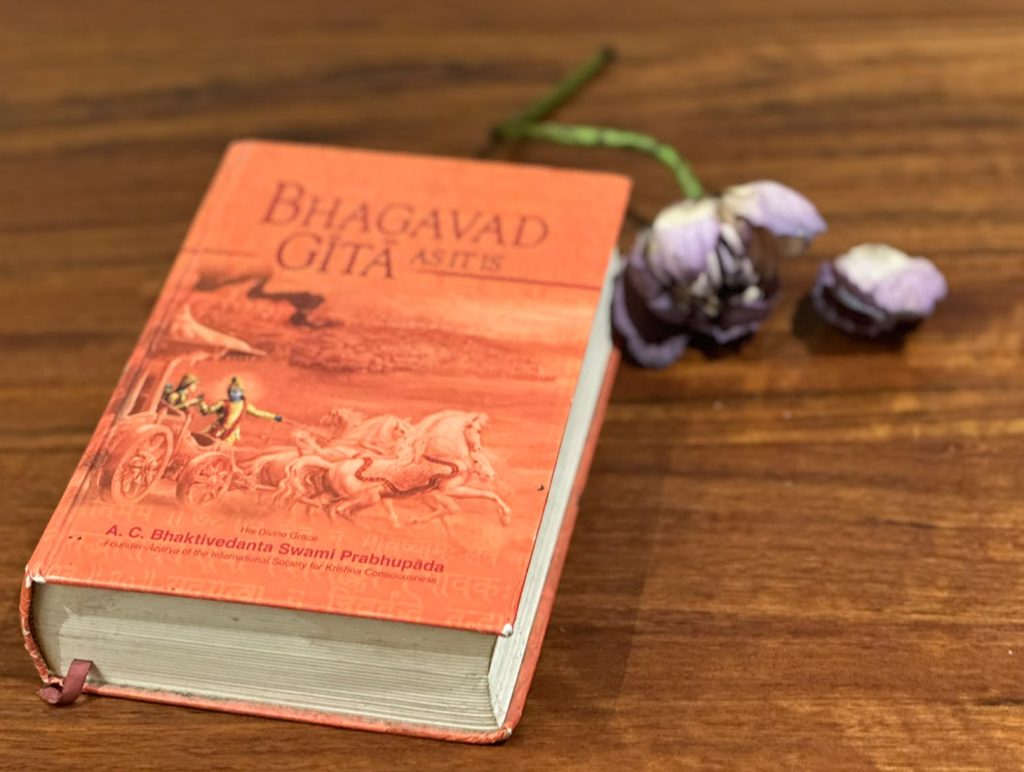
An ancient scripture, a restless mind and a timeless reminder that sometimes the answers we seek are already waiting within us.
There are moments in life when the world seems to fall silent, yet the mind refuses to stop speaking. When relationships become complicated, dreams begin to crumble, people walk away, and the road ahead looks unfamiliar, we find ourselves asking questions that have no easy answers.
Why did this happen to me?
Why do good intentions sometimes lead to painful endings?
Why does life make us choose between what we want and what we must do?
And, perhaps most importantly, how does one find peace when everything around feels uncertain?
Somewhere between these questions and the search for answers lies a timeless conversation — the Bhagavad Gita.
It is not merely a religious text resting on the pages of history. It is a conversation about life, fear, responsibility, love, loss, courage and the difficult art of letting go. A conversation that began on a battlefield thousands of years ago but continues to find its way into the battles we fight within ourselves.
When Arjuna stood on the battlefield of Kurukshetra, he was not simply a warrior struggling to lift his bow. He was a human being caught between emotions, relationships, responsibilities and the fear of consequences. His confusion was deeply human. He questioned his purpose, his choices and the very meaning of his actions.
And that is where the Gita becomes remarkably relevant.
Because, in many ways, we are all Arjuna.
We stand on our own Kurukshetras — some are fighting battles at work, some are struggling to save relationships, some are trying to overcome failures, while others are silently fighting battles nobody knows about.
And just when the weight of everything becomes too heavy, Lord Krishna’s wisdom offers a different way of looking at life.
When failure frightens us, the Gita teaches us the value of karma.
It reminds us that our responsibility lies in our actions, not in our obsession with the results. We can give our best, prepare endlessly and work with complete sincerity, but we cannot control every outcome. Sometimes life does not reward us when we expect it to. Sometimes the journey takes us somewhere we never planned to go. Yet, our efforts are never meaningless.
When relationships hurt, the Gita teaches us the art of detachment.
Detachment does not mean becoming cold or stopping ourselves from loving. It means learning to love without losing ourselves, to care without controlling, and to accept that not everyone who enters our lives is meant to stay forever. Some people become lessons, some become memories, and some become blessings.
When fear takes over, the Gita reminds us of our inner strength.
Fear often makes the future appear bigger than our ability to face it. But Krishna’s message encourages us to look beyond temporary circumstances and recognise the strength that already exists within us. Courage is not the absence of uncertainty; it is the willingness to move forward despite it.
When life brings loss, the Gita speaks of the impermanence of everything.
Nothing in this world remains unchanged. Seasons turn, people change, circumstances shift and even the most difficult phases eventually pass. The Gita invites us to understand that change is not always an ending; sometimes, it is life’s way of making room for a new beginning.
And when the mind becomes its own biggest enemy, the Gita offers perhaps its most beautiful lesson: learn to master the mind before allowing it to master you.
Perhaps this is why the Bhagavad Gita feels less like a book of instructions and more like a companion. It does not promise a life without difficulties. It does not suggest that faith will make every problem disappear overnight. Instead, it teaches us how to stand steady when life refuses to stand still.
It tells us that peace is not necessarily found when everything falls into place. Sometimes, peace begins when we stop demanding that everything must.
There is something profoundly beautiful about the thought that the answers to life’s biggest questions may not always come from changing the world around us, but from changing the way we understand it.
The Gita does not necessarily tell us which road to take; it teaches us how to walk with awareness. It does not promise that we will never fall; it reminds us that we can rise with greater wisdom. It does not take away our responsibilities; it gives us the courage to fulfil them.
And perhaps that is the greatest answer of all.
Because life will continue to ask questions. People will continue to surprise us. Dreams will change, plans will fail, and circumstances will test our patience. But when the heart is confused and the mind is crowded with a thousand unanswered questions, the words of Krishna offer a gentle reminder:
Do your duty. Trust the journey. Release what you cannot control. And never lose yourself in the temporary storms of life.
Maybe the Bhagavad Gita is not the answer to every problem because it makes problems disappear.
Maybe it is the answer because it teaches us how to face every problem without losing our peace, our purpose or ourselves.
And sometimes, that is all the answer a human heart needs.

Festivals may have found new ways to reach people in the digital age, but some…
As winter settles over Punjab, the charm of Kashmiri shawls returns to wardrobes, marketplaces and…

The International Lavi Fair 2026 will be held in Rampur, Himachal Pradesh, from November 11…

The lights have dimmed, the music has faded, the last guests have left and the…