








 Manjari Verma
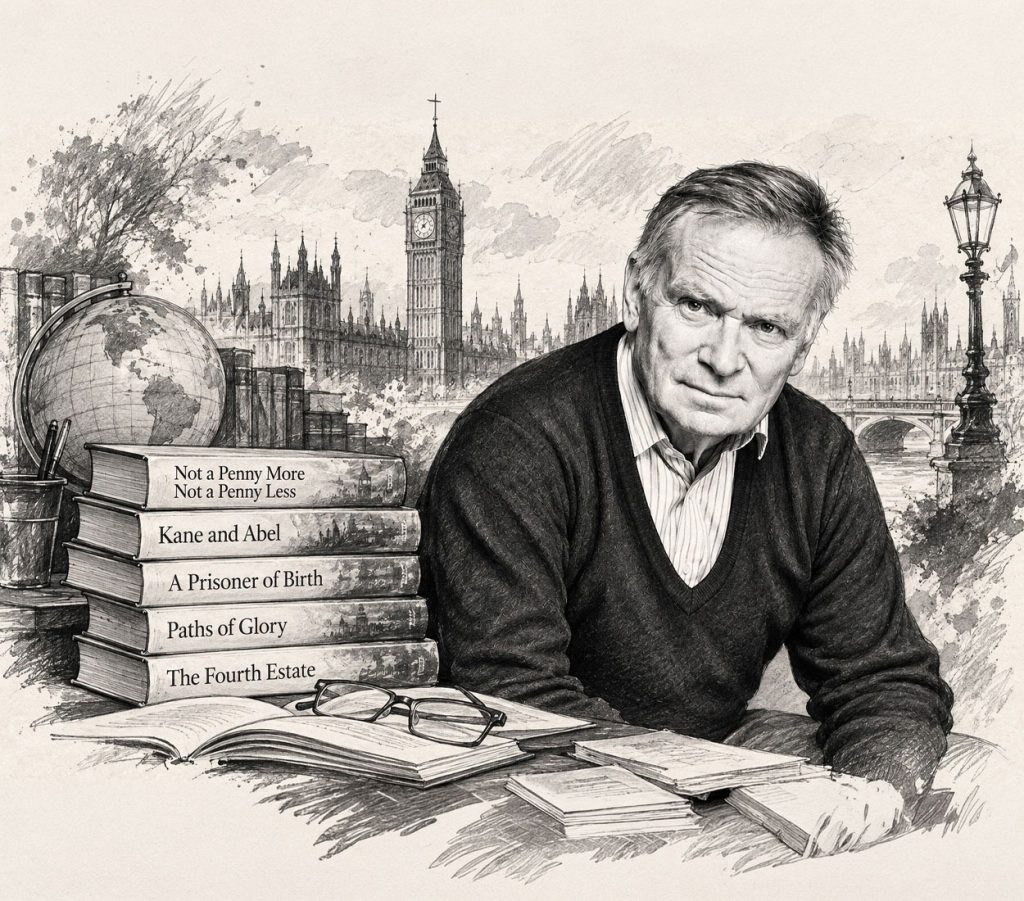
From an athlete and politician to a bestselling novelist and convicted perjurer, Jeffrey Archer lived through extraordinary highs and lows in his lifetime. His death closes a life that often seemed as dramatic as the stories he weaved.
Chandigarh: Some writers spend their lives inventing extraordinary characters. Jeffrey Archer spent his life as a writer doing exactly that and, in a strange twist, became one himself.
His story had almost everything a novelist could ask of a protagonist: ambition and privilege, political power and financial ruin, scandal and imprisonment, public disgrace and reinvention. There were moments of triumph, chapters of controversy, and always another story waiting to be told.
Archer died on October 5, 2026, aged 86. His final novel, Adam & Eve, was due to be published the following day — an almost uncanny coincidence for a writer whose life seemed to resist the idea of a final chapter.
For more than five decades, Archer wrote about people who wanted more: more money, more influence, more power, more time. His novels were populated by ambitious men and women who rose, fell, fought back and tried to alter the course of their lives. Away from the page, Archer’s own life followed a similarly dramatic rhythm.
Born Jeffrey Howard Archer in London in 1940 and raised in Somerset, he grew up surrounded by contradictions. His mother, Lola Archer, was a journalist, while his father, William Archer, had a troubled past involving fraud and bigamy.
Literature, however, was not his first calling.
At Oxford, Archer became an accomplished athlete, earning an ‘Athletics Blue’ and later representing Great Britain. Politics followed. At 29, he became Conservative MP for Louth, beginning a public career that would eventually take him towards the leadership of the Conservative Party and, later, the House of Lords.
But the climb did not continue uninterrupted.
A failed investment pushed Archer towards bankruptcy in the 1970s. Financial necessity helped redirect his ambitions towards writing. His first novel, Not a Penny More, Not a Penny Less, appeared in 1976. Then came Kane and Abel, the book that transformed him into an international bestseller.
The novelist had found his stage.
Archer went on to write a succession of successful novels, including First Among Equals, The Prodigal Daughter, A Matter of Honour, As the Crow Flies and A Prisoner of Birth. His Clifton Chronicles became a sweeping family saga, while the William Warwick books took him into crime and detective fiction.
For journalists, however, The Fourth Estate carried a particular resonance.
Published in 1996, the novel centred on two rival media empires and the men battling for control of them. Inspired partly by real-life newspaper magnates, it examined the uneasy intersection of newspapers, money, influence and power — a world Archer knew not simply as a novelist but as someone who had spent years at the centre of British public life.
Yet the boundary between his fiction and reality was becoming increasingly difficult to draw.
Archer’s political career was eventually overshadowed by scandal. He resigned as Deputy Chairman of the Conservative Party in 1986 and later became embroiled in a legal battle that resulted in his conviction for perjury and perverting the course of justice in 2001.
He was sentenced to four years in prison and served two.
For most people, such a fall might have represented the end of a public life. For Archer, it became another book.
He documented his experience in A Prison Diary, a three-volume account of prison life. Even in one of the most difficult periods of his life, he continued to write, turning experience into narrative and adversity into another chapter.
That instinct to begin again became one of the defining threads of his life.
Archer was married to Dame Mary Archer for nearly six decades. They had two sons, William and James, and five grandchildren. Through political success, financial difficulties, scandal and imprisonment, family remained an important part of his life.
His readers, meanwhile, continued to turn to his books.
Perhaps it was the twists. Perhaps it was the characters who refused to accept defeat. Or perhaps Archer understood one of the oldest truths of storytelling: readers do not simply want to know what has happened. They want to know what happens next.
His characters repeatedly pursued second chances. They lost fortunes and rebuilt them, suffered betrayal and sought revenge, fell from power and fought to return. In many ways, the emotional architecture of Archer’s fiction resembled the arc of his own life.
He was difficult to fit into a single description. He was an athlete who became a politician, a politician who became a bestselling novelist, a celebrated public figure who went to prison, and a controversial man who repeatedly reinvented himself through writing.
There is something fitting about a novelist’s last book arriving just after his death.
Archer spent his life refusing to treat setbacks as endings. A bankruptcy became the beginning of a writing career. Prison became a diary. Political failure became material. Controversy became another chapter in a life already crowded with them.
Now there is no next chapter.
The man who spent decades asking readers to turn one more page has finally reached the last one. Yet the irony is unmistakable: Jeffrey Archer may have written thousands of pages, but it was his own life — its triumphs, contradictions, failures and improbable returns — that ultimately became his most extraordinary story.
And perhaps that is the legacy of Jeffrey Archer: not simply that he knew how to tell a story, but that, until the very end, he lived as though every ending was only an invitation to begin again.
Washington/Tehran, July 9 A fragile truce in the Middle East came under renewed strain on…

Berlin, June 29 France recorded around 1,000 additional deaths during last week’s record-breaking heat wave,…

Beijing, June 22 China has announced new restrictions on several American companies, including a ban…