








 The North News
The North News
Chandigarh, January 13
The United Kingdom has before it a rare opportunity to demonstrate moral leadership by recognising the enduring importance of history—and by acting on it. The Punjab government’s request for access to original archival audio and video recordings linked to the trial of revolutionary freedom fighters Bhagat Singh, Sukhdev Thapar and Shivaram Rajguru, believed to be preserved in British archives in Scotland, is not merely a bureaucratic appeal. It is a call for historical justice.
These revolutionaries are national heroes of India. Their sacrifice was exemplary, their contribution to the freedom struggle decisive, and their ideas—about justice, dignity and resistance to oppression—continue to resonate far beyond India’s borders. The trial that led to their execution in 1931 remains one of the most consequential episodes of the colonial era. Any surviving original recordings or documentation from those proceedings are therefore not routine archival material; they are part of humanity’s shared historical conscience.
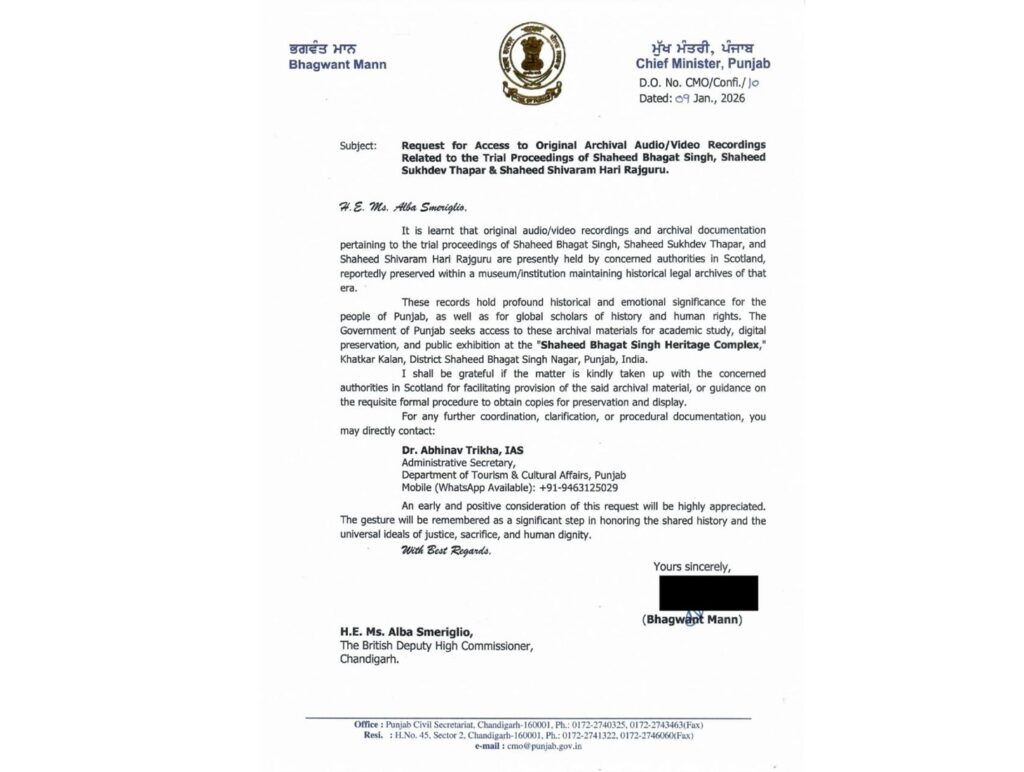
In a letter dated 9 January 2026, Punjab Chief Minister Bhagwant Mann formally approached the British Deputy High Commissioner in Chandigarh, seeking the UK’s assistance in facilitating access to these materials for academic research, digital preservation and public exhibition. The records, reportedly held by a museum or legal archive in Scotland, carry “profound historical and emotional significance” not only for the people of Punjab, but also for scholars of history and human rights worldwide.
The request is measured and constructive. Punjab has proposed that the material, once accessed, be preserved digitally and displayed at the Shaheed Bhagat Singh Heritage Complex in Khatkar Kalan—Bhagat Singh’s ancestral village—ensuring that future generations can engage with history through original sources rather than second-hand retellings. This is not about erasing the past, but about illuminating it.
For the UK government, responding positively would signal an understanding that colonial-era archives do not belong solely to the former imperial power. They belong, ethically and emotionally, to the people whose lives and futures were shaped by those decisions. Facilitating access—through copies, declassification, or guided archival cooperation—would be a gesture of respect towards shared history and universal values of justice and human dignity.
Britain has often spoken of confronting its imperial past with honesty. Here is a chance to turn words into action. Making these documents available to the Punjab government would not diminish British institutions; it would enhance their standing as custodians willing to share history rather than hoard it.
The sacrifices of Bhagat Singh, Sukhdev and Rajguru were made for the freedom and dignity of millions. Nearly a century later, granting access to the records of their final trial would be a small but meaningful step—one that acknowledges the past, honours the dead, and educates the living.
Chandigarh, September 15 Rahulinder Singh Sidhu, son of former Punjab chief minister Rajinder Kaur Bhattal,…

Did information allegedly held by Sushant Singh Rajput’s former manager about drug trafficking, child abuse…
Chandigarh, September 15 Congress leaders including AICC general secretary in-charge of Punjab Sachin Pilot, Leader…
Man wanted in Ambala robbery case traced after three-day search in Royal City Patiala, September…