





 The North News
The North News
Ahmedabad / New Delhi, January 12
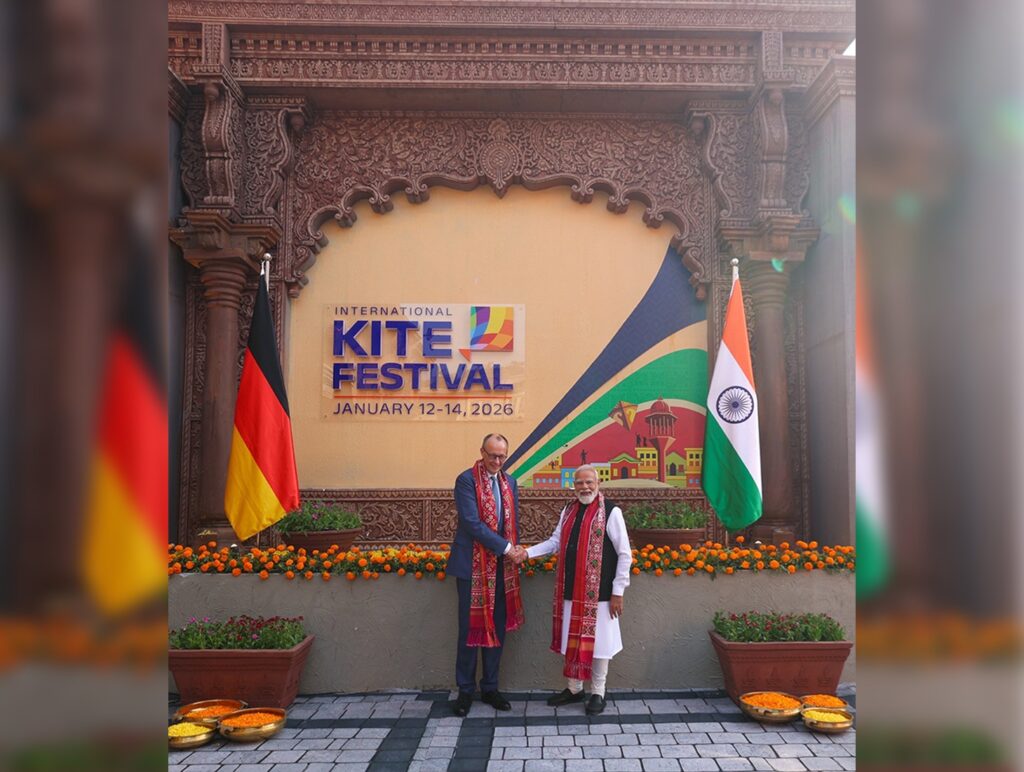
India and Germany have agreed to significantly expand cooperation across defence, trade, technology, climate action and global security following talks between Prime Minister Narendra Modi and German Chancellor Friedrich Merz during the latter’s first official visit to India. In a joint statement issued after delegation-level talks in Ahmedabad, the two leaders reaffirmed their commitment to shared democratic values, a rules-based international order and a free and open Indo-Pacific, describing the relationship as a “key strategic partnership”.
The visit comes as India and Germany mark 25 years of their strategic partnership and prepare to celebrate 75 years of diplomatic relations next year.
Defence and security
The leaders agreed to strengthen defence and military cooperation, including joint exercises, training, regular naval port calls and closer defence-industrial collaboration. Germany confirmed its participation in major Indian naval and air force exercises and announced the deployment of a liaison officer to India’s Information Fusion Centre for the Indian Ocean Region.
Both sides also signed a declaration to develop a defence industrial cooperation roadmap, aimed at co-development and co-production of military platforms and advanced technologies. India and Germany strongly condemned terrorism in all its forms, including cross-border terrorism, and pledged closer cooperation against terror financing and extremist networks. They also condemned recent terror attacks in Jammu and Kashmir and Delhi.
Trade, economy and technology
The leaders welcomed record bilateral trade, which crossed $50bn in 2024, accounting for more than a quarter of India’s total trade with the European Union. They reiterated support for an early conclusion of the India–EU Free Trade Agreement.
Both countries agreed to expand cooperation in semiconductors, artificial intelligence, digital governance, critical minerals and innovation-driven industries. A new partnership on semiconductor ecosystems and critical minerals was announced to strengthen supply chain resilience.
Climate, energy and sustainability
Germany reaffirmed its €10bn commitment under the Green and Sustainable Development Partnership, with about half already allocated to projects in renewable energy, green mobility, climate adaptation and urban infrastructure.
The two leaders also welcomed progress on green hydrogen cooperation, including a major green ammonia offtake agreement, and agreed to deepen collaboration on battery storage, solar manufacturing and wind energy.
Global and regional issues
India and Germany reiterated support for UN Security Council reform, including expansion of permanent and non-permanent membership. They expressed concern over the wars in Ukraine and Gaza, backing diplomatic efforts for lasting peace and humanitarian access.
The leaders also agreed to launch a new bilateral Indo-Pacific consultation mechanism and reiterated support for the India–Middle East–Europe Economic Corridor.
People-to-people ties
Both sides underlined the importance of education, skilled mobility and cultural exchange. Germany announced visa-free transit for Indian passport holders, while India invited German universities to open campuses under its new education policy.
The two leaders agreed to hold the next India–Germany Inter-Governmental Consultations in Germany later in 2026.

Did information allegedly held by Sushant Singh Rajput’s former manager about drug trafficking, child abuse…
New Delhi, September 14 Improving political, diplomatic and military engagement between India and China…
Chandigarh, September 14 Prime Minister Narendra Modi on Monday congratulated the Indian women’s cricket team…
New Delhi, September 12 Prime Minister Narendra Modi and Chinese President Xi Jinping on Saturday…