





 The North News
The North News
New Delhi, July 26
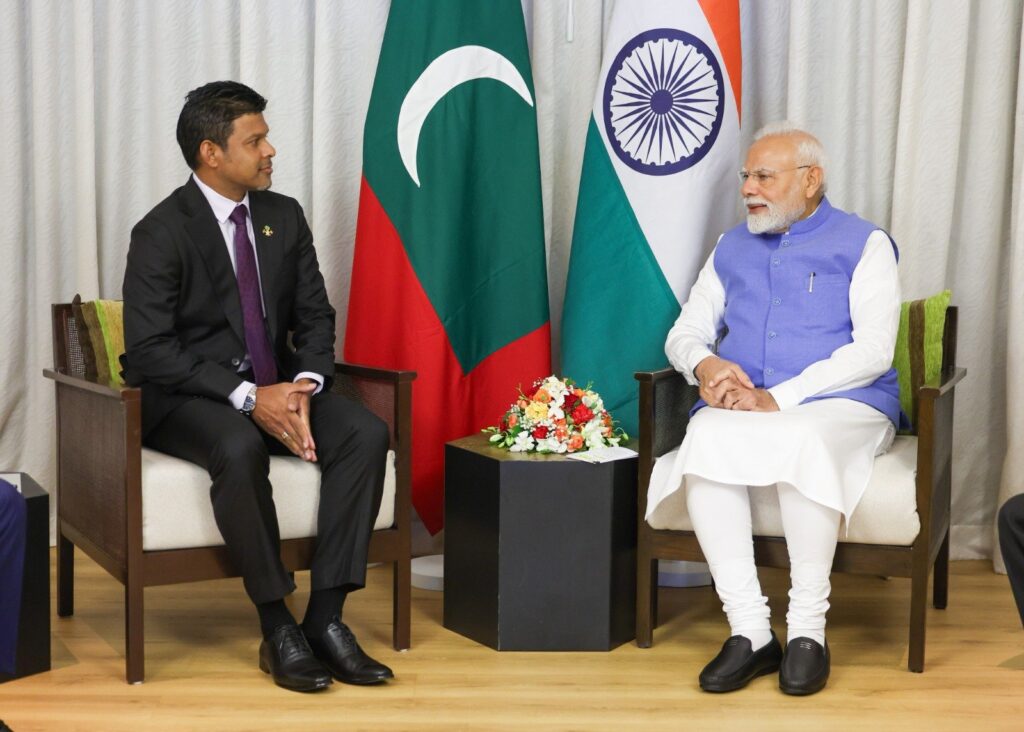
Prime Minister Narendra Modi held talks with Maldives Vice President Uz. Hussain Mohamed Latheef, reaffirming New Delhi’s commitment to expanding cooperation with the island nation across critical areas including infrastructure, technology, energy, and climate change on Saturday. In a post shared on X (formerly Twitter), Modi described the engagement as “a very good meeting,” noting that their discussion “touched upon key pillars of the India-Maldives friendship.”
“Our nations continue to work closely in sectors like infrastructure, technology, climate change, energy and more,” the Prime Minister wrote. “This is greatly beneficial to our people. We look forward to deepening this partnership in the years to come,” he said.
India and the Maldives have signed a new Memorandum of Understanding (MoU) aimed at deepening bilateral cooperation in fisheries and aquaculture, as part of a broader package of six agreements announced during Prime Minister Modi’s state visit to Malé on Saturday. The MoU was signed between India’s Department of Fisheries under the Ministry of Fisheries, Animal Husbandry and Dairying, and the Maldives’ Ministry of Fisheries and Ocean Resources.
Officials say the agreement is designed to promote sustainable tuna and deep-sea fishing, expand aquaculture efforts, and encourage innovation through joint scientific research.
Key elements of the agreement include:
The agreement also outlines a series of collaborative initiatives, such as knowledge exchange in aquatic animal health, biosecurity measures, aquaculture farm operations, and technical expertise in refrigeration and marine engineering. Maldives is expected to benefit from improved production efficiency and diversification in fish species under culture, while India will play a supporting role in offering training and technical support. Both governments have hailed the agreement as a step forward in building a more resilient, innovative, and sustainable fisheries sector in the Indian Ocean region.
New Delhi, September 17 India’s semiconductor ecosystem is expanding rapidly, opening new opportunities for innovation,…
New Delhi, September 17 Prime Minister Narendra Modi on Thursday thanked people across the country…
New Delhi, September 17 Reacting on passage of the sanctioning Russia and Iran Act in…
Six states sign Rs 15,624-crore pact; Delhi, Haryana and Rajasthan to bear state’s estimated power-component…