








Washington, April 1
The United States has identified India’s policies on satellite usage and internet regulation as barriers to foreign trade in its 2026 National Trade Estimate Report on Foreign Trade Barriers, released by the Office of the US Trade Representative (USTR).
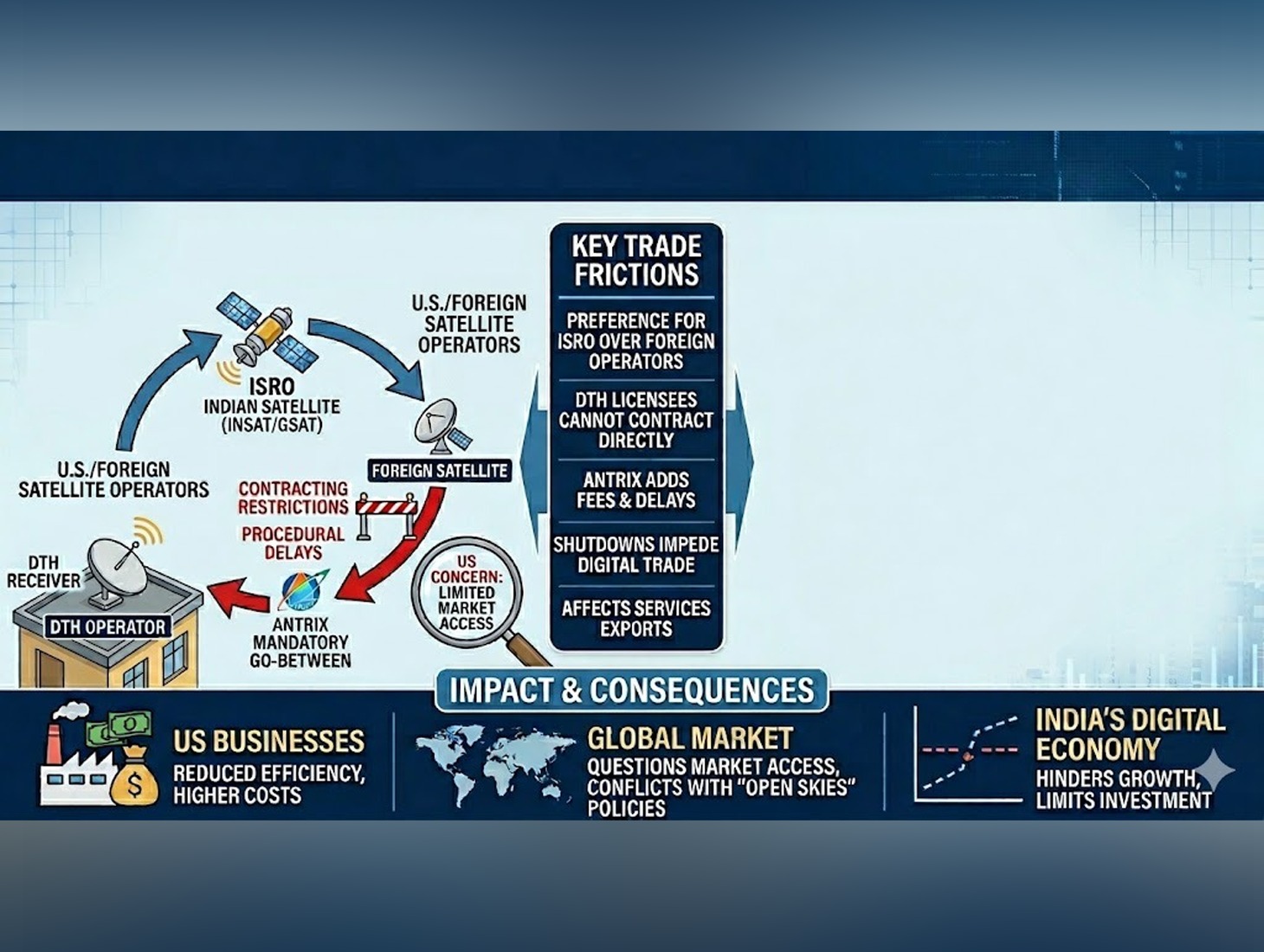
The report pointed to India’s preference for domestic satellites in delivering direct-to-home (DTH) television services, stating that it limits access for foreign satellite operators. It noted that DTH providers are generally not allowed to directly engage with overseas satellite companies and must instead route procurement through Antrix, the commercial arm of the Indian Space Research Organisation (ISRO). Foreign satellite capacity is permitted only when domestic capacity is unavailable, and even then, it is routed through ISRO with additional charges.
The USTR also raised concerns over the increasing use of localised internet shutdowns in India, stating that such measures disrupt access to information and services, hinder business operations, and negatively affect the digital economy. The report added that these restrictions undermine the principles of a free and open internet and may impact US trade and investment, including services exports.
It further highlighted that since 2021, American companies have faced a growing number of content and account takedown requests, some of which appear to be politically motivated.
In addition, the report flagged new security directives issued by India’s Department of Telecommunications for satellite communication providers. These guidelines require companies to enable real-time interception capabilities, block government-specified content, restrict services in sensitive areas, and ensure that all Indian user data and DNS resolution are routed through domestic infrastructure.
Satellite communication providers are also required to register and regularly verify user terminals, share detailed user and device information with law enforcement agencies, implement geo-fencing measures in border areas, and prevent unauthorised access or location spoofing.
The report also noted that companies must ensure that Indian user data is not transferred or decrypted outside the country and must submit a phased plan to source at least 20 per cent of their ground infrastructure domestically within five years of starting operations.
The United States has urged India to adopt a more liberal “open skies” policy, which would allow greater flexibility for consumers in choosing satellite service providers and improve market access for foreign firms.