







The North News
Chandigarh, December 15
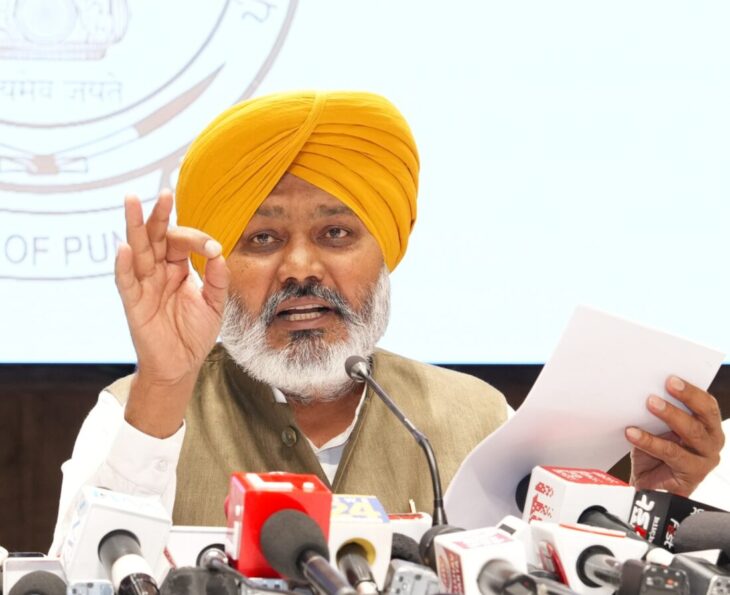
Punjab has given in-principle approval for a ₹1.61 crore micro-level scientific study aimed at addressing the state’s growing water challenges, Finance Minister Harpal Singh Cheema has said. The study will be carried out by the Punjab State Farmers’ and Farm Workers’ Commission in collaboration with IIT Ropar, and will focus on understanding groundwater resources, seepage patterns and subsoil water behaviour to help frame long-term management strategies.
Cheema said that as an agrarian state, Punjab was facing serious concerns over water availability and sustainable use. He described the initiative as a key step towards reviving the state’s agricultural strength. He noted that an earlier macro-level study conducted with the National Institute of Hydrology, Roorkee, had been acknowledged by the Punjab Vidhan Sabha’s Committee on Agriculture Reforms, which subsequently recommended a more detailed micro-level assessment. According to the finance minister, the study will use advanced scientific methods, including carbon dating and isotope analysis of subsoil and reservoir water, alongside a detailed examination of seepage patterns across the state. The exercise will also involve profiling all available water resources, mapping aquifers to support policy decisions, carrying out heliborne surveys, exploring alternative water sources and estimating seepage rates at a micro level.
The total cost of the project has been pegged at ₹221.65 lakh. IIT Ropar will contribute ₹60 lakh from its own resources, while ₹161 lakh will be funded through the state farmers’ commission. In return, the institute will provide technical support covering project design, field investigations, sample collection, use of specialised instruments, laboratory facilities and training for capacity building.
The study will be completed in five phases over a 12-month period following the release of funds. These include identifying sampling sites, developing a hydrogeological framework of aquifer systems, conducting hydro-chemical and isotopic analysis to assess contamination and source areas, identifying regions for canal network expansion, and recommending management measures.
Cheema said the collaboration with IIT Ropar reflected the Punjab government’s commitment to science-based policymaking. He added that the government, led by Chief Minister Bhagwant Singh Mann, was focused on finding sustainable, long-term solutions to safeguard the interests of farmers.