




The North News
New Delhi, November 18
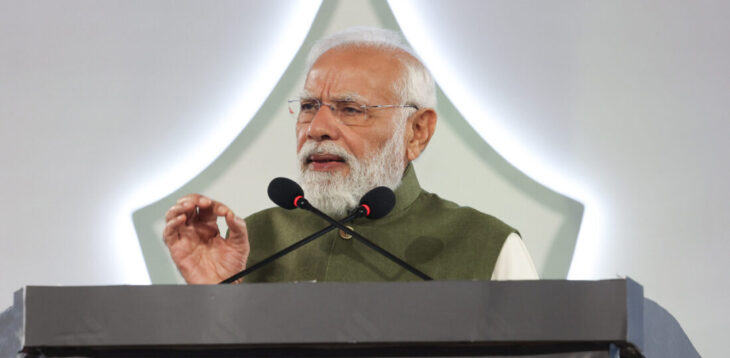
Prime Minister Narendra Modi said at a lecture in Delhi held in honour of newspaper founder Ramnath Goenka that his government remained committed to strengthening democratic institutions and advancing development, invoking Goenka’s legacy as a steadfast advocate of press freedom and public accountability. Addressing journalists , academics and political figures at the annual Ramnath Goenka Lecture, hosted by The Indian Express on Monday, Modi revisited stories from Goenka’s clashes with authority during the Emergency of the 1970s. He recounted an incident in which Goenka was allegedly threatened with imprisonment by a powerful minister, saying his refusal to yield “became part of an unwritten archive of resistance”.
Modi said Goenka’s “positive impatience” — his desire to see stagnant institutions shift — was mirrored in a contemporary India eager to push ahead on development. “This is a country impatient to become self-reliant,” he said, presenting India as one of the few economies to maintain momentum through a run of global shocks. The Prime Minister argued that despite the pandemic, the war in Europe and volatility in West Asia, India continued to grow at around 7%, which he described as evidence that the “Indian growth model” had become an international point of reference.
Prime Minister Modi also placed heavy emphasis on electoral participation, citing Bihar’s landmark turnout last week, where more women voted than men. He said the results reflected people’s rising expectations and a shift toward parties seen as delivering stability and development. In a pointed message to state governments of all parties, he urged them to “compete on governance, not rhetoric”, warning that voters were increasingly intolerant of misrule. Without naming opponents, he accused previous administrations in Bihar of ushering in “jungle raj”, adding that the electorate “will not forget betrayal”.
Prime Minister Modi rejected claims that his government and party operate in perpetual campaign mode, saying what drives his administration is not electoral opportunism but “emotional commitment” to improving daily life. He praised party cadres for working “with sweat and sacrifice”, particularly in regions where workers have been targets of political violence.
The Prime Minister framed social justice as the expansion of essential services to those historically excluded, pointing to millions of new toilets, bank accounts, social security coverage and housing schemes. These, he said, had allowed 25 crore people to escape poverty in the past decade — although independent economists dispute the methodology used by the government.
He described Goenka, who died in 1991, as a figure whose conviction and stubborn independence still held meaning for today’s India. Whether the government’s own approach to media freedom fits within the tradition Goenka championed is a question that continues to divide journalists, but Modi presented the publisher as an exemplar of duty, dissent and national purpose.