








The North News
Bengaluru, February 10
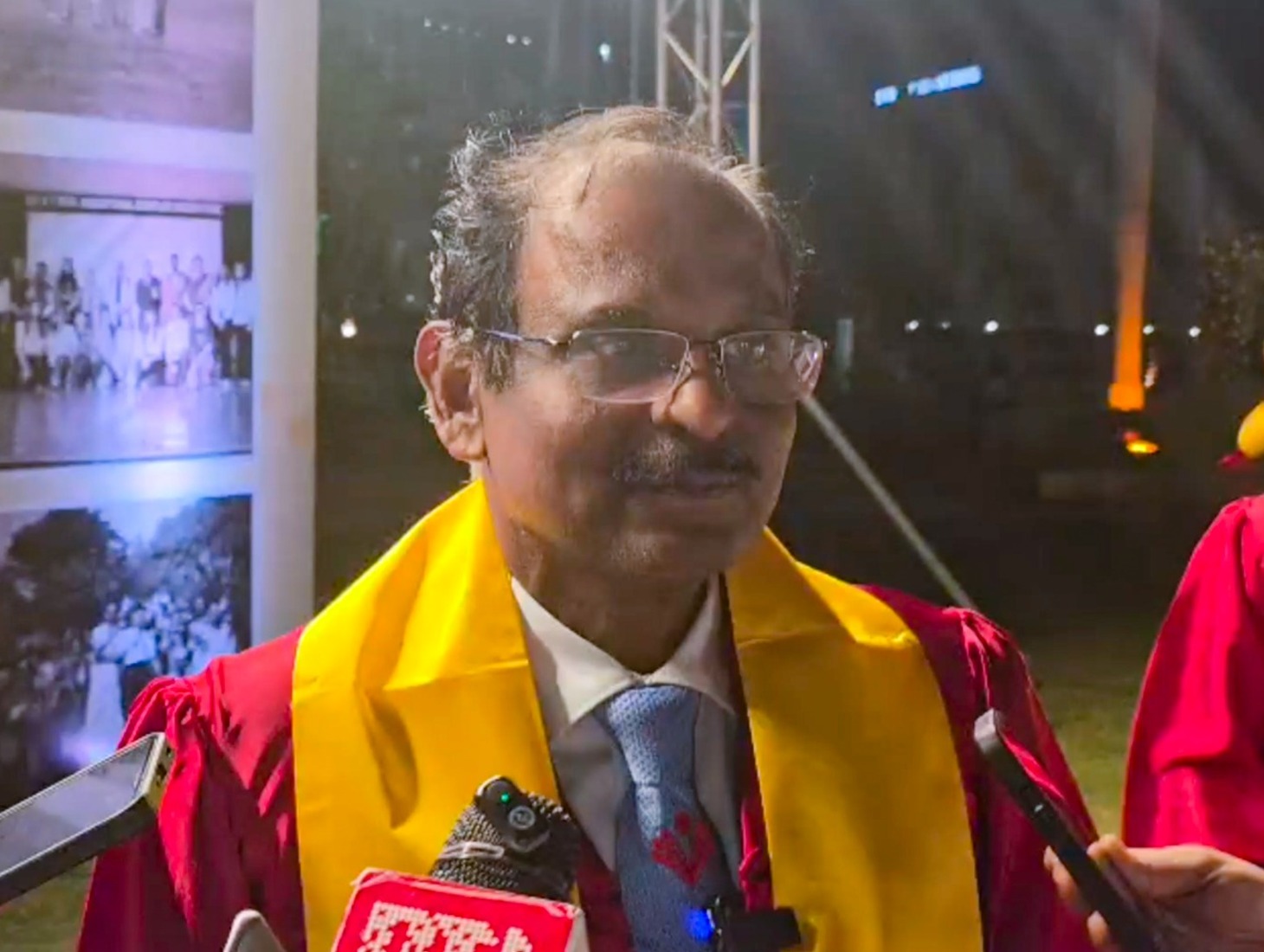
ISRO Chairman V Narayanan on Tuesday said that India’s space programme was conceived as a people-centric and application-driven initiative, rooted in international cooperation rather than competition.
Highlighting six decades of the country’s space journey, Narayanan said the programme had evolved from modest beginnings into a globally respected ecosystem that serves not just India but the international community, with collaboration as its core philosophy.
Speaking at the inaugural ceremony of the US-India Space Business Forum, the ISRO chief noted the contribution of USA in India’s space programme.
Space-related activity in India started in 1962, 15 years after the independence and the first rocket India launched was made in the US and supplied by NASA.
Narayanan underlined that the Indian space mission is mainly for the benefit of people.
“The Indian space programme was started not to compete with anybody but to bring advanced space technology for the benefit of the common man of India,” Narayanan, Secretary, Department of Space, said.
He stressed that the vision of the programme has expanded over time to serve global needs while remaining human-centric.
“Today, we strongly believe it is not only for the common man of India, it also serves the global community. And it is a human centric, application oriented program,” he said, calling for deeper international partnerships in space exploration and commerce.
Welcoming US delegates and industry leaders, he said the forum symbolised the growing convergence between India and the United States in the space sector.
PTI
“This type of programme should be collaborative; an internationally collaborative one, and in that context the US-India Space Business Forum has brought almost 14 business partners from the USA,” Narayanan said.
Recalling early Indo-US cooperation, he cited the launch of India’s first sounding rocket in 1963 and subsequent joint missions, including satellite applications, health observation studies, and lunar exploration.
“Let me thank the US team for the outstanding support at that point of time, what you extended was the beginning of the space activity in the country,” he said.
Referring to recent milestones, Narayanan highlighted joint achievements such as the Chandrayaan missions, the NISAR satellite, and commercial launches, stating that cooperation had matured into a partnership of equals.
“It demonstrated to the world the emotional collaboration, rather than just collaboration, between India and the US, and a strong bond was demonstrated through this mission,” he added.
He also pointed to the rapid growth of India’s private space ecosystem following sectoral reforms in 2020 and outlined ambitious future goals, including building the country’s own space station by 2035 and undertaking crewed lunar missions.
“Space is common for the entire global community, and the benefit should be enjoyed by every citizen of this globe,” Narayanan said, and called for sustained global cooperation.
He said Indian industry today contributes a substantial share of mission hardware and software, enabling ISRO to scale operations while reducing costs and timelines.
“Approximately 75 per cent of the funding and realisation comes through Indian industries, because it is the Indian industries which build most of the hardware and software,” Narayanan said.
Looking ahead, the ISRO Chairman outlined an ambitious roadmap that includes Chandrayaan-4 and Chandrayaan-5, Mars and Venus missions, expansion of Earth observation and navigation constellations, and the Gaganyaan human spaceflight programme.
He said India is targeting the launch of its first space station module by 2028 and a fully operational multi-module Indian space station by 2035, while also working towards a crewed lunar mission by 2040.
Narayanan said India’s long-term human space exploration plans would require a new class of heavy-lift launch vehicles with vastly higher capability than those currently in service.
Recalling that India’s first successful launch vehicle in 1980 could lift barely 35 kg to Low Earth orbit (LEO), he said future crewed lunar missions would demand rockets capable of lifting 80-100 tonnes, necessitating the development of entirely new architectures, propulsion systems and manufacturing ecosystems.
He said ISRO is already working on next-generation launch vehicles with a 30,000-kg LEO capacity as an intermediate step, but stressed that achieving lunar human missions by 2040 would require scaling up several times over through sustained technological development and international collaboration.