








The North News
New Delhi, December 15
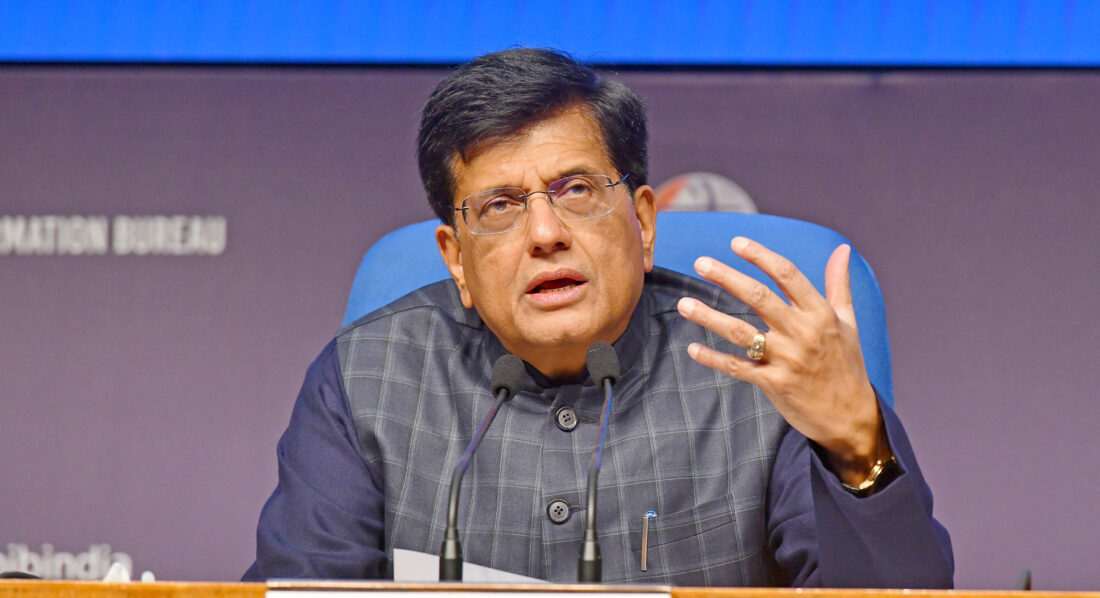
India’s transformation from power scarcity to power sustainability over the past 11 years reflects “bold vision, honest intent and relentless execution”, Commerce and Industry Minister Piyush Goyal said on Monday. Addressing a briefing in New Delhi on the death anniversary of Sardar Vallabhbhai Patel, Goyal said the country was remembering not only the “Iron Man of India” but also a leader who believed India must stand on its own feet politically, economically and strategically.
He said that spirit of self-reliance had been carried forward under Prime Minister Narendra Modi, particularly in the energy sector. India, he noted, recorded its highest-ever coal production of 1,048 million tonnes in the 2024–25 financial year, while coal imports fell by about 8 percent. Goyal said solar power capacity had expanded 46-fold in the last 11 years, making India the world’s third-largest producer, while wind capacity rose from 21 gigawatts in 2014 to 53 gigawatts in 2025. India is now the fourth-largest refining hub globally and plans to raise refining capacity by 20 percent, he added. Of the 34,238 kilometres of authorised natural gas pipelines, more than 25,900 kilometres are already operational.
The Minister said the country had moved towards surplus power generation, nationwide grid integration and leadership in renewable energy. “This change did not happen by accident,” he said, adding that India had progressed from power scarcity to power security and now towards sustainability.
Minister Goyal outlined five pillars underpinning the shift. The first, he said, was universal access, with electricity reaching every household under the Saubhagya scheme. More than 47 crore LED bulbs distributed under the UJALA programme have reduced electricity bills and carbon emissions, while 10 crore households now have clean cooking gas connections. Farmers, he added, were becoming energy providers through the PM-KUSUM scheme.
Affordability formed the second pillar. The minister said GST on clean energy equipment had been reduced from 12% to 5%, inter-state transmission charges for solar and wind power had been waived, and the 20% ethanol blending target had been achieved ahead of the original 2030 deadline.
The third pillar, availability, has seen power shortages fall from 4.2% in 2013 to 0.1% in 2025, with a unified national grid helping India meet a record peak demand of 250 gigawatts.
On financial viability, Goyal said reforms under the PM-UDAY scheme had strengthened power distribution companies, cutting their dues from ₹1.4 lakh crore in 2022 to about ₹6,500 crore in 2025. The fifth pillar, sustainability and global responsibility, has placed India among global leaders, he said, noting that the country is the first G20 nation to meet its Paris Agreement commitments, with half of its installed power capacity now coming from non-fossil fuel sources.
Looking ahead to the centenary of Independence in 2047, Goyal said the government was recalibrating its strategy to meet future challenges. He highlighted the National Green Hydrogen Mission, which targets production of five million tonnes annually by 2030, and the PM Surya Ghar scheme, under which rooftop solar systems are being installed in around 20 lakh homes.
Quoting the prime minister, he said strengthening the energy sector required empowering citizens, adding that recommendations of a high-powered committee on coal — including faster exploration, mining and coal gasification — were under consideration.
Goyal said he was confident that as India moves towards Viksit Bharat 2047, its energy sector would emerge as a global case study in balancing scale, speed and sustainability.