








The North News
New Delhi, October 7
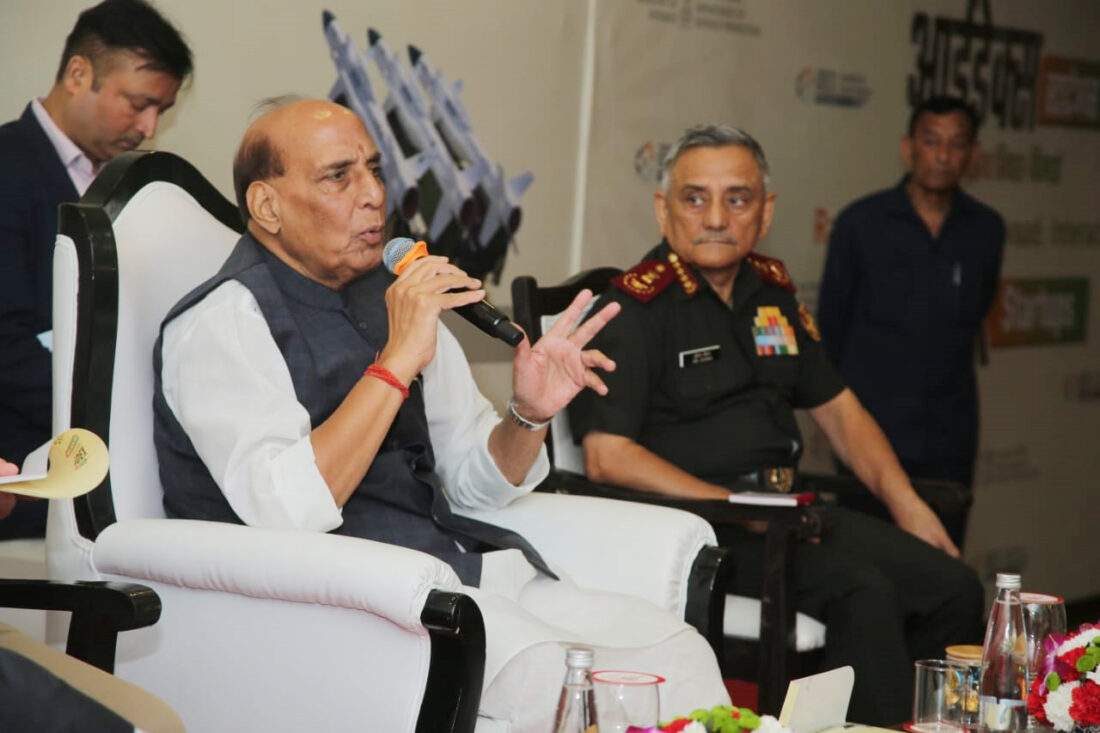
Defence Minister Rajnath Singh on Monday said that India’s defence and security are the collective responsibility of the entire nation, calling on all states and union territories to actively participate in strengthening the country’s defence manufacturing sector. Speaking at the inauguration of the National Conference on ‘Opportunities of Defence Manufacturing in the Country’ at Vigyan Bhawan, New Delhi, Singh stressed that building a robust and globally competitive defence ecosystem requires collaboration between the Centre, states, and private industry.
“Strengthening defence is not just the duty of one institution or government—it is the shared resolve of all Indians,” he said. The Defence Minister underlined that self-reliance in defence is not merely an economic or industrial goal, but a matter of strategic autonomy directly tied to India’s sovereignty. Citing examples like Operation Sindoor, he noted that state governments and their agencies had actively supported national exercises, showing that collective efforts can overcome any challenge.
Rajnath Singh highlighted the rapid growth of India’s defence manufacturing sector over the past decade, with total production rising from ₹46,000 crore in 2014 to over ₹1.5 lakh crore in 2025, the highest ever recorded. Of this, he said, more than ₹33,000 crore comes from the private sector — reflecting the growing role of industry in the government’s Aatmanirbhar Bharat (self-reliant India) mission.
India’s defence exports, he added, have also surged from less than ₹1,000 crore in 2014 to ₹23,500 crore in 2025, marking the country’s shift from one of the world’s largest importers of defence equipment to an emerging exporter of advanced defence systems. “This remarkable journey from importer to trusted exporter is a testament to our national resolve,” Rajnath Singh said. Reaffirming Prime Minister Narendra Modi’s vision for self-reliance, Singh said India aims to achieve ₹3 lakh crore in defence manufacturing and ₹50,000 crore in exports by 2029. He emphasised that beyond figures, the goal represents “the confidence that our armed forces use weapons built on our own soil, designed by our scientists and engineers.”
Rajnath Singh released a Compendium of State Policies on Defence and Aerospace Manufacturing, which consolidates best practices from across India. The document, he said, would promote coordination between the Centre and states and serve as a reference for industry and innovators.
“This compendium will encourage both competition and collaboration among states to attract investment and strengthen the defence industrial base,” he said.
The Defence Minister outlined several policy reforms aimed at improving the ease of doing business in the sector. These include simplified quality assurance timelines through self-certification, a Centralised Defence Testing Portal, and the Defence Testing Infrastructure Scheme (DTIS) to develop modern testing facilities.
He said the Ministry continues to refine frameworks such as the Defence Acquisition Procedure (DAP) 2020, Defence Procurement Manual (DPM) 2025, and the Defence Offsets Policy to encourage innovation, technology absorption, and private investment.
“Our reforms are not just regulatory measures — they are enablers of opportunity,” Rajnath Singh added.
The conference saw participation from defence industry leaders, state officials, and policymakers, all reaffirming India’s ambition to emerge as a global hub for defence innovation and manufacturing.