







 The North News
The North News
Chandigarh, January 17
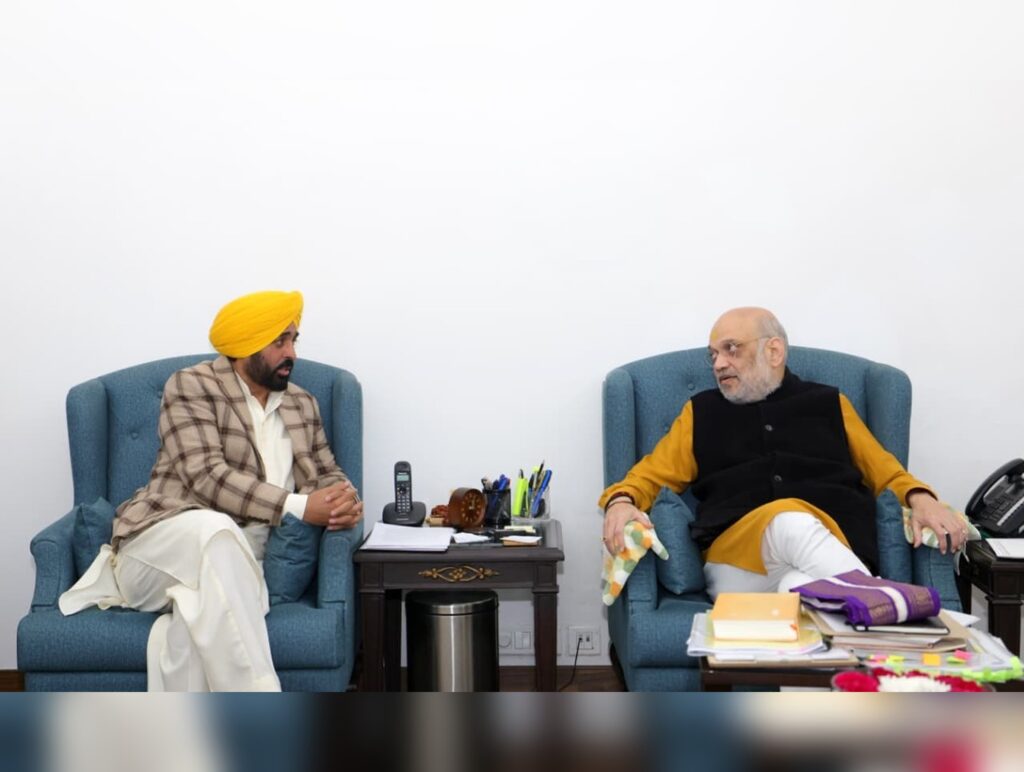
Punjab’s Chief Minister, Bhagwant Singh Mann on Saturday announced what he called a major relief for farmers in the state’s border belt, after the central government agreed in principle to shift the border security fencing closer to the India–Pakistan boundary.
Chief Minister Mann said the move would allow thousands of acres of farmland currently lying beyond the fence to be cultivated without restrictions. He raised the issue during a meeting with Union Home Minister Amit Shah in New Delhi on Saturday.
Along the 532-kilometre India–Pakistan border in Punjab, the fencing is located deep inside Indian territory in several areas. As a result, farmers have for years been required to cross the fence with identity cards and under the escort of Border Security Force personnel to reach their own fields.
“The Home Minister informed me that the matter is under active consideration and that the fencing will be shifted towards the international border,” Mann said, adding that the realignment would not compromise national security. He noted that a similar exercise has already been carried out in parts of Pathankot.
The Chief Minister said the change would end daily hardship for farmers in border districts and restore normal agricultural activity on land that legally belongs to Punjab but remains cut off by security arrangements.
During the meeting, Mann also raised a range of long-pending issues, including Punjab’s objections to the proposed Seeds Bill 2025, the unresolved Sutlej-Yamuna Link canal dispute, delays in the movement of foodgrains by the Food Corporation of India, the freezing of commission for arthiyas, non-payment of the Rural Development Fund and Market Fees, and concerns over Punjab’s administrative role in Chandigarh.
On the Seeds Bill, he argued that the draft law weakens the role of states and does not provide adequate safeguards or compensation for farmers if registered seeds fail. He said Punjab, as a leading agrarian state, must have a stronger voice in seed regulation.
Reiterating the state’s position on river waters, Mann said Punjab had no surplus water to share and that the construction of the Sutlej-Yamuna Link canal was “neither viable nor just”.
He also flagged storage and transportation bottlenecks, warning that slow movement of wheat and rice stocks could affect both farmers and national food security. The Home Minister, he said, assured him that the concerns raised would be examined and taken up in priority meetings.

Chandigarh, September 15 Rahulinder Singh Sidhu, son of former Punjab chief minister Rajinder Kaur Bhattal,…

Did information allegedly held by Sushant Singh Rajput’s former manager about drug trafficking, child abuse…
Chandigarh, September 15 Congress leaders including AICC general secretary in-charge of Punjab Sachin Pilot, Leader…
Man wanted in Ambala robbery case traced after three-day search in Royal City Patiala, September…