








 The North News
The North News
Chandigarh, December 18
The latest round of local government elections in Punjab has produced a clear significant political signal, the Aam Aadmi Party (AAP) continues to dominate the state’s rural power structures, while the gap between it and its rivals remains wide and, in many districts, structurally entrenched.
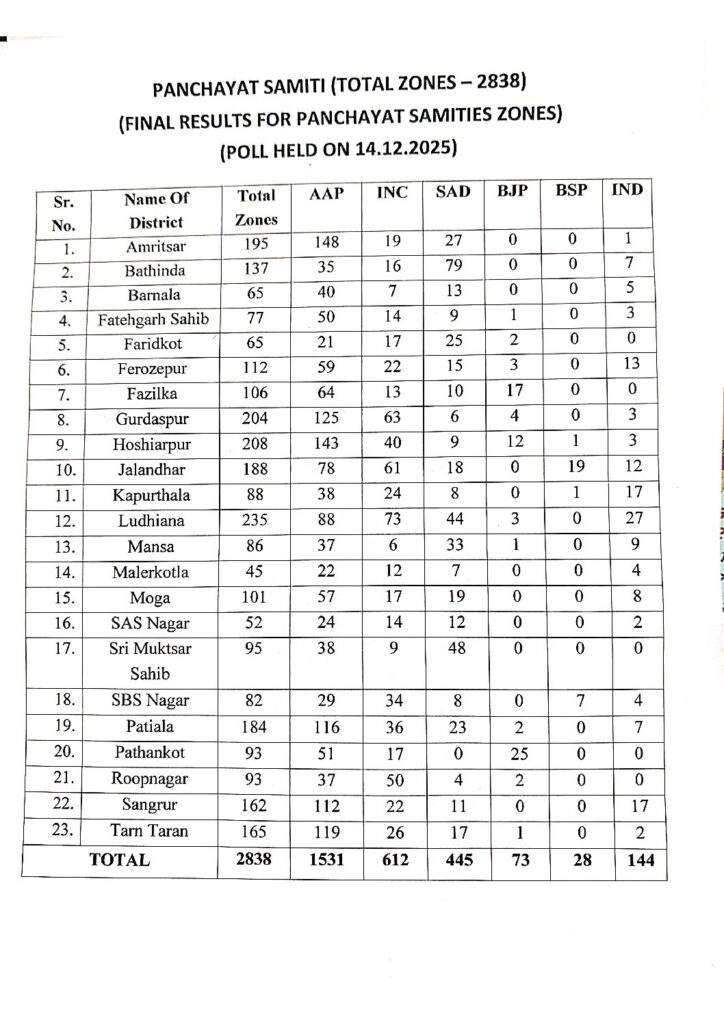
Across Punjab’s 2,838 Panchayat Samiti zones, AAP has secured 1,531 seats — a decisive majority that places it far ahead of the Congress, which finished second with 612 seats. The Shiromani Akali Dal (SAD) came third with 445 seats, while the BJP lagged well behind with just 73. Independents and smaller parties remain marginal players in terms of institutional control. The results also point to a growing case for a renewed SAD–BJP alliance in the state.
The scale of AAP’s lead is as striking as its geographic spread. In districts such as Amritsar, Hoshiarpur, Patiala, Sangrur and Tarn Taran, the party posted commanding wins, often taking well over half of the available seats. These are not narrow victories driven by protest sentiment, but broad mandates that point to organisational penetration and sustained voter alignment at the village level.
For Congress, the results underline its position as Punjab’s principal opposition, but also expose its limitations. The party has shown pockets of resilience in districts such as Roopnagar and SBS Nagar, where it has remained competitive. Yet across much of Malwa and Majha, Congress appears unable to convert discontent with incumbents into durable rural leadership, leaving it structurally weaker than its headline numbers suggest.
The Shiromani Akali Dal’s showing reflects a longer-term erosion rather than a sudden collapse. While it continues to draw strength from traditional strongholds such as Bathinda and Sri Muktsar Sahib, its shrinking footprint elsewhere highlights the difficulty it faces in reconnecting with a rural electorate that has shifted towards welfare delivery and administrative performance.
The BJP’s success remains largely confined to border and urban-influenced districts such as Pathankot and parts of Fazilka, limiting its relevance in village-level governance.
A similar pattern is evident in the Zila Parishad elections, where AAP again emerged as the dominant force. Out of 346 declared seats, AAP won 218, compared with 62 for Congress and 46 for SAD. The BJP secured seven seats. The results reinforce AAP’s control across Malwa, Majha and Doaba, consolidating its influence at both the Panchayat Samiti and district council levels.
Local elections in Punjab have often served as early indicators of broader political and economic trends. Control over panchayats and zila parishads not only shapes service delivery and welfare distribution, but also determines access to networks of patronage and local capital — factors that can influence investment, implementation of schemes and political mobilisation.
For the opposition, the challenge is now strategic rather than tactical. Without rebuilding village-level leadership and narrowing the large numerical gap with AAP, Congress and SAD risk being locked into secondary roles well before the 2027 assembly election cycle gathers momentum.

Six states sign Rs 15,624-crore pact; Delhi, Haryana and Rajasthan to bear state’s estimated power-component…

Search at Urban Estate Phase II office continues into morning; two government vehicles parked outside…

Chandigarh, September 15 Rahulinder Singh Sidhu, son of former Punjab chief minister Rajinder Kaur Bhattal,…

Did information allegedly held by Sushant Singh Rajput’s former manager about drug trafficking, child abuse…