



 The North News
The North News
New Delhi, December 5
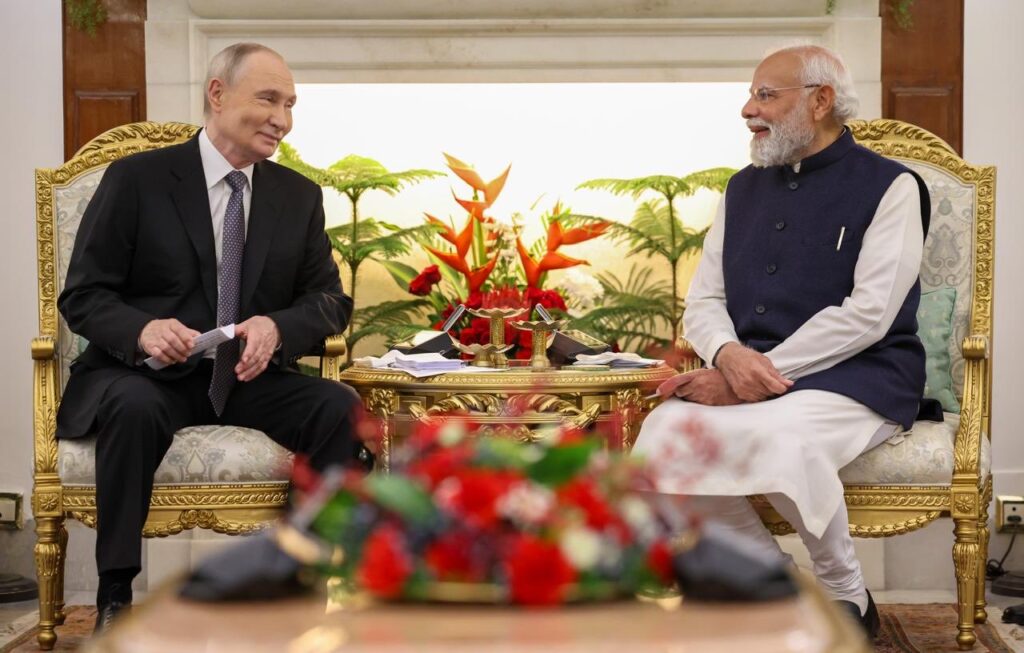
India and Russia have agreed to deepen cooperation across defence, trade, energy and strategic sectors during President Vladimir Putin’s state visit to New Delhi for the 23rd India–Russia annual summit, the two countries said in a joint statement on Friday.
The leaders announced new steps to promote joint manufacturing of spare parts, components and other equipment for Russian-origin military platforms under India’s Make in India programme. The initiative will include transfer of technology and joint ventures to meet the requirements of India’s armed forces and, where appropriate, exports to “mutually friendly” third countries.
Prime Minister Narendra Modi and President Putin said military and military-technical cooperation had remained a “pillar” of the Special and Privileged Strategic Partnership for several decades. They welcomed the outcomes of the 22nd meeting of the Intergovernmental Commission on Military and Military-Technical Cooperation (IRIGC-M&MTC), held in New Delhi on 4 December.
Both sides noted a shift towards joint research, co-development and co-production of advanced defence systems, in line with India’s push for self-reliance. The leaders also expressed satisfaction with ongoing military exchanges, including the INDRA joint exercises and meetings between defence ministers on the sidelines of the Shanghai Cooperation Organisation summit.
Both sides said the relationship had remained resilient despite a challenging geopolitical environment and agreed to “unlock the full potential” of their partnership. They welcomed high-level contacts in recent months, including meetings at the BRICS and SCO summits and multiple ministerial visits.
The leaders noted the opening of new Indian Consulates General in Yekaterinburg and Kazan, which they said would help expand regional trade and people-to-people ties.
They praised progress on negotiations for a free trade agreement between India and the Eurasian Economic Union and directed officials to intensify work on an investment protection pact. Both sides called for the removal of tariff and non-tariff barriers, improved logistics, smooth payment mechanisms and solutions to insurance and reinsurance challenges to help reach the bilateral trade target of USD 100bn by 2030.
Russia and India said they would continue efforts to settle bilateral trade in national currencies and explore interoperability between payment systems, financial messaging networks and central bank digital currency platforms.
The two leaders also welcomed long-term fertiliser supply arrangements, agreements on mobility of skilled workers and deeper cooperation in minerals, precious metals and critical raw materials. Energy remained a major pillar of the partnership, with both sides noting active collaboration between companies in oil, gas, refining, petrochemicals, LNG and upstream technologies. They agreed that outstanding issues affecting investments in the energy sector should be resolved promptly. India and Russia said they would expand cooperation on transport corridors, including the International North-South Transport Corridor, the Chennai–Vladivostok maritime route and the Northern Sea Route. They welcomed railway cooperation and an MoU on training specialists for ships operating in polar waters.
Both countries reaffirmed plans to boost trade and investment in the Russian Far East, covering sectors such as agriculture, mining, energy, pharmaceuticals and maritime transport. India reiterated its readiness to play an active role as an Observer in the Arctic Council.
Russia and India agreed to broaden cooperation in nuclear energy, including life-cycle support for the Kudankulam Nuclear Power Plant (KKNPP), non-power applications, new reactor projects and localisation of nuclear equipment.
They noted progress in constructing new units at KKNPP and discussed identifying a second site for Russian-designed nuclear reactors in India.
On space cooperation, both sides welcomed closer ties between ISRO and Roscosmos in human spaceflight, satellite navigation, planetary exploration and rocket engine development.
Six states sign Rs 15,624-crore pact; Delhi, Haryana and Rajasthan to bear state’s estimated power-component…

Did information allegedly held by Sushant Singh Rajput’s former manager about drug trafficking, child abuse…
New Delhi, September 14 Improving political, diplomatic and military engagement between India and China…
Chandigarh, September 14 Prime Minister Narendra Modi on Monday congratulated the Indian women’s cricket team…