








 The North News
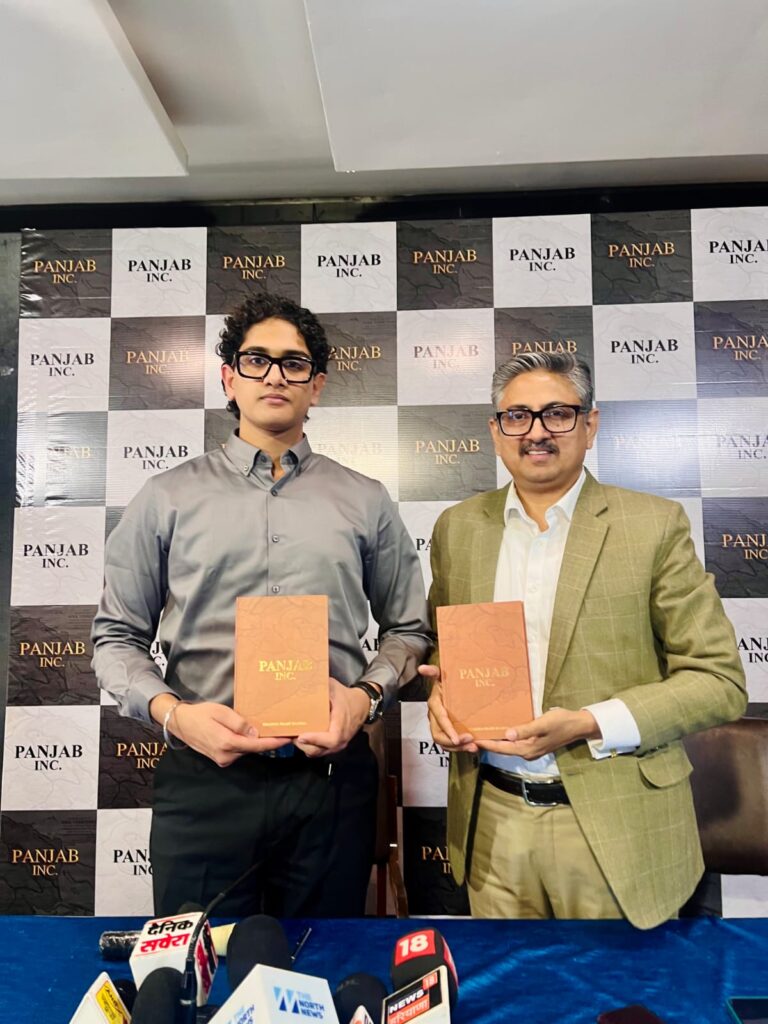
Young author Shaurya revisits Punjab’s forgotten story of enterprise
The North News
Chandigarh, November 19
Punjab’s economic story has long been eclipsed by its more familiar narratives of conflict, Partition and political upheaval. But beneath those turbulent chapters lies a deeper, steadier history of enterprise, trade and commercial ingenuity, said young author Shaurya Prabh Sharma at the launch of his new book Panjab INC. at the Chandigarh Press Club on Wednesday.
“Look closer, and you will see that even in moments of despair, trade thrived,” he told the audience. That continuity, he said, forms the spine of his book, which traces how commerce shaped Punjab’s political and social life over centuries.
A substantial section of Panjab INC. focuses on the era of Maharaja Ranjit Singh, whom Shaurya describes as a leader who understood that economic strength required more than military might. “Governance was never just about armies or fortresses,” said the 18-year-old commerce student, who developed an interest in entrepreneurship at an early age. “It was about building an architecture of commerce.” Singh’s administration, he added, created conditions in which merchants from Central Asia and artisans from Kashmir could travel and trade with confidence.
Shaurya argues that this legacy is still visible in the global spread of Punjabi enterprise — in renewable energy firms in Chandigarh, retail chains in Delhi, trucking businesses in California and technology companies in Toronto. These successes, he said, are not sudden achievements but part of a long tradition of adaptation and reinvention.
The book also examines historic trade corridors, including the Grand Trunk Road, which he calls “a vein of commerce carrying wealth and stories”. During research trips to old commercial hubs such as Amritsar, Multan, Ludhiana and Lahore, he was struck by how vividly their economic pasts could still be imagined. From Multan’s indigo exports and Ludhiana’s bicycles to Amritsar’s shawls, he writes, these goods carried “a cultural signature” that travelled far beyond the subcontinent.
Panjab INC. also looks at the rise of regional newspapers and the business families that built them, placing journalism within a wider commercial ecosystem. Shaurya identifies a set of enduring values that, he argues, have shaped Punjabi business culture: reinvestment, resilience, hospitality and honour — all tied to the belief that “tomorrow will bring another harvest, another customer, another chance”. These principles, he says, have been carried across generations, from industrial families such as the Malhotras, Aroras, Kapoors, Singhs, Chopras, Oswals and Jindals to neighbourhood shopkeepers.
“This book is not simply about commercial history,” he said. “It is about legacy — an inheritance that links Punjabis across geographies.” For many families, he argued, trade has long been entwined with cultural identity and social obligation. Practices such as reinvesting profits into community welfare, honouring debts at personal cost and nurturing long-standing customer relationships are, he said, “not lessons from textbooks but parts of Panjab’s lived history”.
He said the global footprint of Punjabi entrepreneurs — from wholesalers in Nairobi to retailers in New York and business leaders in Dubai — stems from this tradition. When Punjabis moved abroad, he added, they carried “not only skills and hope, but also an invisible inheritance of values”.
Shaurya dedicated the book to entrepreneurs known and unknown — from Amritsar’s shawl weavers and Ludhiana’s bicycle manufacturers to Canadian shopkeepers who still maintain accounts in Gurmukhi, and to families whose ambitions span Punjab’s fields, international campuses and corporate boardrooms. “This book is your mirror,” he said. “The story of Panjab’s enterprise is not distant; it remains alive in each of us.” Shaurya’s father, Lalit K Sharma, Mantrin CEO of, was also present on the occasion. Lalit explained how the idea for the book was conceived and eventually took shape. He said each chapter tells a unique story and expressed hope that every young person will read it to understand the journey of Punjab’s traders. He added that the book also encourages the youth to explore the state’s untapped potential.
Speakers highlight Dahiya’s contributions to literature and higher education Chandigarh, September 16 A Festschrift honouring…

Three cartridges, a motorcycle and scooter also seized during the operation Chandigarh, September 16 Counter…

Party’s Patiala rural in-charge Jaspal Singh Bittu Chatha also raises drug abuse and law and…

Forest Hill Resort hosts motorsport event on challenging trails in Shiwalik landscape Chandigarh, September 16…